

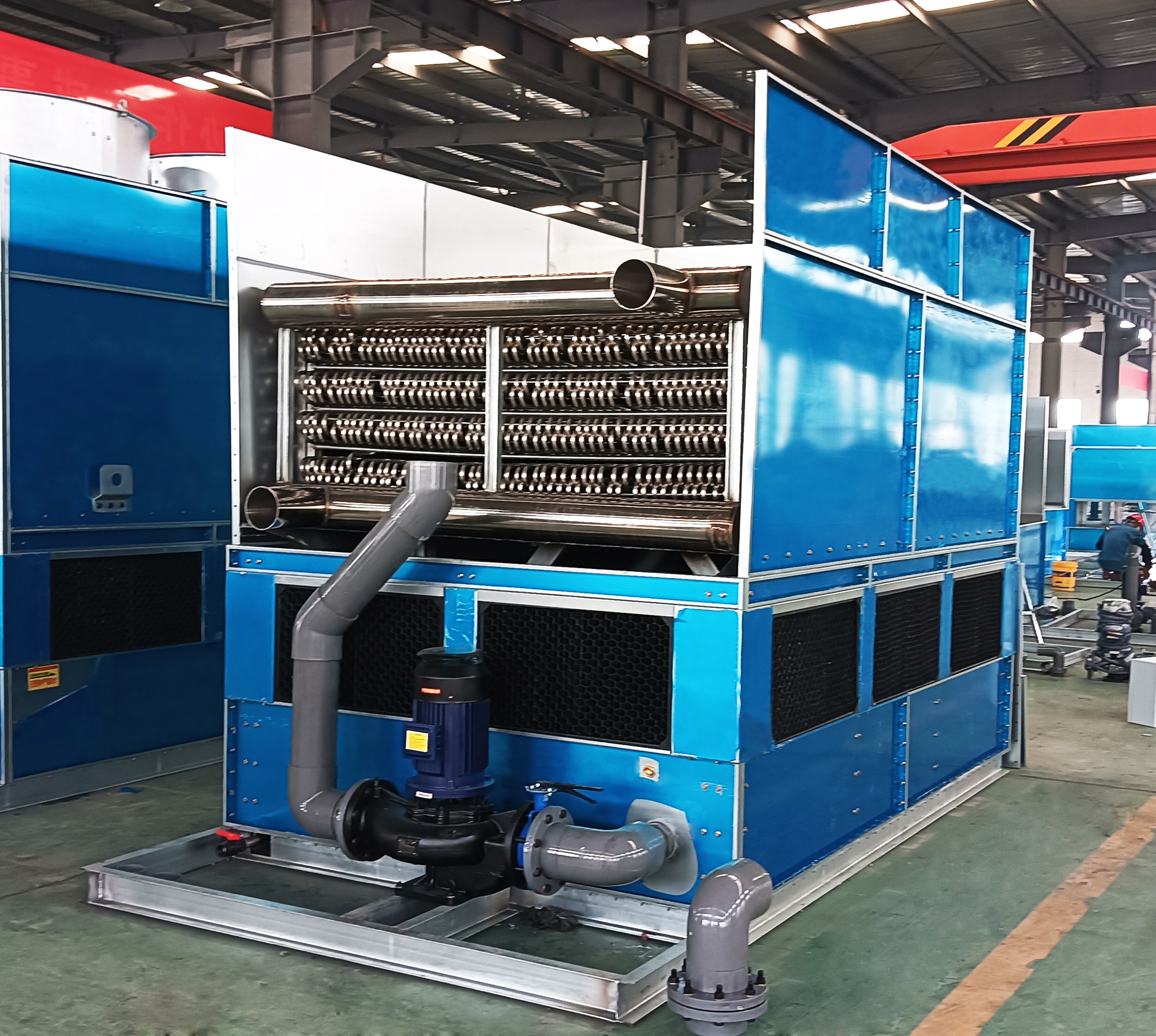
A Coil Cooling Tower is another name for a Closed Circuit Cooling Tower. The term is used because the “coil” (the heat exchanger) is the defining component that separates it from a standard open cooling tower.
In this system, the fluid you want to cool never touches the outside air; instead, it stays protected inside a series of tubes (the coil).Why is it called a “Coil” Cooling Tower?
In a standard tower, the water is sprayed over plastic “fill” to create surface area. In a coil tower, the metal coil acts as the heat exchange surface. This design creates two distinct loops:
- The Sealed Loop (Internal): Your process fluid (water, glycol, or oil) flows through the inside of the coil. It remains pure, clean, and at constant pressure.
- The Evaporative Loop (External): Clean water is sprayed over the outside of the coil. A fan blows air over the wet coil, causing the spray water to evaporate and pull heat away from the fluid inside the tubes.
Coil Material Options
The performance and lifespan of the tower depend heavily on what the coil is made of:
- Galvanized Steel: The most common and cost-effective; the coil is “hot-dipped” in zinc to prevent rust.
- Stainless Steel: Best for highly corrosive environments or where the process fluid is chemically aggressive.
- Copper: Offers the highest heat transfer efficiency (nearly 7x better than steel) and is naturally resistant to corrosion, though it is more expensive.
Best Use Cases for Coil Towers
You would typically choose a coil-type tower over a standard one in these scenarios:
- Contamination-Sensitive Equipment: Protecting the micro-channels in data center liquid cooling or high-end medical imaging machines (MRI/CT).
- Water Conservation: During winter, the spray pump can be turned off, and the tower can act as a Dry Cooler, using only the fan to cool the coils with cold air.
- Glycol Systems: Since the internal loop is sealed, you can use antifreeze (glycol) without worrying about it evaporating or needing constant chemical balancing.
- Process Fluid Variety: It can cool fluids other than water, such as hydraulic oil or quenching fluids, which cannot be exposed to the atmosphere.