

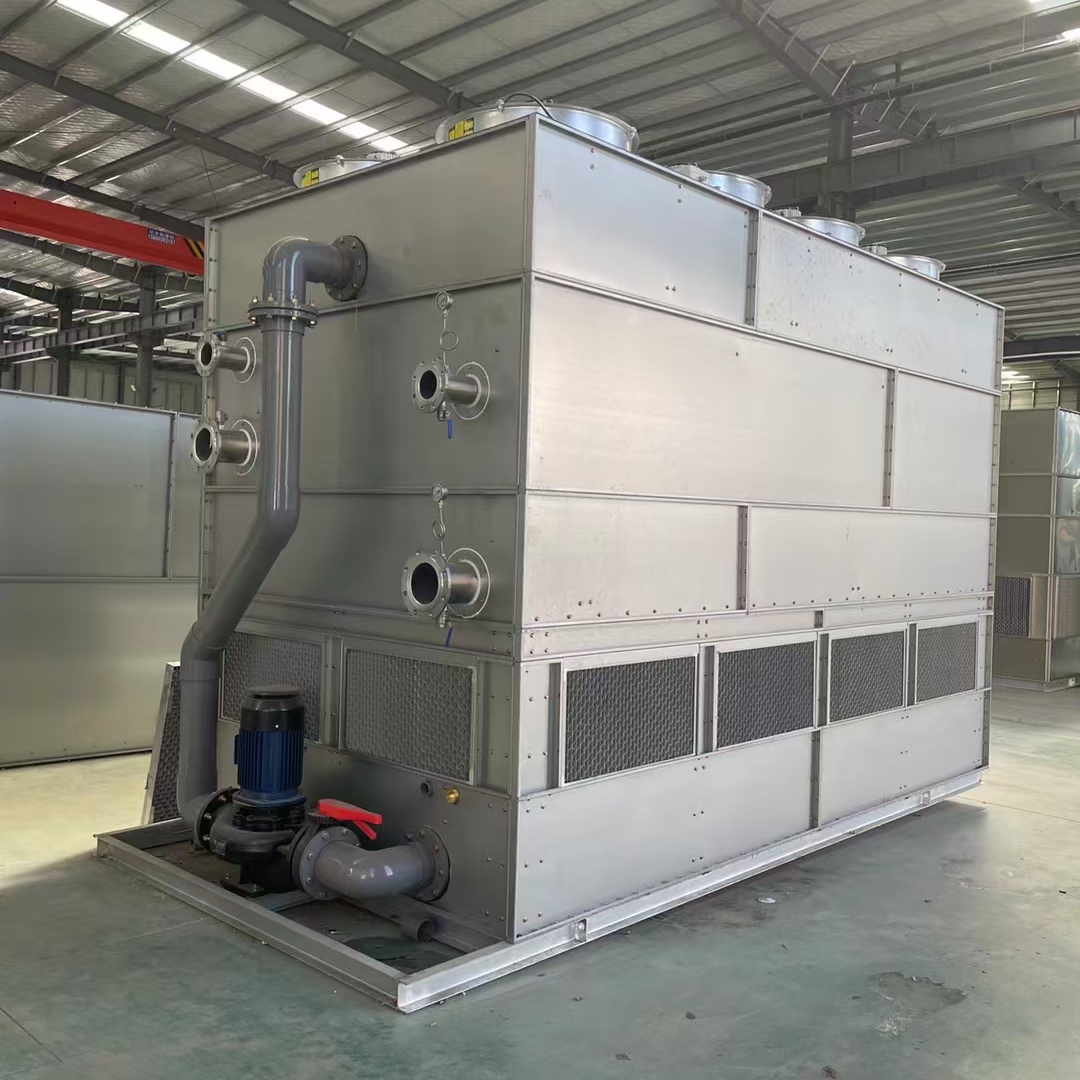
Role of Closed-Circuit Cooling Tower in Oil and Gas industry
In the oil and gas industry, a closed-circuit cooling tower provides a reliable, contaminant-free cooling loop for critical equipment and processes. Its primary advantage is protecting the system’s integrity by preventing the process cooling fluid from being exposed to the outside air, which is vital for operations where even minor impurities can cause fouling, scaling, or equipment failure.
Core Roles: Protecting Critical Operations
Closed-circuit cooling towers play a vital role in several key areas across the oil and gas value chain.
- Gas Processing and Compression: They provide essential cooling for compressors and engines, which generate immense heat during gas gathering and pipeline transmission. At large compressor stations, these towers can cool critical power devices like motors and converters in a closed water loop, maintaining stable and efficient operation. This closed-loop design ensures the cooling water remains pure and free from the debris and contaminants often found in industrial settings, significantly improving equipment reliability and reducing maintenance.
- Oil Refining: Refineries use closed-circuit towers to cool various process streams and equipment. For example, they are used in delayed coking units to cool the “contacting” water system. By isolating the cooling fluid, these towers help mitigate issues like fouling in heat exchangers, which can be caused by contaminants like oil in the water. This contributes to both environmental and economic benefits by enabling the recovery of waste gases and oils.
- Chemical Processing Support: While not the primary focus, closed-circuit cooling towers are also integral to the broader petrochemical sector, which is closely linked to oil and gas. They protect process fluids from contamination and reduce water consumption, supporting reactors, condensers, and other chemical processing units. The oil and gas sector is a major application area for these towers, alongside HVAC and power generation.
Strategic Choice for Efficiency and Sustainability
The choice of a closed-circuit system also offers significant operational and environmental benefits for oil and gas companies.
- Protecting Fluid Quality: A closed-loop design is often selected when protecting process fluid quality is paramount, when the risk of contamination is high, or when the system requires a specific fluid like glycol. This isolation dramatically reduces the need for chemical treatment and the issues associated with scale and corrosion.
- Water Conservation: While some water is lost to evaporation even in a closed system, the overall water demand can be significantly reduced through optimized design and by integrating the tower with other cooling methods. For example, one study on retrofitting an oil refinery with a hybrid cooling system showed measurable water savings.
In summary, closed-circuit cooling towers are a critical asset for the oil and gas industry. They deliver the high reliability and process protection needed for continuous operation, making them an essential component for maintaining safety, efficiency, and profitability across upstream and downstream activities.