

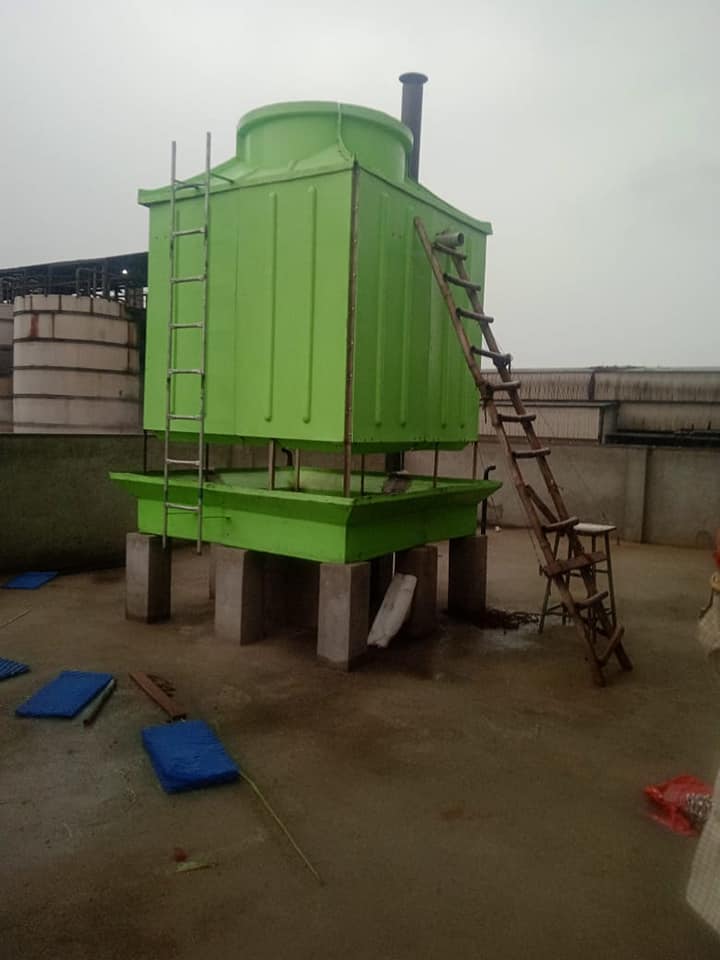
Counter Flow Cooling Tower, it helps to break down the name. “Flow” refers to the movement of air and water, and “Counter” means they move in opposite directions.
So, in a counter flow cooling tower, hot water falls vertically downward while air is pulled vertically upward—they flow against each other, head-to-head.
This is one of the two main airflow designs (the other being Crossflow, where air moves horizontally). The counter flow design is widely considered the most thermodynamically efficient configuration for heat rejection. Here is the engineering breakdown.
How It Works (Step-by-Step)
- Water Enters the Top: Hot water from your industrial process or HVAC chiller is pumped to the top of the tower and sprayed through high-pressure nozzles into a fine mist.
- Air Enters the Bottom: A powerful fan (usually an induced draft fan located at the very top) pulls massive volumes of ambient air in through louvers at the bottom of the tower.
- The “Counter” Clash: The falling water and the rising air meet head-on. As the air travels up through the falling water, it absorbs heat. A small percentage of the water evaporates, which pulls the latent heat out of the bulk water, dropping its temperature significantly.
- Cold Water Exits the Bottom: The now-cooled water collects in a basin at the bottom and is pumped back to your process. The now-hot, moisture-laden air is exhausted out the top of the tower (visible as that white plume of vapor).
Why Choose Counter Flow? (The Pros)
Counter flow towers are the industry standard for demanding applications because of their superior thermal performance:
- Highest Thermal Efficiency: Because the coldest water at the very bottom meets the driest, least-humid air (which just entered the tower), the temperature difference is maximized. This allows the water to be cooled to a temperature that approaches the ambient wet-bulb temperature more closely than a crossflow tower can achieve.
- Smallest Footprint: For a given cooling capacity, a counter flow tower has a smaller ground footprint than a crossflow tower. The water distribution system is contained entirely inside the tower, and the fan is on top, making it a very compact, boxy shape.
- Better Water Distribution: The pressurized spray nozzles at the top provide a very uniform water distribution across the entire fill surface, eliminating “dry spots” where air can bypass without doing any cooling.
The Trade-Offs (The Cons)
While highly efficient, counter flow towers come with specific engineering challenges:
- Higher Pumping Head (Energy Cost): Because the spray nozzles are at the top and must operate under pressure, the water pump must work harder (pump to a greater height) than in a crossflow tower, where water simply falls by gravity over a distribution basin. This means slightly higher electrical consumption for the pump.
- Maintenance Access: The spray nozzles are located inside the tower and are harder to access for cleaning and inspection. If they get clogged with debris or scale, the water distribution becomes uneven, and efficiency plummets.
- Higher Air Pressure Drop (Fan Energy): The air has to push through the water spray and the fill media, creating more resistance. The fan must work harder (drawing more power) compared to a crossflow tower of the same size.
- Vulnerable to Freezing: In cold climates, the spray nozzles at the top are exposed to the cold inlet air. If the tower is shut down in winter, water left in the nozzles can freeze and crack them.
The “Bottleneck” Limitation
Counter flow towers are generally limited in maximum size. Because the water is sprayed from the top and air is pulled from the bottom, the entire tower acts like a sealed column of falling water and rising air.
If you make it too wide, the air can’t distribute evenly across the fill. As a result, most large counter flow towers are factory-assembled, modular units. For massive applications (like a 1,000 MW power plant), engineers don’t build one giant counter flow tower; they install a series of smaller modular counter flow towers side-by-side. For truly gigantic, single-structure towers (like the hyperbolic natural-draft towers at nuclear plants), they almost exclusively use the crossflow design.
RP + Counter Flow: The Perfect Match
Since you just asked about FRP (Fiber-Reinforced Plastic) cooling towers, it is worth noting that Counter Flow + FRP is the most common high-performance pairing in the industry.
- The compact, boxy shape of a counter flow tower is perfectly suited to being molded from lightweight, corrosion-resistant FRP panels.
- The internal hot-water distribution basin, the fan stack, and the drift eliminators are all made from FRP or PVC to withstand the constant moisture and chemical attack.
- This combination delivers maximum cooling efficiency in a small footprint, with virtually zero rust or corrosion, making it the go-to choice for hospitals, data centers, chemical plants, and offshore oil platforms.
Quick Summary Comparison:
| Feature | Counter Flow | Crossflow |
| Air/Water Direction | Opposite (Up vs. Down) | Perpendicular (Horizontal vs. Down) |
| Thermal Efficiency | Highest | Slightly Lower |
| Footprint | Smallest | Larger |
| Pumping Energy | Higher (Needs pressure nozzles) | Lower (Gravity feed) |
| Maintenance | Harder to access nozzles | Easier access to basins |
| Freeze Risk | Higher (Exposed top nozzles) | Lower |