

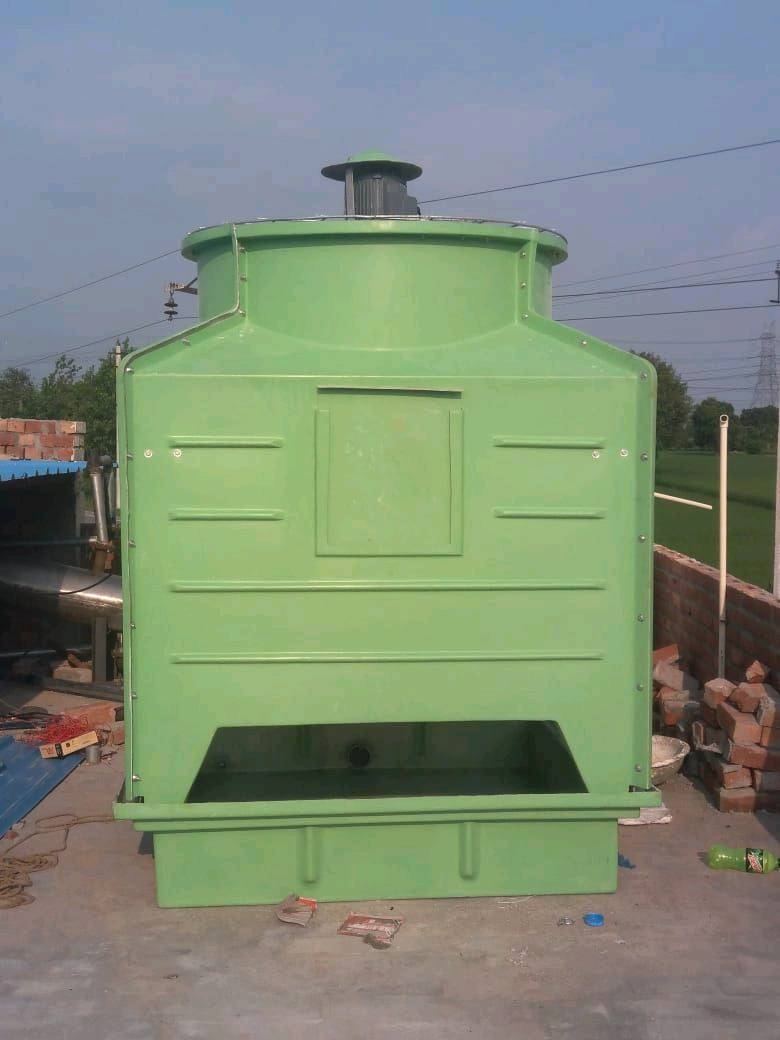
To understand a Cross Flow Cooling Tower, let’s do the same breakdown as before. “Flow” refers to the movement of air and water, and “Cross” means they move at a 90-degree angle (perpendicular) to each other.
In a cross flow cooling tower, hot water falls vertically downward under gravity, while air is pulled horizontally across the falling water.
While counter flow is the efficiency champion, cross flow is the maintenance champion—and it dominates the landscape of massive industrial installations (like nuclear power plants) because of its simplicity and ease of access. Here is the full engineering breakdown.
How It Works (Step-by-Step)
- Water Enters the Top Basin: Hot water from your process is pumped to the top of the tower. However, instead of being sprayed through pressurized nozzles, it is released into an open, gravity-fed distribution basin at the very top.
- Gravity Takes Over: The water flows through metering holes in the bottom of this basin and simply drips down over the “fill” (the plastic honeycomb media). No high-pressure pumping is required to atomize the water.
- Air Moves Horizontally: A large fan (usually an induced draft fan located on the side or top) pulls air in through large intake louvers on the sides of the tower. The air travels horizontally, perpendicular to the falling water.
- The “Cross” Interaction: As the air moves horizontally through the falling water, it strips away heat via evaporation. The now-cooled water collects in a basin at the bottom, while the hot, saturated air exits out the top or the opposite side of the tower.
Why Choose Cross Flow? (The Pros)
Cross flow towers aren’t just built for fun; they offer massive operational and maintenance benefits, especially at a large scale:
- The Lowest Pumping Energy: Because the water relies on gravity to fall through the tower (instead of being pushed through high-pressure spray nozzles), the water pump only needs to lift the water to the top basin. This significantly reduces the pump’s electrical consumption compared to a counter flow design.
- Unbeatable Maintenance Access: This is the #1 reason engineers love cross flow. The entire top of the tower is an open, walkable basin. You can walk right up to it, easily remove the covers, and physically inspect or clean the distribution holes. If algae or scale clogs a hole, you can clear it in minutes without shutting the tower down.
- Lower Air Pressure Drop: The air moves horizontally through a “dry” fill section before hitting the water, encountering less resistance than in a counter flow tower (where air must push up against falling water). This means the fan requires less horsepower to move the same volume of air, saving energy.
- Massive Single-Structure Capacity: Because the air intake is on the sides and the water falls straight down, cross flow towers don’t suffer from the “air distribution bottleneck” that limits the width of counter flow towers. You can build them absolutely enormous. This is why the giant hyperbolic natural-draft towers at nuclear plants are almost exclusively cross flow designs.
The Trade-Offs (The Cons)
Nothing is perfect, and cross flow towers have their own engineering headaches:
- Lower Thermal Efficiency: Because the coldest water at the bottom meets the driest air at the bottom (inlet), the temperature driving force is not as high as in a counter flow tower. To achieve the exact same cooling performance as a counter flow tower, a cross flow tower must be physically larger (taller and wider).
- Uneven Water Distribution (Puddling): Since water is fed by gravity through holes in an open basin, it is susceptible to wind, tower vibration, and minor blockages. If the tower isn’t perfectly level, water will pool on one side, creating “dry spots” in the fill where air bypasses without doing any cooling.
- Vulnerable to Sunlight & Algae: Because the top basin is open to the sun (unlike the enclosed spray header in a counter flow tower), algae and biofilm can grow rapidly in the warm, sunlit water, requiring regular chemical treatment and cleaning.
- Higher Freeze Risk for Inlet Louvers: In freezing climates, water splashing near the air inlets at the sides can freeze solid, building up massive blocks of ice on the louvers that can collapse the tower structure.
Cross Flow vs. Counter Flow: The Direct Head-to-Head
Here is the quick comparison to lock in your understanding:
| Feature | Cross Flow | Counter Flow |
| Air/Water Direction | Horizontal vs. Vertical (90°) | Vertical Up vs. Vertical Down (180°) |
| Water Distribution | Gravity-fed, open basin (no pressure) | Pressurized spray nozzles |
| Thermal Efficiency | Good, but requires a larger tower | Best (smallest tower for same duty) |
| Pumping Energy | Lowest (just lift to top) | Higher (needs high pressure for nozzles) |
| Maintenance | Excellent (walkable, open basin) | Harder (nozzles are internal and hidden) |
| Best Suited For | Massive power plants, large refineries | Compact HVAC, data centers, chemical plants |
The Iconic Example: The Hyperbolic Nuclear Tower
If you’ve ever seen a picture of a nuclear power plant with those gigantic, hourglass-shaped concrete towers, you are looking at a Natural-Draft Cross Flow Cooling Tower.
- There are no fans; the shape creates a natural chimney effect that pulls air in horizontally through the bottom.
- The hot water is sprayed from a massive ring at the top and falls straight down. Air enters through the wide bottom and moves horizontally across the falling water.
- The cross flow design is critical here because if they used counter flow, the weight of the falling water would push back against the rising air, reducing the natural draft effect. Cross flow allows the air to move horizontally with zero resistance from the falling water.
FRP + Cross Flow: The Industrial Standard
Since you asked about FRP (Fiberglass) cooling towers, it’s important to note that while FRP is heavily used in counter flow towers, cross flow towers are often built from concrete or heavy steel for mega-projects.However, packaged FRP Cross Flow towers are extremely common for medium-sized industrial applications (like plastic injection molding plants, medium factories, and large commercial HVAC) because the FRP casing perfectly withstands the constant splashing and chemical attack, while the open top basin makes it easy for plant maintenance crews to walk in and service the tower without specialized tools