

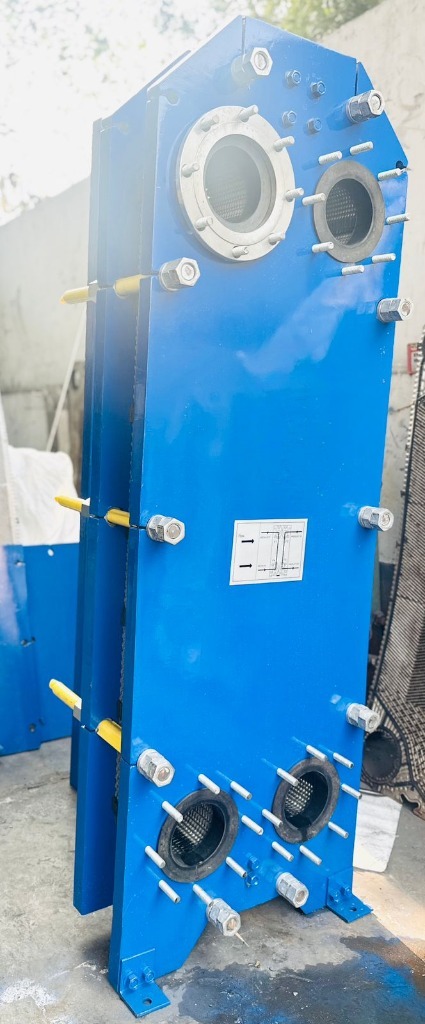
Types of Plate Heat Exchanger
1. Gasketed Plate Heat Exchanger
This is the most common and classic type, described in the previous answer. It consists of plates sealed with gaskets and held together in a frame.
- How it Works: A pack of corrugated plates with peripheral gaskets is compressed between a fixed frame plate and a movable pressure plate using tightening bolts. The gaskets direct the fluids into alternating channels and prevent leakage.
- Key Feature: Serviceability. The unit can be easily opened for cleaning, inspection, or adding/removing plates to change capacity.
- Advantages:
- Easy to maintain and clean.
- Highly flexible (capacity can be adjusted).
- Good for fouling fluids due to easy access.
- Disadvantages:
- Gaskets are a potential leak point.
- Limited by gasket material for temperature and pressure.
- Not suitable for aggressive fluids that degrade the gasket material.
- Typical Applications: HVAC, water heating, food and beverage processing (e.g., milk pasteurization), and many general industrial duties.
2. Brazed Plate Heat Exchanger (BPHE)
In this type, the plate pack is permanently fused together using a brazing material, eliminating the need for gaskets and a frame.
- How it Works: Stainless steel plates are stacked alternately and then brazed together in a vacuum furnace. The brazing material (typically copper for standard applications, nickel for ammonia or corrosive fluids) seals the plate edges and contact points, creating a very strong, compact block.
- Key Feature: Compactness and Robustness. No gaskets, no frame.
- Advantages:
- Extremely compact and lightweight.
- Can handle much higher pressures and temperatures than gasketed types.
- Lower cost for a given capacity.
- Highly efficient.
- Typical Applications: Residential and commercial heat pumps, refrigeration systems, combi-boilers, and hydraulic and lubrication oil coolers.
3. Welded Plate Heat Exchanger
Welded PHEs are designed for the most demanding applications where gaskets are not suitable. They use a combination of welding and, in some cases, gaskets.
a) Fully Welded Plate Heat Exchanger
The entire plate pack is welded together, usually by laser or TIG welding, forming a solid block without any gaskets.
- Key Feature: Suitable for extreme conditions.
- Advantages:
- Can handle very high temperatures and pressures, corrosive fluids, and aggressive media that would destroy gaskets.
- More compact than a shell and tube exchanger for the same duty.
- Typical Applications: Chemical processing, oil and gas production, refrigeration