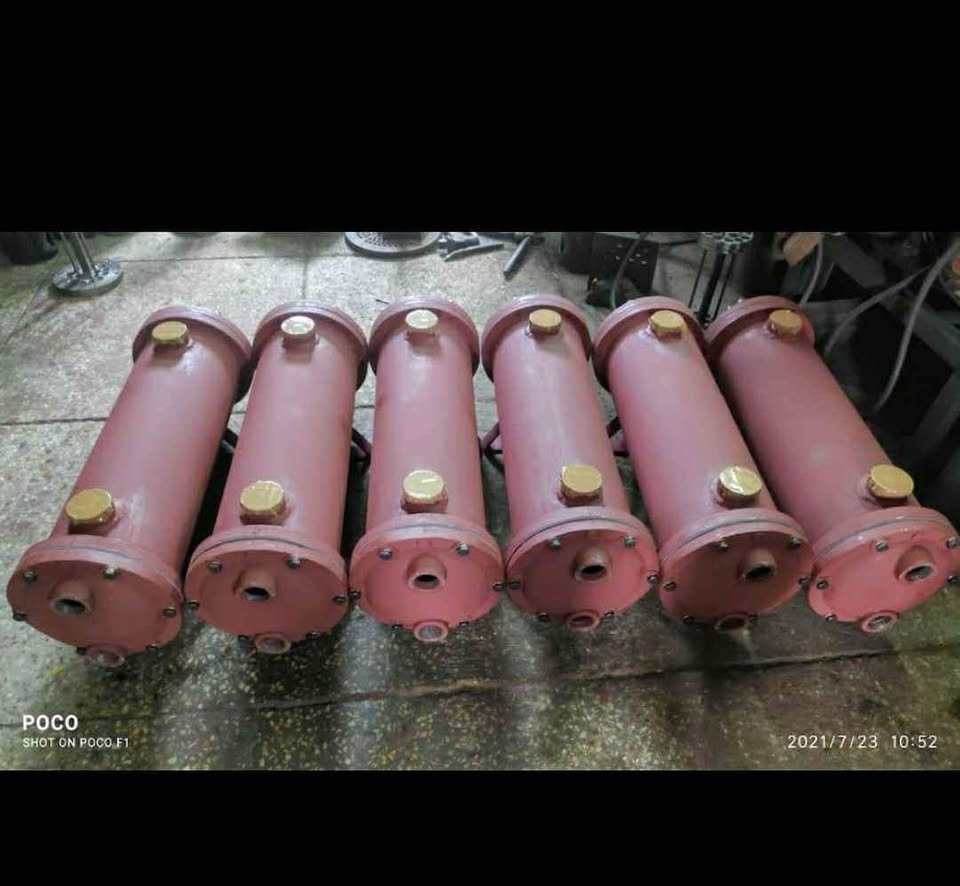
Maintaining a shell and tube oil cooler in marine or industrial applications is crucial for efficient heat transfer, preventing leaks, and avoiding costly downtime. Below is a comprehensive maintenance checklist:
1. Routine Inspection & Monitoring
Visual Checks:
Look for oil leaks, seawater seepage, or corrosion on the shell, tubes, and end caps.
Check sacrificial anodes (if fitted) – replace if >50% depleted.
Temperature & Pressure Monitoring:
Compare inlet/outlet temps of oil & coolant – a higher ∆T indicates fouling.
Monitor pressure drop – Increased pressure drop = clogged tubes.
2. Cleaning Procedures
A. Tube Side (Coolant Side – Usually Seawater/Freshwater)
Mechanical Cleaning (For Heavy Fouling):
Use nylon brushes or high-pressure water jetting (avoid metal tools to prevent tube damage).
For seawater-cooled units, remove barnacles, silt, and marine growth.
Chemical Cleaning (For Scaling/Biofouling):
Circulate mild acidic (citric/phosphoric acid) or alkaline solutions to dissolve deposits.
For Cu-Ni tubes: Avoid strong acids (can cause dezincification).
B. Shell Side (Oil Side)
Solvent Flushing:
Use kerosene or diesel to dissolve sludge/varnish deposits.
Hot Oil Flushing (For Heavy Contamination):
Circulate hot oil (80-100°C) with turbulent flow to dislodge carbon deposits.
3. Leak Testing & Repairs
Hydrostatic Test:
Pressurize the water side with freshwater to check for leaks (1.5x working pressure).
Dye Penetrant Test:
For detecting cracks in tube-to-tube sheet joints.
Tube Plugging:
If leaks are found, plug damaged tubes (max 10% of total tubes to avoid efficiency loss).