

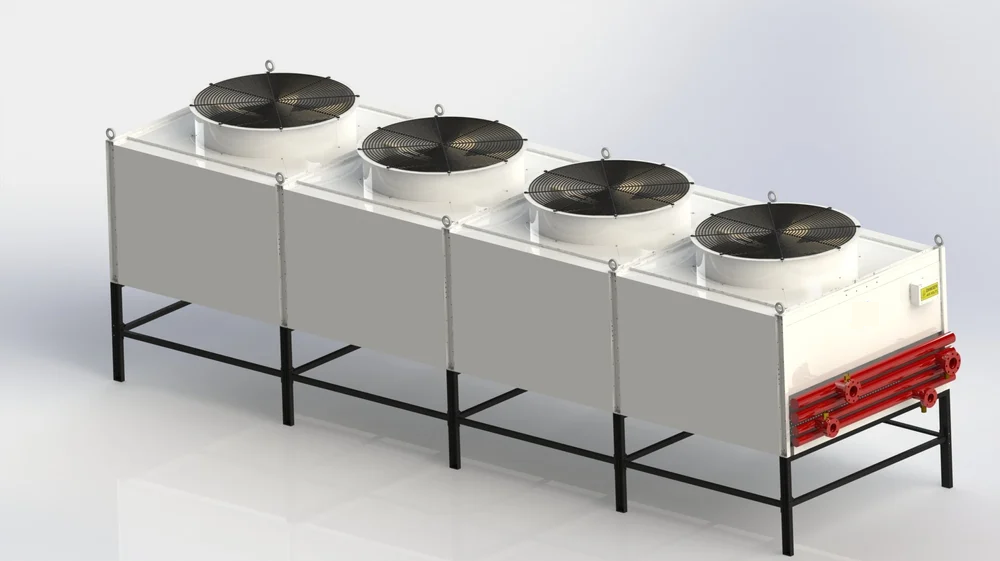
Best material for Construction of Dry cooling tower used in Sea Shore Area
Selecting the best material for a dry cooling tower in a sea shore area is a critical engineering decision. The primary enemy is salt-induced corrosion, which aggressively attacks most metals.
The single most important factor is protecting the heat exchanger core (finned tubes), as it is the most expensive part to replace and its failure means the entire system fails.
Here is a breakdown of the best materials for each component, focusing on the harsh marine environment.
Executive Summary: Best Material Choices
- Heat Exchanger Finned Tubes (The Core): Aluminum Fins with Cupronickel (CuNi) 90/10 or 70/30 Tubes. This is the industry gold standard for severe marine service.
- Structure & Casing: Hot-Dip Galvanized Steel (HDG) with a high-quality paint system or Stainless Steel (AISI 316L or 304L) for critical parts.
- Fans & Louvers: Fiberglass Reinforced Plastic (FRP) or Stainless Steel.
- Fasteners & Hardware: Stainless Steel (AISI 316 or 316L) exclusively.
Detailed Breakdown by Component
1. Heat Exchanger Core (Finned Tubes)
This is where the heat transfer happens. It consists of tubes and fins.
| Material Option | Pros | Cons | Verdict for Seashore |
| Aluminum Fins / Carbon Steel Tubes | Low cost, good thermal conductivity (Al). | Disastrous. Carbon steel tubes will corrode through very quickly. Standard in inland applications, but completely unsuitable for marine. | Not Recommended |
| Aluminum Fins / Galvanized Steel Tubes | Better than plain carbon steel; zinc provides sacrificial protection. | The zinc coating is thin and can be compromised. Once scratched, the steel underneath corrodes rapidly. Not reliable for long-term marine exposure. | Poor |
| Aluminum Fins / Stainless Steel Tubes (AISI 304/304L) | Good corrosion resistance, strong. | 304 Stainless is susceptible to chloride stress corrosion cracking (CSCC) in the presence of salt and warmth. A significant risk. | Fair, but Risky. A better option than carbon steel, but not the best for long-term reliability. |
| Aluminum Fins / Stainless Steel Tubes (AISI 316/316L) | Excellent corrosion resistance due to Molybdenum content, which resists pitting from chlorides. | More expensive than 304. Still a very small risk of pitting in extreme conditions, but generally very robust. | Very Good. A common and reliable choice for many marine applications. |
| Aluminum Fins / Cupronickel Tubes (90/10 or 70/30) | Exceptional resistance to saltwater corrosion. CuNi alloys are specifically designed for marine environments. Highly resistant to biofouling and stress corrosion cracking. | Highest material cost. Heavier than aluminum. | Best / Gold Standard. This is the preferred choice for maximum service life and reliability in a harsh seashore environment. |
| All-Aluminum Core | Excellent thermal conductivity, lightweight, and lower cost. Forms a protective oxide layer. | The aluminum fins and tubes are vulnerable to pitting corrosion from salt. Less robust than CuNi tubes in the long run. | Good. A cost-effective alternative to CuNi, but the service life may be shorter. Ensure it has a protective coating. |