

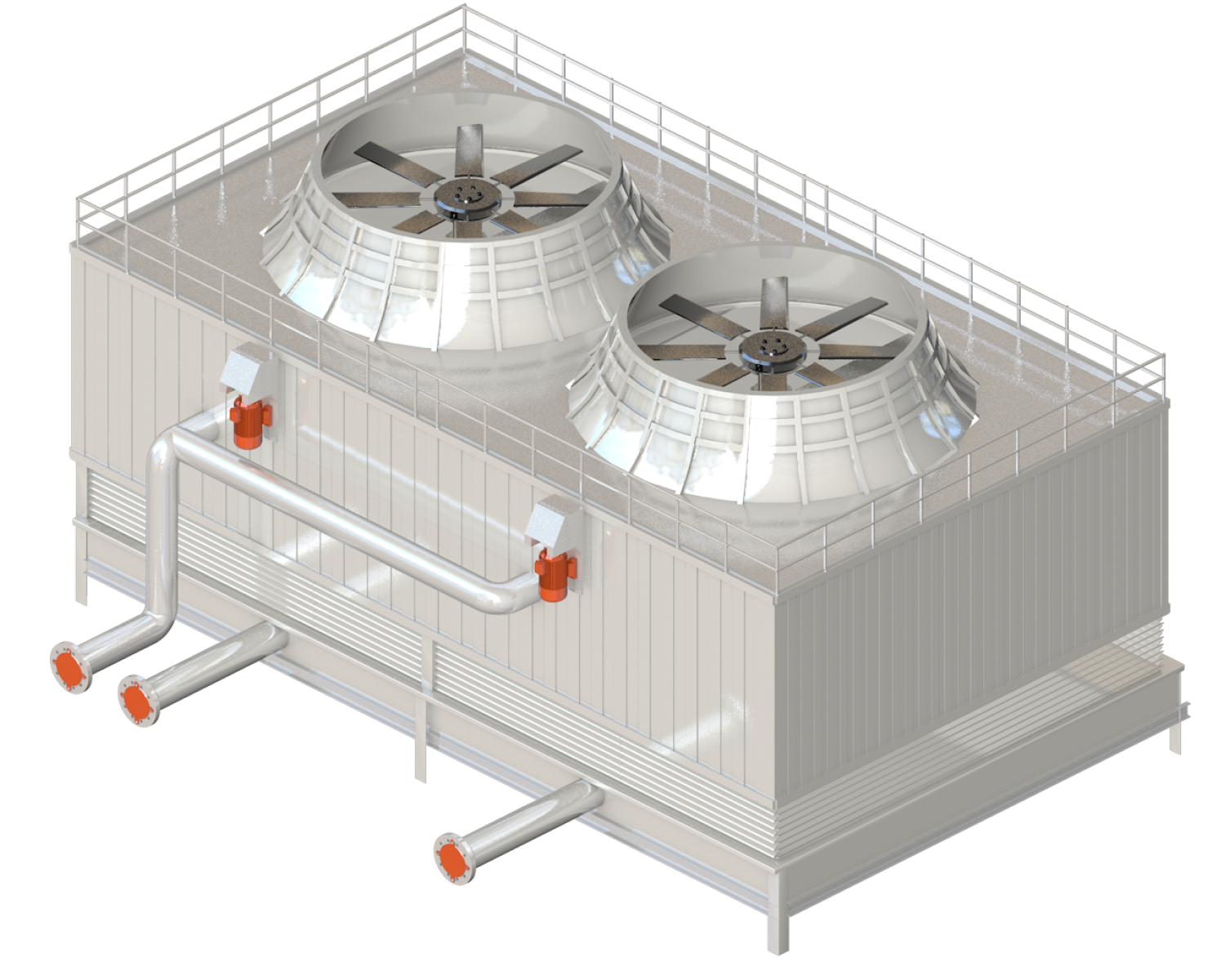
Comparison: Dry Cooling Tower vs. Wet Cooling Tower
| Feature | Dry Cooling Tower | Wet Cooling Tower (Evaporative) |
| Principle | Sensible Heat Transfer (Air cools fluid) | Latent Heat Transfer (Evaporation cools fluid) |
| Water Usage | Zero (except for occasional cleaning) | High (continuous evaporation and blowdown) |
| Coolant Circuit | Closed Loop | Open or Closed Loop |
| Cooling Efficiency | Lower. Highly dependent on ambient dry-bulb temperature. | Higher. More efficient as it depends on ambient wet-bulb temperature, which is lower. |
| Footprint & Size | Larger for the same cooling capacity. | Smaller for the same cooling capacity. |
| Capital Cost | Generally Higher | Generally Lower |
| Operational Cost | Lower (no water/chemical costs, but higher fan power). | Higher (continuous cost of water, water treatment chemicals, and pumping). |
| Environmental Impact | No water consumption; no vapor plume. | High water consumption; produces a visible vapor plume. |
| Maintenance | Cleaning fins to prevent clogging. | Combating scale, algae, and corrosion; water treatment. |
| Risk in Cold Weather | Risk of coolant freezing. | Lower freezing risk due to constant movement. |