

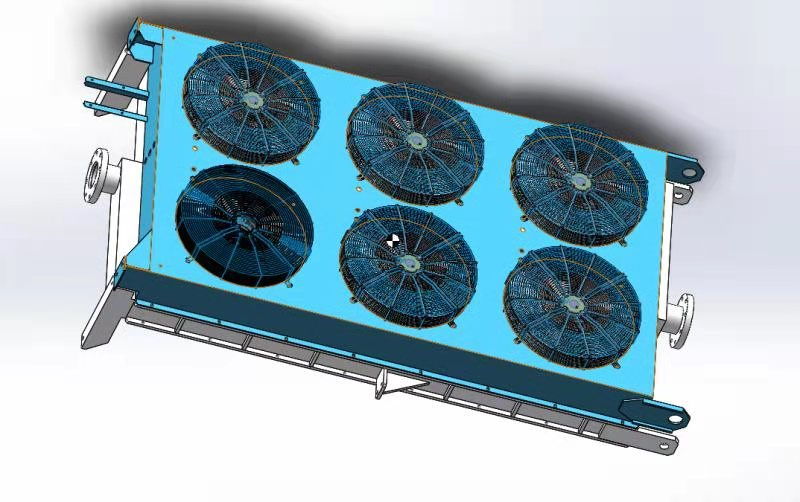
how to Select best cooler for Genset Engine.
Selecting the best cooler for a genset engine is a critical engineering decision that balances performance, cost, reliability, and site-specific conditions. There is no one-size-fits-all answer.
Here is a structured, step-by-step guide to selecting the optimal cooling system for your genset engine.
Step 1: Understand the Fundamental Options
First, you must understand the three primary types of cooling systems available:
| System Type | Core Principle | Best For | Key Limitation |
| 1. Radiator with Air Cooled Heat Exchanger (ACHE) | Dry Cooling. Ambient air cools the engine coolant directly via a finned-tube radiator and fan. | Standby power, mobile units, arid regions, low-maintenance sites. | Performance limited by ambient dry-bulb temperature. |
| 2. Heat Exchanger with Remote Dry Cooler | Dry Cooling. Engine coolant is cooled by a separate, remote air-cooled unit via a heat exchanger. | Large installations where fan noise must be isolated from the genset. | Performance limited by ambient dry-bulb temperature. Higher cost than integrated ACHE. |
| 3. Heat Exchanger with Cooling Tower | Evaporative Cooling. Engine coolant is cooled by water from a cooling tower via a heat exchanger. | Large, prime power applications, high-ambient temperature regions, continuous duty. | High maintenance (water treatment), water consumption, health risk (Legionella). |