

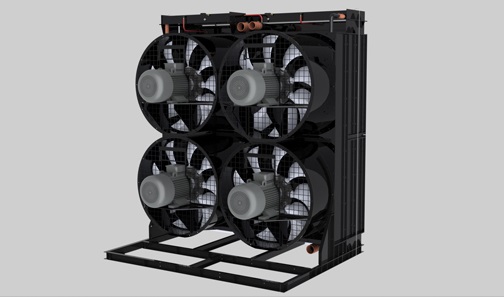
Components of the Loop
Imagine the coolant traveling in a circle, and these are the parts it encounters:
1. Water Block (Heat Source Interface)
- Function: This is the part that makes direct contact with the component you want to cool (e.g., CPU, GPU). It has a base (often copper) that absorbs heat and a channeled interior where coolant flows to carry that heat away.
- Analogy: The “sponge” that soaks up the heat.
In an Industrial System (e.g., Genset): This is the Heat Exchanger or “Jacket Water Cooler” that is plumbed into the engine block to absorb heat from the engine
Pump
- Function: The heart of the system. It provides the pressure to circulate the coolant throughout the entire loop, pushing it from the heat source to the radiator and back again.
- Key Consideration: The pump must be powerful enough to overcome the resistance (pressure drop) of the entire loop, especially the long tubes to the remote radiator.
3. Radiator (Heat Exchanger)
- Function: This is the namesake part and the primary location for heat dissipation. It consists of a metal core (usually aluminum or copper) with many fins and channels. As the hot coolant passes through it, the fins transfer the heat to the air.
- Analogy: The car’s radiator, but located away from the engine.
4. Fans
- Function: Mounted on the radiator, these fans force ambient air through the radiator fins, dramatically increasing the rate of heat transfer from the metal to the air. Fan speed can often be controlled to balance noise and cooling performance.
5. Tubes / Hoses
- Function: The “vascular system” that connects all the components. They carry the coolant to and from the remote radiator.
- Types:
- Soft Tubes: Flexible tubing (e.g., PVC, EPDM rubber). Easy to work with, good for vibration isolation. Common in industrial applications and beginner PC builds.
- Hard Tubes: Rigid tubing (e.g., acrylic, PETG). Used for a cleaner, more aesthetic look in custom PC builds, but less practical for industrial use.
6. Coolant
- Function: The specialized fluid that transports the heat. It’s not just water; it contains additives to prevent corrosion, growth of algae/bacteria, and to lower the freezing point.
- Types: Can be distilled water with additives, pre-mixed colored fluids, or specialized industrial coolants.
7. Fittings
- Function: The critical connectors that create a secure, leak-free seal between the tubes/hoses and the other components (pump, water block, radiator). Each type of tubing requires its specific fitting type (e.g., compression fittings for soft tubes, hard tube fittings for rigid tubes).
. Reservoir
- Function: A tank that holds a reserve of coolant. It makes filling the loop and bleeding air bubbles out (purging) much easier. While not strictly mandatory, it is highly recommended for any complex loop.
Supporting and System-Specific Parts
For PC & High-Precision Systems:
- Drain Valve: A crucial part for maintenance, allowing you to easily drain the coolant from the system without making a mess.
- Temperature Sensor: Plugs into the motherboard or a separate controller to monitor coolant temperature, allowing fan and pump speeds to be regulated based on coolant temp rather than component temp for smoother operation.
- Fan/Pump Controller: A hardware or software-based device to manage the speed and performance of the cooling components.
For Industrial Systems (e.g., Genset with Remote Radiator):
- Heat Exchanger (Plate & Frame): Often used as an interface between the engine’s primary coolant loop and the secondary loop that goes to the remote radiator. This protects the engine from any issues in the remote loop.
- Expansion Tank: A necessary tank that allows for the expansion and contraction of the coolant as it heats and cools, maintaining system pressure.
- Circulation Pump (Secondary): A heavy-duty, often electrically powered pump dedicated to moving coolant through the long lines to the remote radiator.
- Air Bleed Valves: Automatic or manual valves to remove trapped air from the highest points in the system.
- Control System: Monitors coolant temperature and pressure, and controls the remote radiator’s fans and the circulation pump, often with built-in alarms and failsafes.
Summary of the Flow Path
A complete remote radiator system integrates these parts into a single, continuous loop:
Heat Source (e.g., CPU/Engine) → Water Block / Heat Exchanger → Pump → Outlet Hose/Tube → Remote Radiator → Inlet Hose/Tube → Back to Heat Source
In an industrial two-loop system, it would be:
Engine → Primary Loop Pump → Plate Heat Exchanger → Secondary Loop Pump → Remote Radiator → Back to Plate Heat Exchanger