

. High-Performance Computing & Data Centres
This is where the concept is most visible to enthusiasts and professionals.
- Extreme Overclocking and Custom PC Builds:
- Application: Enthusiasts building high-end PCs for gaming, video editing, or 3D rendering often use custom water loops. A remote radiator allows them to use a massive, multi-fan radiator (e.g., a 1080mm or even larger) that could never fit inside a standard PC case.
- Benefit: Achieves significantly lower CPU and GPU temperatures, enabling stable performance at extreme overclocking settings that would be impossible with internal cooling.
- Compact and Small Form Factor (SFF) PCs:
- Application: A user wants a very powerful PC in a tiny case like the Dan A4 or Louqe Ghost S1. There’s no internal space for a meaningful radiator.
- Benefit: The entire cooling system (radiator, pump, reservoir) can be mounted externally, allowing for a powerhouse PC in a minuscule footprint. This is often called a “dual-chassis” setup.
- Silent Workstations:
Application: Audio production studios, recording engineers, and users who require absolute silence
- Benefit: By moving the radiator and its fans to another room, a closet, or even just outside a window, the primary workstation can become virtually silent, eliminating the distracting noise of cooling fans.
- High-Density Server Racks and Data Centres:
- Application: Individual server racks or entire data halls generating immense heat. Instead of cooling each server internally, a centralized, more efficient remote liquid cooling system is used.
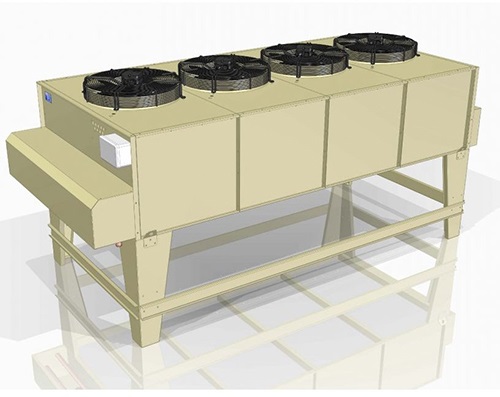
- Benefit: Heat is captured at the source (CPU/GPU) and transported away via liquid to a large, remote heat exchanger (often on the building’s roof or a dedicated cooling plant). This is far more energy-efficient than trying to cool the entire room with air conditioning.
2. Industrial Machinery & Manufacturing
This is one of the oldest and most critical applications, where reliability is paramount.
- High-Power Laser Systems:
- Application: Industrial lasers for cutting, welding, and engraving generate intense heat that must be removed with extreme precision to maintain beam quality and power.
- Benefit: A remote chiller or radiator system provides stable, consistent cooling, allowing the laser source to be compact while the robust cooling unit is placed in a serviceable location.
- CNC Machines, Mills, and Lathes:
- Application: The spindle motors and drives on CNC equipment generate significant heat, which can cause thermal expansion and lead to machining inaccuracies.
- Benefit: A remote cooling system maintains a stable temperature in critical components, ensuring the machine can hold tight tolerances for hours of operation.
- Plastic Injection Molding & Die Casting Machines:
- Application: These machines use hydraulic systems and heated barrels that require precise temperature control.
- Benefit: Remote heat exchangers cool the hydraulic oil and other process fluids, improving machine efficiency, cycle times, and product consistency.
- Power Electronics & Motor Drives:
- Application: Large variable-frequency drives (VFDs), rectifiers, and transformers in industrial settings.
- Benefit: Liquid cooling with a remote radiator allows these powerful electronic components to be built in a much smaller enclosure while dissipating heat more effectively than air cooling, leading to higher power density and longer lifespan.
3. Automotive, Aerospace & Military Vehicles
In these fields, space is at a premium, and environments are extreme.
- Heavy-Duty and Specialized Vehicles:
- Application: Mining trucks, bulldozers, and military tanks have incredibly powerful engines and transmissions packed into tight, dusty compartments.
- Benefit: The radiator can be mounted on the roof, side, or another part of the vehicle with better access to clean, cool air, protecting it from debris and improving cooling efficiency.
- Racing and High-Performance Cars:
- Application: In some race car designs, to improve aerodynamics or weight distribution, engineers may use a remote radiator setup.
- Benefit: Allows for more flexible packaging of components and can help reduce the frontal area of the car for better aerodynamic performance.
- Aerospace and Avionics:
- Application: Cooling critical electronic systems (avionics) in aircraft.
- Benefit: Heat generated by electronics in the cockpit or fuselage can be transported via liquid to a remote heat sink on the aircraft’s skin, where it can be dissipated into the outside air.
. Other Niche Applications
- High-Fidelity Audio Amplifiers:
- Application: Some high-end, high-power amplifier manufacturers use remote radiators.
- Benefit: Keeps the amplifier chassis compact and free from fan vibration, which can electrically noise, resulting in cleaner audio output.
- Scientific and Medical Equipment:
- Application: MRI machines, DNA sequencers, and particle detectors often have components that require precise, stable temperatures.
- Benefit: Remote cooling allows the sensitive instrument to remain in a controlled environment while the heat-generating and noisy cooling hardware is placed in a separate utility room.