

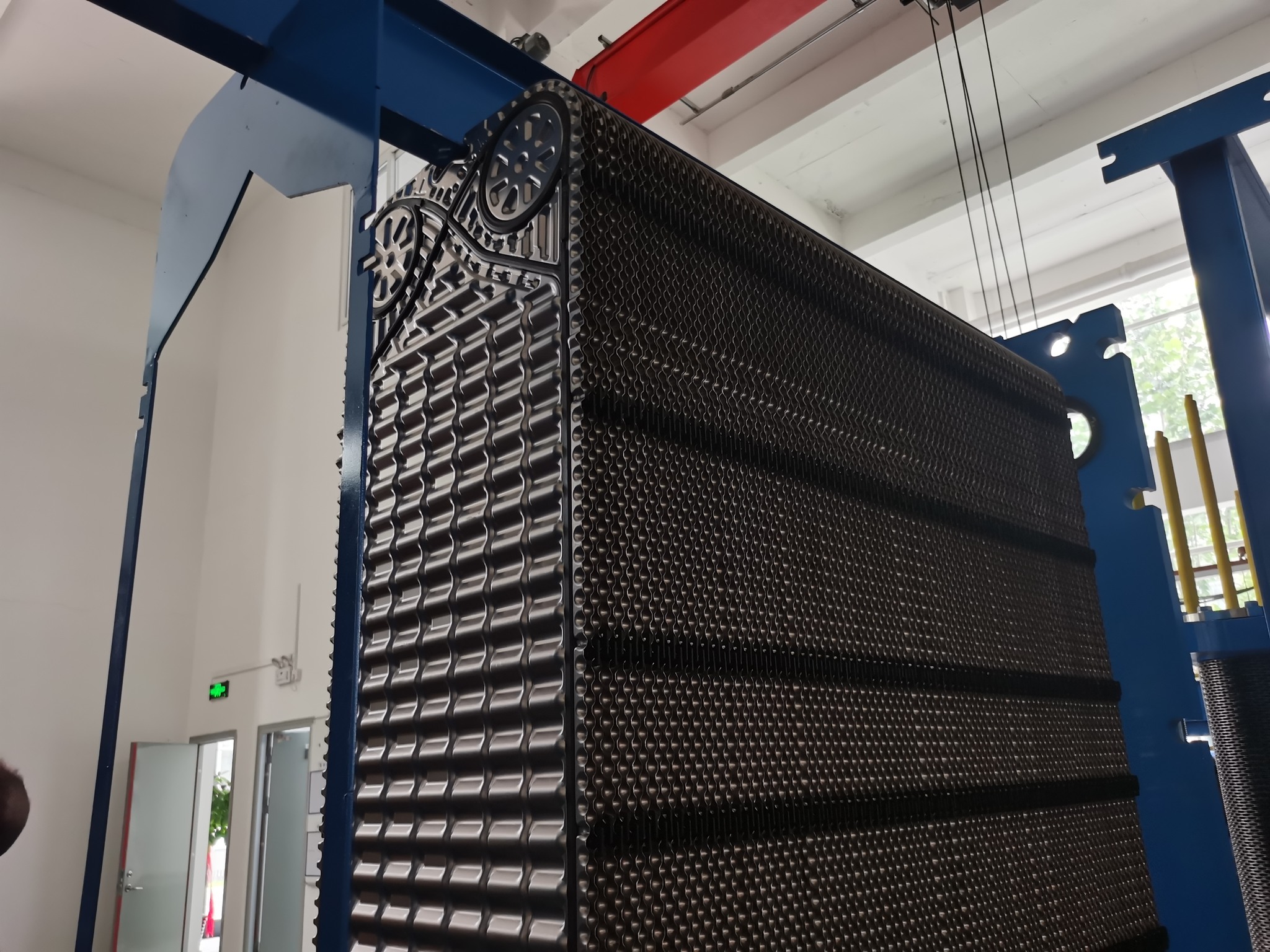
Best plate heat exchanger Suitable for pressure of 5 bar, 15 bar and 35 bar ?
Selecting the best plate heat exchanger for different pressure ranges is a key engineering decision. The “best” choice involves balancing pressure capability, maintenance needs, and cost.
Here is a clear breakdown of the most suitable types for 5 bar, 15 bar, and 35 bar.
Overview: Pressure Capabilities by Type
- Gasketed PHE: Good for Low to Medium pressure (typically up to 25-30 bar).
- Brazed PHE (BPHE): Good for Medium to High pressure (typically up to 30-45 bar).
- Semi-Welded PHE: Good for Medium to High pressure (similar to Brazed, but one side is contained).
- Fully Welded PHE: Excellent for Very High pressure (can be designed for 80 bar and far beyond).
. For 5 Bar (Low Pressure)
This is a very common pressure for HVAC, general industrial water, and many process applications.
Most Suitable and Cost-Effective Choice: Gasketed Plate Heat Exchanger
- Why: A standard gasketed PHE handles 5 bar with a significant safety margin. This is well within its standard operating range.
- Advantages at this Pressure:
- Lowest Cost: The most economical option for this duty.
- Easy Maintenance: Can be opened for cleaning, which is ideal for systems with potential fouling (e.g., cooling tower water).
- Flexibility: Capacity can be easily modified by adding/removing plates.
- Typical Applications:
- HVAC chilled and hot water systems.
- Cooling tower water circuits.
- Domestic hot water heating.
- Many food and beverage processes.
Conclusion for 5 Bar: A Gasketed PHE is almost always the best choice due to its cost-effectiveness and serviceability. There is no need to pay for the higher pressure rating of a brazed or welded unit.
2. For 15 Bar (Medium Pressure)
This pressure is common in industrial processes, higher-temperature water systems, refrigeration, and power packs.
Top Contenders:
- Brazed Plate Heat Exchanger (BPHE)
- Gasketed Plate Heat Exchanger (Heavy-Duty)
- Semi-Welded Plate Heat Exchanger
Analysis:
- Brazed Plate Heat Exchanger (BPHE) – Often the Best Choice
- Why: 15 bar is well within the standard range for most BPHEs. They are compact, efficient, and have no maintenance costs (no gaskets).
- Ideal for: Refrigeration systems, heat pumps, hydraulic oil coolers, and other clean, sealed systems where space is limited.
- Limitation: Not cleanable; only for non-fouling fluids.
- Gasketed Plate Heat Exchanger (Heavy-Duty) – The Serviceable Choice
- Why: Many gasketed models are rated for 16, 20, or 25 bar. A model specifically selected for a 16-20 bar rating would be perfect.
- Ideal for: Applications where the fluid may foul and require cleaning (e.g., process fluids, certain coolants).
- Limitation: Requires more space than a BPHE and has ongoing gasket maintenance.
- Semi-Welded Plate Heat Exchanger – The Specialist Choice
- Why: Excellent for 15 bar, but often overkill unless you have a specific need to contain one hazardous fluid (e.g., ammonia refrigerant) while allowing the other side to be serviced.
- Ideal for: Industrial refrigeration with ammonia, or processes with one corrosive and one fouling fluid.
Conclusion for 15 Bar:
- For a clean, sealed system: Choose a Brazed PHE.
- For a system requiring cleaning or maintenance: Choose a heavy-duty Gasketed PHE.
- For a system with a hazardous fluid (like ammonia): Choose a Semi-Welded PHE.
3. For 35 Bar (High Pressure)
This is a high pressure that rules out standard gasketed units and enters the domain of welded and specialized brazed units. Common in oil & gas, high-pressure gas cooling, chemical synthesis, and certain power applications.
Most Suitable and Safe Choice: Fully Welded Plate Heat Exchanger
- Why: 35 bar is a standard operating range for many fully welded designs. Their all-welded, gasket-free construction is specifically engineered for this kind of mechanical stress. They are robust and reliable.
- Advantages at this Pressure:
- Extreme Robustness: Can handle pressure surges and thermal cycling.
- No Gaskets: Eliminates the risk of gasket blow-out, which is a significant risk in gasketed PHEs at this pressure.
- Handles High Temperatures: Often paired with high pressure.
- Typical Applications:
- Gas compressor cooling (aftercoolers).
- High-pressure synthesis loops in chemical plants.
- High-pressure oil and gas processes.
Alternative for Specific Cases:
- Special High-Pressure Brazed Plate Heat Exchanger:
- Some specialized BPHEs are designed for pressures up to 40-45 bar.
- Consider this only if: The system is perfectly clean, the duty is well-defined, and the compact size of a BPHE is absolutely critical. The fully welded unit is generally the safer and more standard choice.
NOT Recommended for 35 Bar:
- Standard Gasketed PHEs: Their maximum is typically 25-30 bar. At 35 bar, you risk gasket failure and leakage.
- Standard Semi-Welded PHEs: While more robust than gasketed, their pressure rating is often similar, and the gasketed side may still be a limitation. Special high-pressure semi-welded designs exist but are not common.
Conclusion for 35 Bar: The Fully Welded Plate Heat Exchanger is the unequivocally correct and safest engineering choice for continuous duty at 35 bar.
Summary Table
| Operating Pressure | Best Suitable Type(s) | Key Reason |
| 5 Bar | Gasketed PHE | Cost-effective, serviceable, and well within its pressure range. |
| 15 Bar | Brazed PHE or Heavy-Duty Gasketed PHE | BPHE for compact, sealed systems. Gasketed for serviceable systems. |
| 35 Bar | Fully Welded PHE | Specifically designed for high-integrity containment of high pressures. |
Final Note: Always confirm the specific pressure rating (and temperature rating) for the exact model and size you select with the manufacturer, as capabilities can vary.