

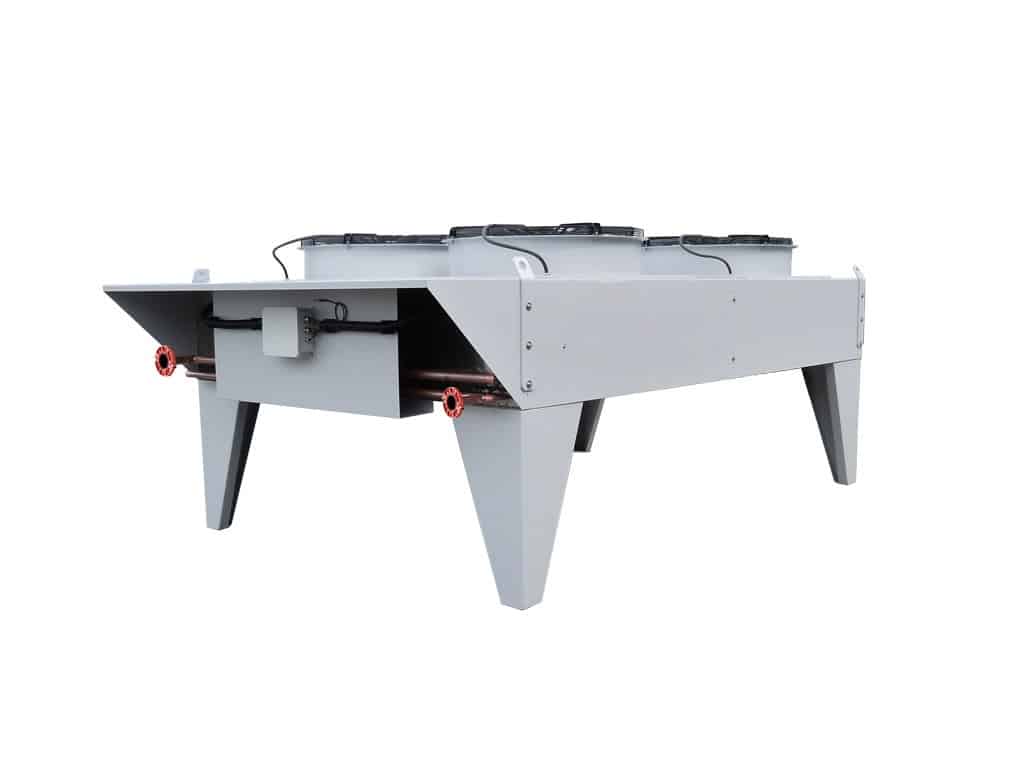
Performance of Air-Cooled Oil Coolers: With Fins vs. Without Fins
The presence of fins dramatically impacts the cooling efficiency, size, and overall performance of an air-cooled oil cooler. Below is a detailed comparison:
1. Heat Transfer Efficiency
| Factor | With Fins | Without Fins |
| Surface Area | High (5-10x more than bare tubes). | Low (Only tube surface). |
| Heat Dissipation | Excellent (Fins enhance convection). | Poor (Limited cooling). |
| Cooling Capacity | High (Handles heavy thermal loads). | Low (Suitable only for light cooling). |
Winner: Finned coolers (far superior heat transfer).
2. Airflow & Thermal Resistance
| Factor | With Fins | Without Fins |
| Airflow Turbulence | High (Fins disrupt laminar flow). | Low (Smooth tubes reduce heat exchange). |
| Thermal Resistance | Low (Efficient heat transfer to air). | High (Heat stays trapped in oil). |
| Dependence on Airspeed | Works even at low speeds (Fins optimize cooling). | Needs high airflow (Less effective at idle). |
Winner: Finned coolers (better at all airspeeds).
3. Size & Weight Considerations
| Factor | With Fins | Without Fins |
| Compactness | Smaller size (Same cooling in less space). | Bulky (Needs larger tubes for same effect). |
| Weight | Lightweight (Aluminum fins add little mass). | Heavier (Requires thicker tubes). |
| Installation Flexibility | Fits in tight spaces. | Requires more room. |
Winner: Finned coolers (more space-efficient).
4. Applications Comparison
| Application | With Fins | Without Fins |
| Automotive (Engine/Transmission) | Standard (e.g., turbocharged engines). | Rarely used (inefficient). |
| Industrial Hydraulics | Common (handles high heat loads). | Only for very light-duty systems. |
| Heavy Machinery | Essential (excavators, mining). | Impractical (overheats quickly). |
| Aerospace | Preferred (weight & efficiency). | Never used (cooling too weak). |
Winner: Finned coolers (used in 95% of applications).
5. Cost & Maintenance
| Factor | With Fins | Without Fins |
| Manufacturing Cost | Slightly higher (fin attachment process). | Cheaper (simple tubes). |
| Long-Term Value | Saves money (prevents overheating damage). | False economy (poor cooling → oil breakdown). |
| Maintenance | Easy (just clean fins periodically). | Minimal (but cooling is inadequate). |
Winner: Finned coolers (better ROI despite slightly higher cost).
When Would a Finless Cooler Work?
A smooth-tube (no fins) oil cooler might be used in:
- Very low-heat applications (e.g., small hydraulic systems).
- Situations where airflow is extremely high (e.g., high-speed vehicles).
- Budget prototypes (but not recommended for long-term use).