

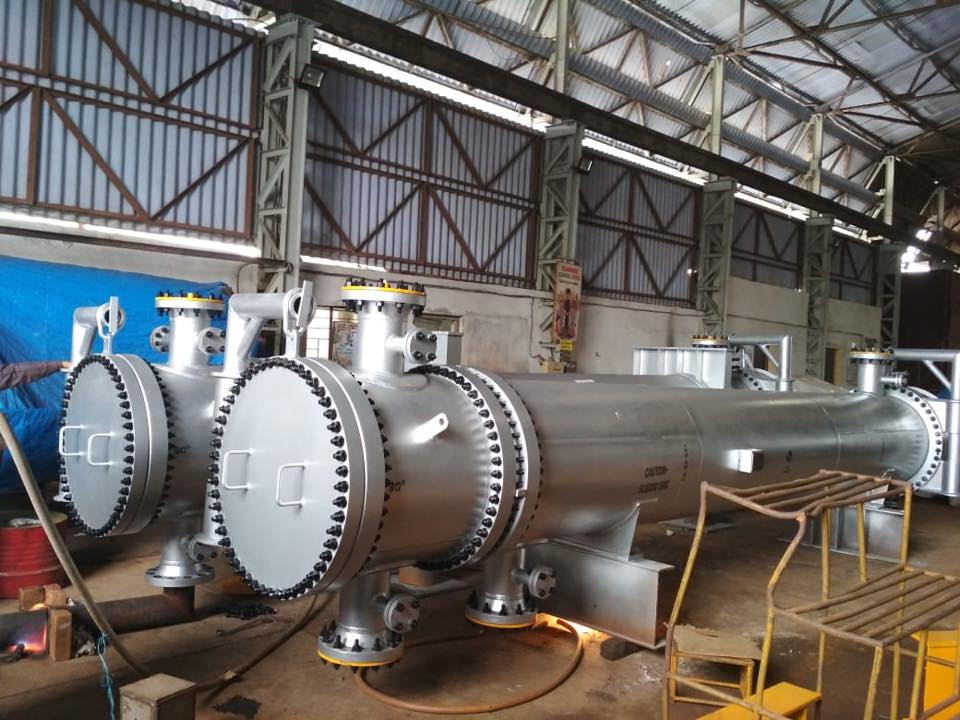
Why Shell & Tube Heat Exchangers?
- High pressure & temperature tolerance (ideal for steam, oil, and gas).
- Easy maintenance & cleaning (accessible tube bundles).
- Customizable designs (fixed, floating, U-tube types).
Shell and Tube Heat Exchanger vs. Plate Heat Exchanger: Key Differences
Choosing between a shell and tube (STHE) and a plate heat exchanger (PHE) depends on application requirements, operating conditions, and cost. Below is a detailed comparison:
1. Design & Construction
| Feature | Shell and Tube (STHE) | Plate Heat Exchanger (PHE) |
| Structure | Cylindrical shell with tubes | Stacked corrugated plates with gaskets/welds |
| Surface Area | Lower compactness (larger footprint) | High compactness (more surface area in small space) |
| Materials | Metals (CS, SS, Ti, Cu-Ni) | SS 316, titanium, graphite, polymer-coated |
| Maintenance | Removable bundle (some designs) | Easy to clean (gasketed), but welded types are harder |
STHE: Better for high-pressure/temperature applications.
PHE: More compact & efficient for low-viscosity fluids.