

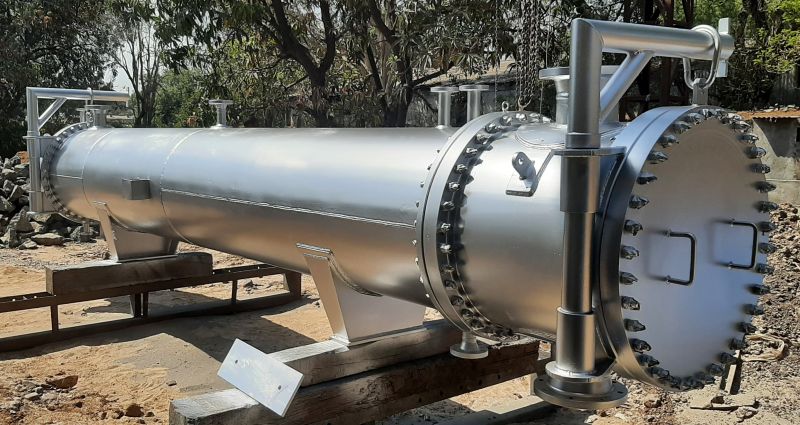
Use of Shell and Tube Heat Exchanger Water Treatment & Desalination
- Multi-stage flash (MSF) desalination.
Effluent cooling/heating.
Shell and Tube Heat Exchangers are among the most widely used heat exchangers in industries due to their robust design, versatility, and efficiency. Here are their key advantages:
1. High Pressure & Temperature Resistance
- Can handle high-pressure (up to 3000 psi) and high-temperature (up to 600°C) applications.
- Ideal for steam generation, power plants, and oil refineries.
2. Suitable for a Wide Range of Fluids
- Works with liquids, gases, and two-phase fluids (e.g., steam condensation).
- Compatible with corrosive, viscous, and fouling fluids (with proper material selection).
3. Robust & Durable Construction
- Carbon steel, stainless steel, titanium, and nickel alloys can be used based on fluid properties.
- Long service life with proper maintenance.
4. Easy to Clean & Maintain
- Removable tube bundles allow mechanical cleaning (brushing, hydro blasting).
- Fixed tube sheets simplify maintenance in less fouling applications.
5. High Heat Transfer Efficiency
- Baffles improve turbulence, enhancing heat transfer.
- Large surface area due to multiple tubes increases efficiency.