

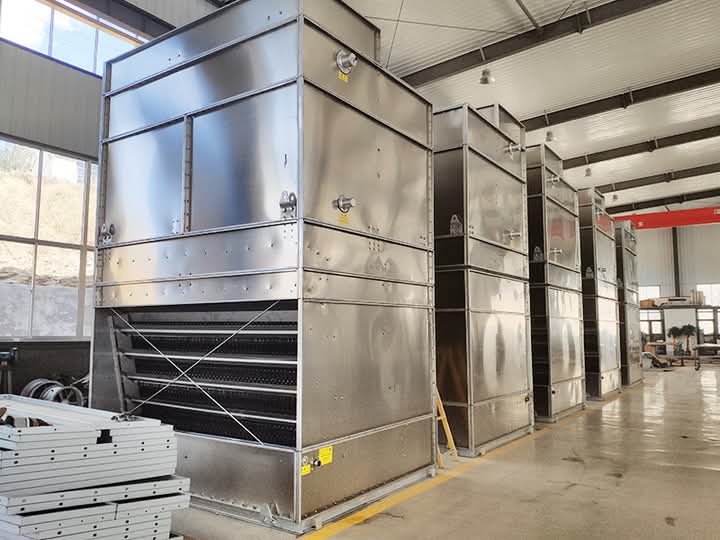
Closed-Circuit Cooling Tower vs. Open-Circuit Cooling Tower
Cooling towers are essential for rejecting heat in industrial and HVAC systems. The key difference between closed-circuit and open-circuit cooling towers lies in how they handle the process fluid (water or coolant).
1. Closed-Circuit Cooling Tower
- Design: Uses a heat exchanger to separate the process fluid from the cooling water.
- Operation:
- Process fluid circulates in a closed loop (never exposed to the atmosphere).
- Cooling water is sprayed over the heat exchanger coils, evaporating to remove heat.
- Advantages:
- Prevents contamination of process fluid (no exposure to air, dirt, or debris).
- Reduced scaling and fouling (since the primary loop remains clean).
- Lower water treatment costs (only makeup water for evaporation is needed).
- Disadvantages:
- Higher initial cost (due to heat exchanger coils).
- Slightly lower efficiency (indirect heat transfer).
- Applications:
- Chilled water systems, industrial processes with sensitive fluids (e.g., chemicals, medical).
2. Open-Circuit Cooling Tower
- Design: Directly exposes process water to the air.
- Operation:
- Hot process water is sprayed over fill media.
- Air passes through, evaporating some water and cooling the rest.
- Advantages:
- Lower initial cost (simpler design).
- Higher thermal efficiency (direct evaporative cooling).
- Disadvantages:
- Water contamination risk (exposure to air, dust, and microbes).
- Higher water treatment costs (chemicals needed to prevent scaling, algae, and corrosion).
- More water consumption (due to drift and blowdown losses).
- Applications:
- Power plants, HVAC systems (where water quality is less critical).
Key Differences Summary
| Feature | Closed-Circuit Cooling Tower | Open-Circuit Cooling Tower |
| Process Fluid Exposure | No (closed loop) | Yes (direct contact with air) |
| Water Contamination Risk | Low | High |
| Maintenance | Lower (clean loop) | Higher (scaling, fouling) |
| Efficiency | Slightly lower (indirect cooling) | Higher (direct cooling) |
| Cost | Higher initial cost | Lower initial cost |
| Water Usage | Less (only evaporative loss) | More (drift + blowdown) |
Which One to Choose?
- Closed-Circuit: Preferred for sensitive processes, high water quality requirements, and long-term savings on maintenance.
Open-Circuit: Suitable for cost-sensitive applications where water treatment is manageable