

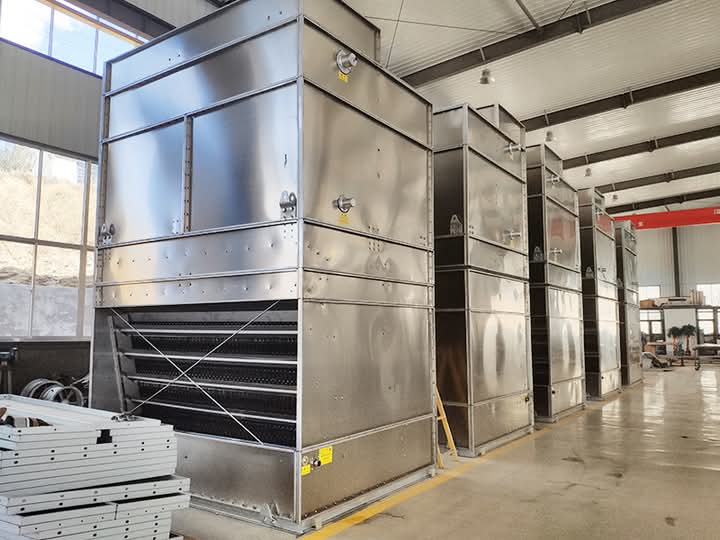
Proper water treatment is critical to prevent corrosion, scaling, biological growth, and fouling in closed-loop cooling systems. Since CCCTs recirculate the same water (unlike open towers), maintenance focuses on long-term stability rather than constant bleed-off.
1. Key Water Quality Parameters for CCCTs
| Parameter | Target Range | Purpose |
| pH Level | 8.0 – 10.0 (alkaline) | Prevents corrosion |
| Conductivity | < 5,000 µS/cm | Controls dissolved solids |
| Hardness (CaCO₃) | < 200 ppm | Prevents scaling |
| Chlorides | < 500 ppm (stainless steel: < 100 ppm) | Avoids pitting corrosion |
| Sulphates | < 500 ppm | Prevents sulphate attack |
| Dissolved Oxygen | < 50 ppb (with scavengers) | Reduces oxidation |
| Microbial Count | < 10,000 CFU/mL | Prevents biofouling |
2. Water Treatment Chemicals for CCCTs
A. Corrosion Inhibitors
- Molybdate-based (for steel/copper, non-toxic)
- Nitrite-based (for iron/steel, requires pH > 9)
- Silicate-based (for aluminum systems)
- Azoles (for copper protection)
B. Scale Inhibitors
- Phosphonates (e.g., HEDP, ATMP) – Prevents CaCO₃ & CaSO₄ scaling
- Polyacrylates – Disperses suspended particles
- Polyphosphates – Used in low-hardness water
C. Biocides (Microbial Control)
- Oxidizing Biocides (e.g., chlorine, bromine, hydrogen peroxide) – Kills bacteria & algae
- Non-Oxidizing Biocides (e.g., isothiazolin, DBNPA) – For biofilm control
- Biofilm Dispersants (e.g., quaternary ammonium compounds)
D. Oxygen Scavengers
- Sodium sulfite (common, but increases TDS)
- Hydrazine (high-efficiency, but toxic – used in power plants)
- Carbohydrazide (safer alternative to hydrazine)
3. Water Maintenance Procedures
A. Initial System Fill & Flushing
- Pre-cleaning: Flush with alkaline detergent to remove mill scale & grease.
- Passivation: Apply nitrite or molybdate to form protective oxide layer.
- Inhibitor Charge: Add corrosion inhibitors at start-up.
B. Routine Monitoring & Treatment
Weekly Checks:
- pH & conductivity (adjust with inhibitors if needed).
- Visual inspection for leaks or discoloration.
Monthly Tests:
- Corrosion coupons (measures metal loss).
- Microbial testing (ATP swabs or dip slides).
Quarterly Maintenance:
- Dosing booster (replenish inhibitors/biocides).
- Filter cleaning/replacement (if installed).
C. Annual/Shutdown Maintenance
Full System Flush (remove sludge/debris).
Coil Cleaning (high-pressure water or mild acid wash).
Inhibitor Recharge (replace depleted chemicals).
4. Common Water-Related Issues & Solutions
| Problem | Cause | Solution |
| Corrosion (rust) | Low pH, high oxygen | Increase pH, add oxygen scavenger |
| Scale Build-up | High hardness, high TDS | Add scale inhibitor, soften makeup water |
| Biofouling | Bacteria/algae growth | Shock-dose biocide, clean system |
| Foaming | High organics, surfactants | Defoamers, filtration |
| Copper Plating | Galvanic corrosion | Azole-based inhibitors |
5. Makeup Water Requirements
- Softened water (if hardness > 200 ppm).
- Deionized (DI) or RO water (for ultra-high-purity systems).
- Chloride & sulfate control (critical for stainless steel systems).
6. Best Practices for CCCT Water Maintenance
Automated Monitoring (real-time sensors for pH, conductivity, corrosion rate).
Closed-Loop Testing (quarterly lab analysis for metals & microbes).
Proper Chemical Dosing (avoid over/under-treatment).
Leak Prevention (seal all connections to avoid oxygen ingress).