

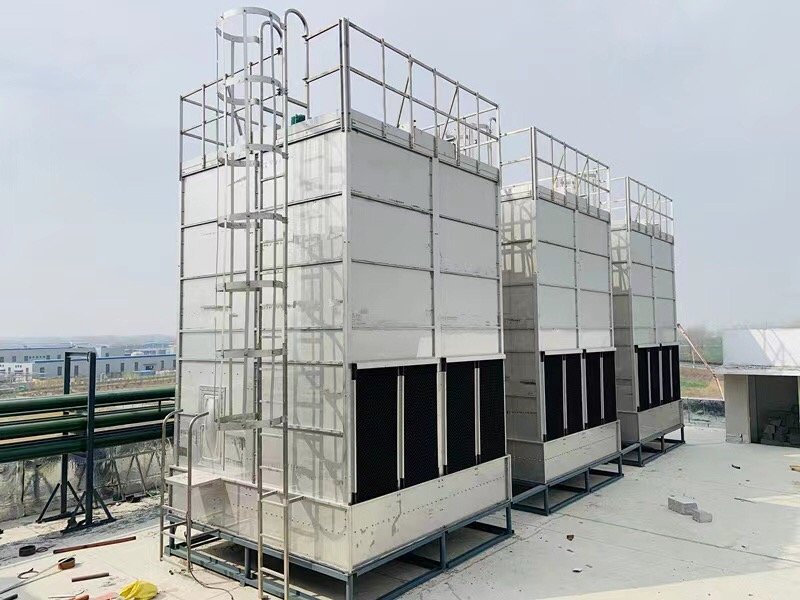
A Closed-Circuit Cooling Tower (also known as an Evaporative Fluid Cooler) is a specialized heat rejection device that cools a process fluid while keeping it completely isolated from the environment.
Unlike a standard “open” cooling tower where the water is exposed to the air, a closed-circuit system uses a heat exchange coil to keep the process fluid clean and contaminant-free.
How It Works: The Two-Circuit System
A closed-circuit tower operates using two separate fluid loops that work together to reject heat:
- Internal Circuit (The “Clean” Loop): The hot process fluid (e.g., water or a glycol mixture) circulates inside a sealed coil. It never comes into direct contact with the outside air or the spray water.
- External Circuit (The “Evaporative” Loop): A separate system sprays water over the outside of the coil. Simultaneously, a fan draws air over the wet coils.
The Cooling Process:
- Heat is transferred from the hot fluid inside the coil, through the coil walls, and into the spray water film outside.
- The fan-driven air causes a small portion of the spray water to evaporate, which removes the heat and releases it into the atmosphere.
- The remaining spray water falls into a basin and is pumped back up to be reused.
Key Components
- Heat Exchange Coil: Usually made of galvanized steel, copper, or stainless steel. This is the heart of the system where the internal fluid stays protected.
- Spray System: Includes a pump and nozzles that distribute water evenly over the coils.
- Fan System: Moves air through the unit to facilitate evaporation.
- Drift Eliminators: Specialized baffles that prevent water droplets from being carried out of the tower by the air stream.
Advantages of Closed-Circuit Cooling tower with Open Cooling Towers
| Feature | Closed Circuit Tower | Open Circuit Tower |
| Fluid Quality | Remains clean/uncontaminated | Exposed to dust, debris, and bacteria |
| Maintenance | Low (Internal loop stays clean) | High (Requires frequent cleaning/treatment) |
| Water Usage | Lower (Can run “dry” in winter) | Higher (Constant evaporation needed) |
| Initial Cost | Higher (Due to the heat exchange coil) | Lower |
| Space | Compact (Self-contained) | May require external heat exchangers |