

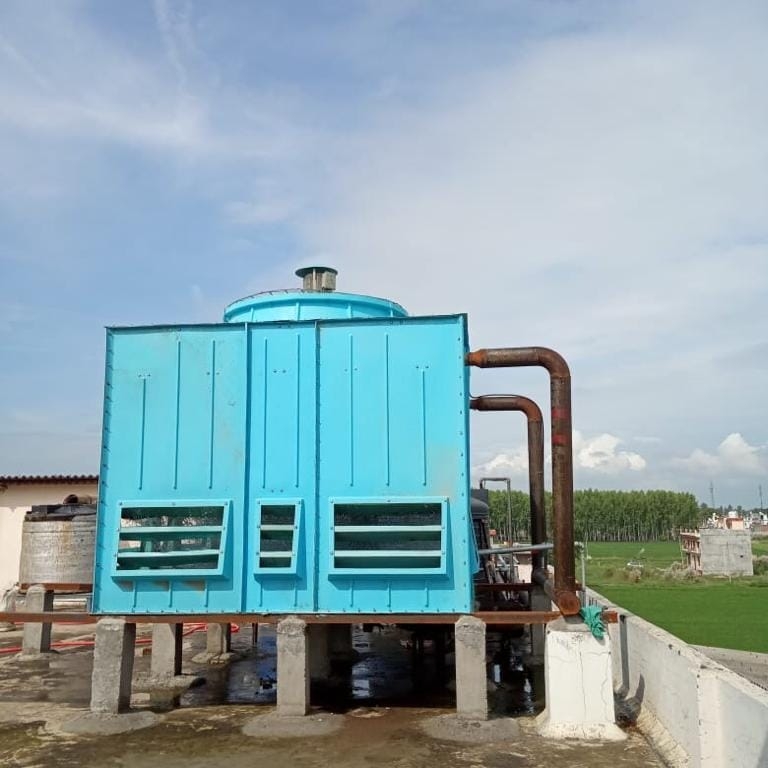
The core application of a cooling tower is simple: to reject massive amounts of waste heat into the atmosphere when you don’t have an infinite, cheap supply of cool water (like a river or ocean) available.
They are the “heat exhaust” system for heavy industry and large buildings. Here is the sector-by-sector breakdown of their applications:
1. Power Generation (The Largest User)
This is the #1 application for cooling towers. As we discussed earlier, thermal power plants (nuclear, coal, natural gas, and biomass) use massive condensers to turn exhaust steam back into water after it passes through the turbine.
- The Application: Cooling towers provide the billions of gallons of cool water required to run these condensers.
- Why not just use a river? Many plants are built inland, far from large bodies of water. A cooling tower allows a 1,000 MW power plant to recycle about 95% to 98% of its cooling water, reusing the same water over and over instead of drawing millions of gallons a day from a local source.
- The Nuclear Exception: Natural-draft hyperbolic towers (the giant hourglass shapes) are almost exclusively used for nuclear and very large coal plants because they can reject the immense waste heat without the parasitic power drain of running giant electric fans.
2. HVAC and Data Centers (Urban Cooling)
If you live in a city, look up at a large office building, hospital, or hotel—you will likely see a squat, boxy cooling tower on the roof.
- The Application: These towers reject the heat absorbed by the building’s indoor air conditioning system (chillers). The chillers cool water to circulate through the building, but they generate massive heat themselves. The cooling tower throws that captured heat (plus the compressor heat) into the outside air.
- Data Centers: This is the fastest-growing application. Server racks generate enormous heat. Cooling towers are critical for keeping thousands of servers cool 24/7, preventing crashes and downtime. They are often paired with “free cooling” systems that use the tower to directly cool the servers without running the chiller during cold winter months, saving massive amounts of electricity.
3. Oil, Gas, and Chemical Refining
In refineries and chemical plants, processes run at extremely high temperatures, and they also use a lot of steam.
- The Application: Cooling towers cool the process streams directly (via heat exchangers) and condense the overhead vapors from distillation columns.
- Critical Duty: They cool compressors and turbines, which generate immense friction heat. Without tower cooling, the lubricating oil in these massive machines would break down, leading to catastrophic mechanical failure.
- Safety: In chemical plants, cooling towers also serve as an emergency backup. If a reactor runs too hot and threatens to “run away” (over-pressurize and explode), cooling tower water is instantly diverted to quench and cool the reactor to stop the reaction.
4. Manufacturing and Industrial Production
Almost every heavy manufacturing process generates heat that must be removed:
- Plastic & Rubber Injection Molding: Molds must be cooled precisely so the plastic sets properly and the parts can be ejected without warping.
- Metal Heat-Treating & Forging: Huge furnaces and presses generate extreme heat; cooling towers cool the hydraulic fluids and quench tanks.
- Food & Beverage: As we discussed, cooling towers provide the chilled water used in plate heat exchangers to rapidly cool milk, beer, and juice after pasteurization.
- Paper & Pulp: The massive rollers that press paper generate friction heat; cooling towers keep them from warping.
5. Geothermal and Renewable Energy
- Geothermal Power: Steam from underground is often contaminated with corrosive gases. Cooling towers are used to condense this geothermal steam without running it through expensive, corrosion-prone heat exchangers. The cooling tower allows the contaminated water to be safely reinjected back into the earth.
- Bioenergy/Waste-to-Energy: Plants that burn municipal solid waste or biomass use cooling towers to handle the heat from incineration, just like a coal plant.
An Emerging Application: Water Conservation (“Dry Cooling”)
In extremely arid regions (like deserts), water is scarce. Engineers are increasingly applying Hybrid or Dry Cooling Towers (also called Air-Cooled Condensers).
- Instead of evaporating water, these act like giant car radiators; hot water runs through finned tubes, and massive fans blow air over them.
- The trade-off: They use zero water, but they are much less efficient (they can’t cool water below the air temperature) and cost significantly more to operate because the fans run constantly. They are primarily used in power plants in water-stressed areas like the Middle East or parts of the American Southwest.
The Hidden Application: Environmental Compliance
Finally, cooling towers are increasingly used for emissions abatement.
- In some chemical plants, the tower is used as a “scrubber.” The water sprayed in the tower absorbs harmful gases (like ammonia or sulfur dioxide) from the process before they can escape into the atmosphere. The contaminated water is then treated, rather than released, helping plants meet strict EPA environmental standards.