

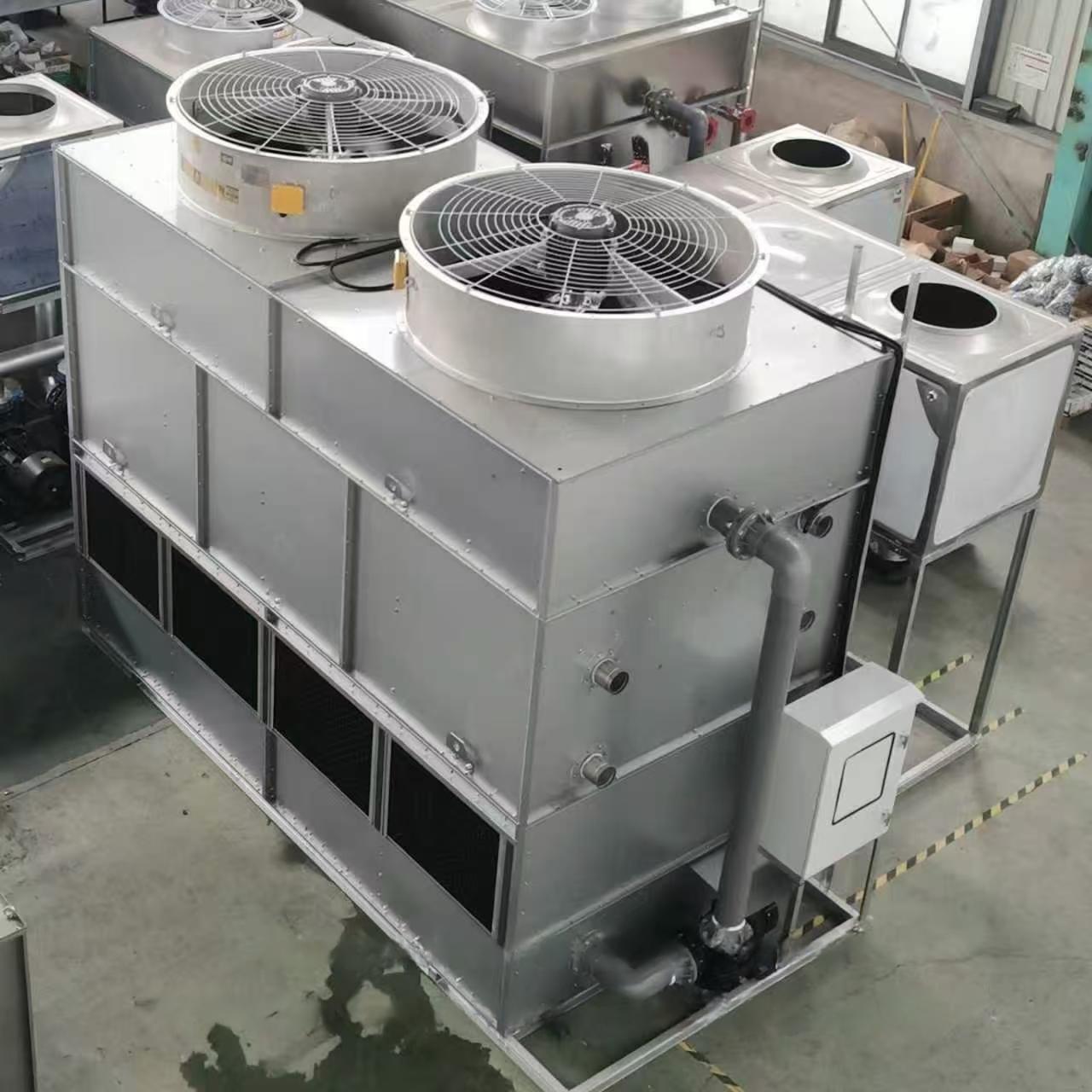
Parts of Closed-Circuit Cooling Tower
A closed-circuit cooling tower is essentially a system of integrated components working together to reject heat while keeping the process fluid isolated from the air . It can be broken down into several key parts, often grouped by their function.
Key Components and Their Functions
Here is a look at the core parts of a closed-circuit cooling tower, based on manufacturer and technical information.
| Component | Primary Function |
| 1. Cooling Coil / Heat Exchanger | The central component where the hot process fluid flows through a sealed tube bundle, transferring its heat to the outside environment . |
| 2. Recirculating Spray Water System | A secondary circuit that sprays water over the cooling coil to enhance heat transfer through evaporation . |
| 3. Air Movement System | Draws air through the tower to carry away the heat and evaporated moisture from the spray water . |
| 4. Drift Eliminators | Capture water droplets from the exiting air stream, minimizing water loss . |
| 5. Basin and Sump | Collects the recirculating spray water at the bottom of the tower for reuse . |
| 6. Structural Components and Casing | The physical framework and outer shell that houses and supports all the other components . |
| 7. Optional Auxiliary Parts | Enhance operational control and safety, such as basin heaters for freeze protection and manometers for monitoring . |
How These Parts Work Together
The process starts with hot process fluid entering the cooling coil at the top of the tower. Simultaneously, the spray water pump pulls water from the basin and sends it through the spray system where nozzles distribute the water evenly over the coil . This water absorbs heat from the coil through conduction.
As the spray water falls, the fan draws air through the tower . This airflow causes some of the spray water to evaporate, which removes a significant amount of heat. The cooled spray water then falls back into the basin to be recirculated . The now-heated, moisture-laden air passes through the drift eliminators before being exhausted from the tower, while the process fluid inside the coil is cooled and returned to the system .
A Key Configuration Note
Some designs may feature a plate heat exchanger as a dedicated room attached to the tower, rather than a single cooling coil . This can offer advantages like easier maintenance. Other advanced designs may also use multiple heat exchangers or a secondary “dry” cooling section for operation in cold climates .
Is there a particular part you’d like to explore in more detail, such as how the spray system works or the different types of heat exchangers used?