

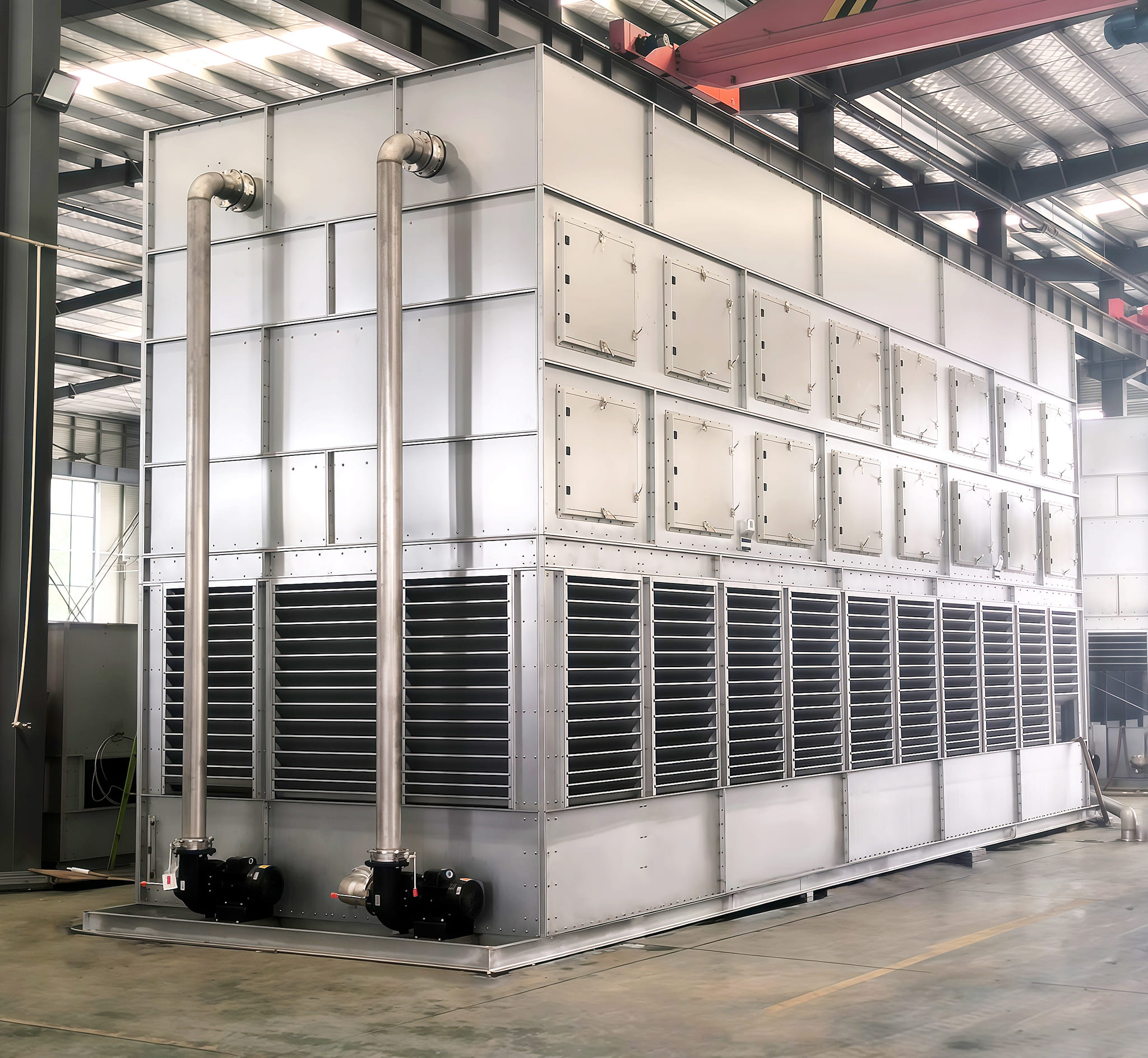
Closed Circuit cooling tower with open circuit cooling tower
When deciding between a closed-circuit and an open-circuit cooling tower, the choice comes down to balancing your priorities: upfront cost and cooling efficiency against long-term reliability, water usage, and maintenance.
Here is a direct comparison to help you understand the key differences.
| Feature | Open-Circuit Cooling Tower | Closed-Circuit Cooling Tower (Fluid Cooler) |
| How It Works | Directly exposes the process water to the air for cooling via evaporation . | Uses a heat exchanger coil to keep the process fluid in a sealed loop, isolated from the air. A separate spray water system cools the coil via evaporation . |
| Water Quality | The process water is exposed to the atmosphere, collecting dust, debris, and microbes. Prone to fouling and scaling . | The process fluid is protected from contamination. Greatly reduced risk of fouling and scaling . |
| Maintenance | High maintenance. Requires constant water treatment (chemicals, filtration) to control scale, corrosion, and biological growth (e.g., Legionella) . | Low maintenance. Maintenance is primarily focused on the external spray system, not the main process loop. Reduces system-wide maintenance and component wear . |
| Initial Cost | Lower initial equipment cost and a more compact footprint for the same capacity . | Higher initial cost (often cited as 3.7x that of an open tower) and a larger physical footprint . |
| Operating Cost & Efficiency | High evaporative efficiency but higher ongoing costs for water treatment and water consumption (due to blowdown and drift) . | Lower operating costs over time due to less water treatment, lower water usage, and reduced maintenance. Can be up to 50% more energy efficient in some applications . |
| Operational Flexibility | Requires freeze protection (basin heaters) in winter. Cannot easily run in a “dry” mode . | Offers more flexibility. Can often operate in a “dry” mode (without spray water) in cold weather, saving water . Also easier to install below grade without flooding risk . |
When to Choose Each Type
- Choose an Open-Circuit Tower if: Your top priorities are a lower initial budget and you have ample space. This type is best for applications where water purity is not critical, and you have a dedicated team to manage the required water treatment and maintenance program . It is common in large industrial plants and some HVAC applications where water quality is less critical .
Choose a Closed-Circuit Tower if: You need to protect sensitive, expensive equipment (like chillers or heat pumps) from fouling. It is also the clear winner if you want to minimize maintenance, reduce
- water consumption and treatment costs, and achieve long-term operational reliability, especially in critical applications like data centers, hospitals, or for systems using water-source heat pumps . While the upfront investment is higher, it typically pays for itself over time.
I hope this side-by-side comparison clarifies the key differences and helps you make a more informed decision. If you can share more about your specific application or constraints, I may be able to offer more targeted guidance.