

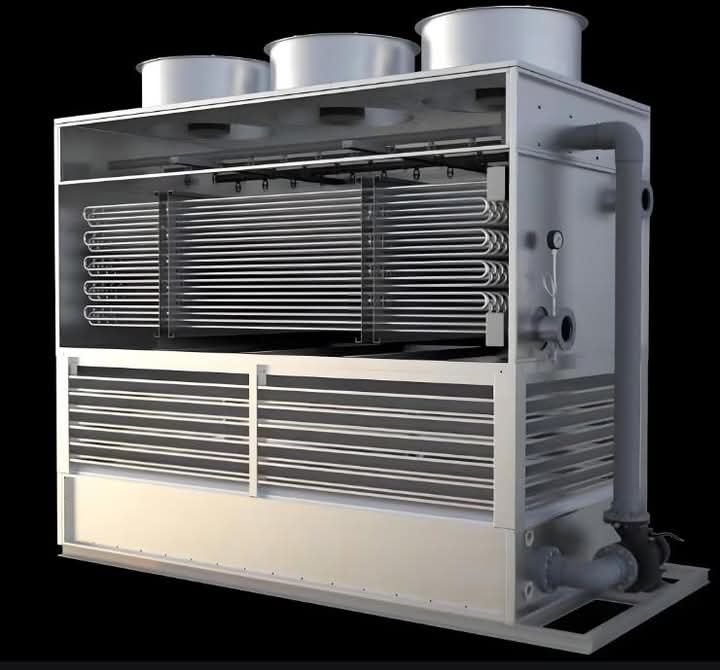
Placing the heat exchanger coil inside a cooling tower (as seen in Closed Circuit Cooling Towers) offers several advantages over traditional open cooling towers or remote heat exchangers. Here are the key benefits:
1. Space & Layout Efficiency
- Compact design: The coil (heat exchanger) is integrated into the tower, eliminating the need for a separate heat exchanger unit.
- Reduced piping: No external connections for cooling water, lowering installation costs and complexity.
2. Improved Energy Efficiency
- Direct cooling: The process fluid is cooled directly by evaporative heat transfer, improving thermal efficiency.
- Lower pump power: Since the cooling water loop is eliminated, energy consumption is reduced.
3. Reduced Water Consumption
- Closed-loop operation: The process fluid (e.g., chilled water, glycol mix) stays inside the coil, preventing evaporation loss.
- Minimal blowdown needed: Unlike open towers, there’s no need for frequent water drainage to control scaling.
4. Prevention of Contamination
- No exposure to outside air: The process fluid remains sealed, avoiding contamination from dirt, debris, or biological growth (e.g., Legionella).
- Ideal for sensitive applications: Used in pharmaceuticals, food processing, and HVAC systems where clean cooling is critical.
5. Lower Maintenance & Longer Lifespan
- Less scaling & corrosion: Since the process fluid is isolated, mineral deposits and corrosion are minimized.
- Reduced fouling risk: No algae or sludge build-up inside the coil compared to open systems.
6. Freeze Protection in Cold Climates
- Glycol compatibility: The closed loop can use antifreeze solutions (e.g., propylene glycol) without affecting the cooling tower’s operation.
- Dry operation possible: Some models allow dry cooling in winter, avoiding water use entirely.
7. Noise & Aesthetic Benefits
- Fewer mechanical components: No external pumps or heat exchangers mean quieter operation.
- Cleaner installation: No risk of water spillage or algae growth on external surfaces.
Common Applications:
- HVAC systems (chillers, heat pumps)
- Industrial processes (chemical plants, power generation)
Data centres (efficient, reliable cooling)
Medical & food industries (contamination-free cooling)
Comparison with Remote Heat Exchangers
| Feature | Coil Inside Tower | Remote Heat Exchanger |
| Space Needed | Compact | Requires extra space |
| Water Use | Lower (closed loop) | Higher (open loop) |
| Maintenance | Less (no scaling in process side) | More (fouling risk) |
| Energy Efficiency | Higher (direct cooling) | Lower (pump losses) |