

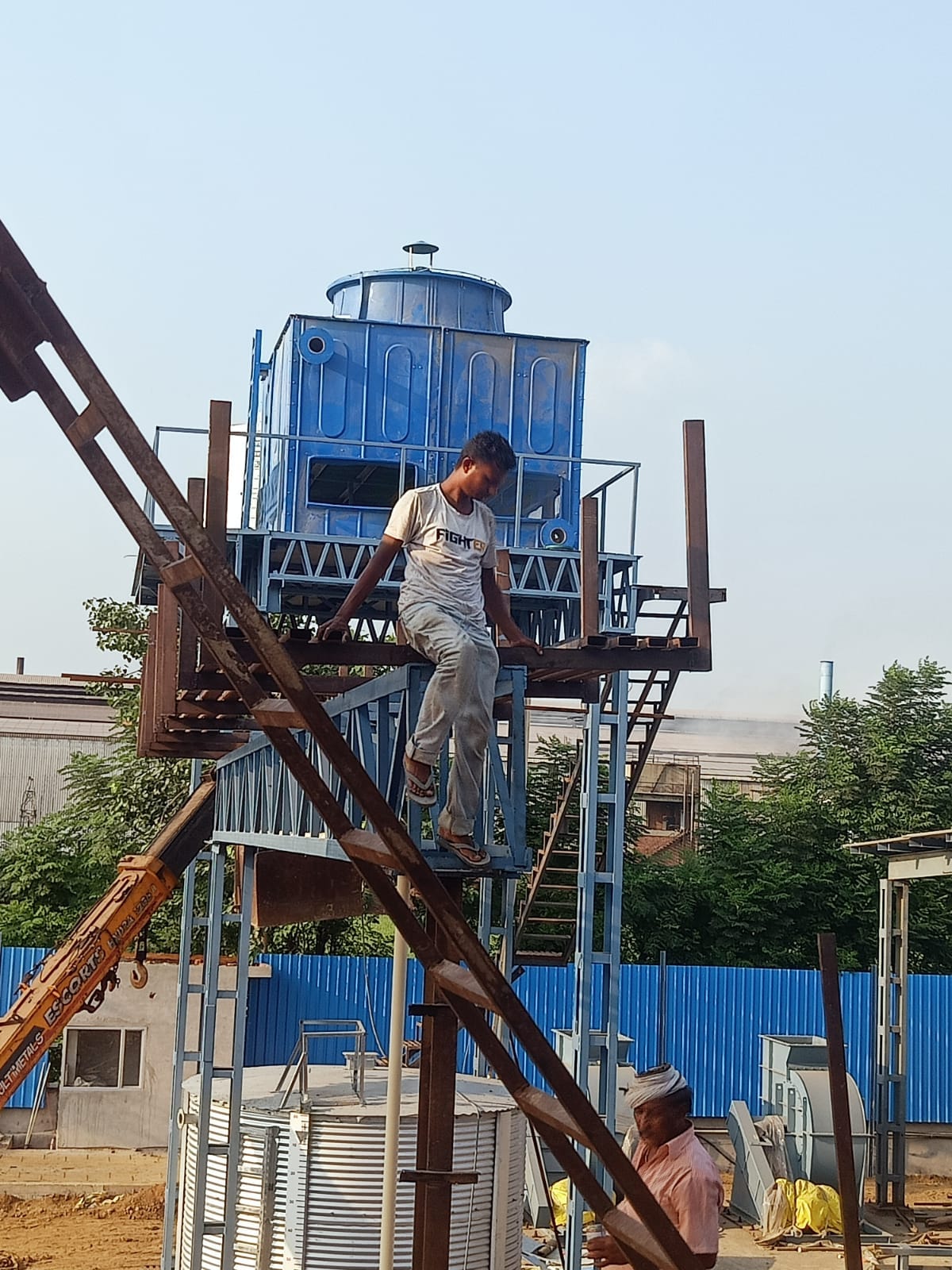
A Direct-Contact or Open Evaporative Cooling Tower is a heat rejection device where the process water to be cooled is in direct physical contact with the atmospheric air, and cooling is achieved primarily through evaporation.
The name breaks down into two key parts:
1. “Direct-Contact” or “Open”
This refers to the fact that the water circuit is open to the atmosphere
- Open System: The hot water from the process (e.g., chiller condenser) is pumped to the top of the tower and openly sprayed or distributed over the fill. It is directly exposed to the ambient air.
- No Barrier: There is no tube wall or heat exchanger surface separating the water from the air (unlike a “closed-circuit” cooling tower).
2. “Evaporative Cooling”
This describes the primary heat transfer mechanism.
- A small portion of the circulating water (typically 1-2%) evaporates, absorbing the latent heat of vaporization (~1000 BTU/lb) from the remaining water.
- This phase change is the driving force for the majority (70-80%) of the cooling effect. The rest is achieved by sensible heat transfer (direct cooling of water by the air).
How It Works (The Direct-Contact Process)
- Hot Water Entry: Process water (e.g., from an industrial heat exchanger or a chiller’s condenser) enters the tower at the top.
- Distribution & Exposure: It is spread over the fill media, creating a vast surface area of thin films or droplets.
- Air Contact: Ambient air is drawn or forced through this falling water curtain. The air and water are in direct contact.
- Heat & Mass Transfer:
- Evaporation: The most energetic water molecules escape into the air stream as vapor, taking heat with them.
- Sensible Transfer: The cooler air also directly absorbs heat from the water.
- Cooled Water Collection: The now-cooled water falls into the cold water basin at the bottom and is pumped back to the process.
- Humid Air Exhaust: The warmed, moisture-laden air is exhausted to the atmosphere, often visible as a plume under the right conditions.
Key Advantages
- High Efficiency: Evaporation is a very effective cooling mechanism, allowing water to be cooled to temperatures approaching the ambient wet-bulb temperature.
- Lower Capital Cost: Generally simpler and less expensive to construct than closed-circuit or dry systems of similar capacity.
Compact Footprint: For a given cooling duty, an open tower is often smaller than an air-cooled (dry) condenser.