

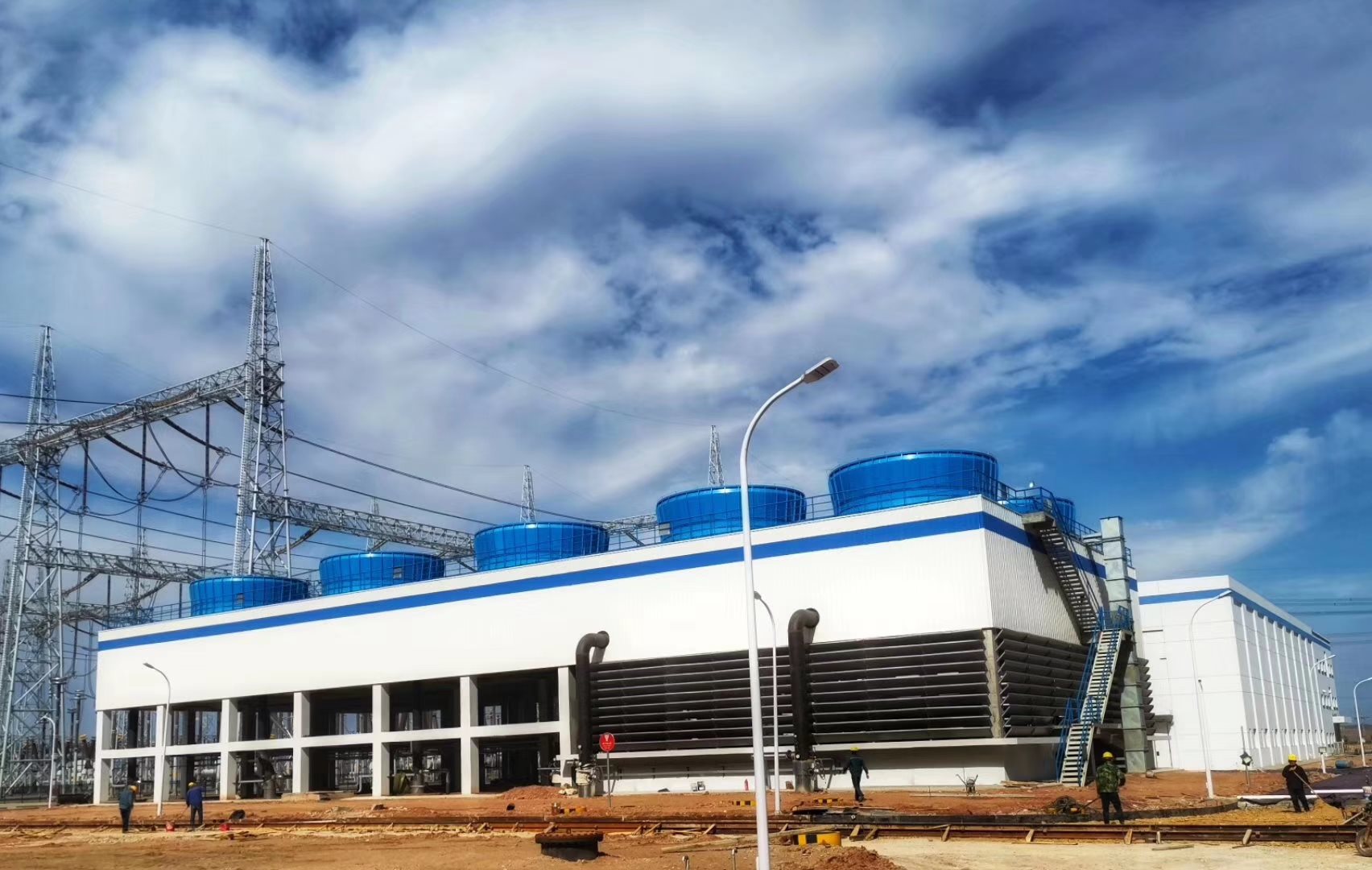
Cooling towers are classified in several ways based on their design, airflow method, construction, and heat transfer principles. Here’s a comprehensive breakdown of the main types:
1. By AIR FLOW GENERATION Method
This is the most common classification.
A. Natural Draft Cooling Towers
- Principle: Use a tall hyperbolic chimney to create airflow via buoyancy (hot, moist air rises naturally).
- No fans are used.
- Types:
- Hyperbolic Natural Draft: Iconic “hourglass” concrete towers used in large power plants.
- Spray-Filled Natural Draft: Older design with internal spray nozzles, less common today.
- Pros: Extremely reliable (no moving parts), low operating cost, handles massive heat loads.
- Cons: Very high capital cost, huge footprint, sensitive to crosswinds, inefficient at low loads.
- Applications: Large thermal/nuclear power plants (500+ MW).
B. Mechanical Draft Cooling Towers
Use fans to force or draw air through the tower. Most common in industrial/commercial settings.
- i. Forced Draft
- Design: Fan located at the air intake (bottom/side) pushes air into the tower.
- Structure: Fan on inlet side, water distribution at top, fill in middle.
- Pros: Easier fan maintenance (accessible), handles high static pressure.
- Cons: Recirculation risk, higher fan power consumption, prone to ice formation in cold climates.
- Applications: Smaller industrial systems, some packaged units.
- ii. Induced Draft
- Design: Fan located at the top (discharge) pulls air through the tower.
- Structure: Fan on top, water distribution above fill, air inlet at bottom.
- Pros: Better air distribution, lower recirculation, more efficient, dominant design.
- Cons: Fan and motor exposed to hot, humid exhaust (corrosion risk), maintenance less accessible.
- Sub-types:
- Counter flow Induced Draft: Air flows upward, opposite to falling water. More efficient, smaller footprint.
- Cross flow Induced Draft: Air flows horizontally, perpendicular to falling water. Lower pressure drop, easier cold-water basin access.
2. By HEAT TRANSFER METHOD (Water-to-Air Contact)
A. Wet (Evaporative) Cooling Towers
- Principle: Hot water contacts air directly, cooling primarily by evaporation.
- Water is exposed to the airstream.
- Pros: Highest efficiency, lowest approach temperatures.
- Cons: Water loss (evaporation, drift, blowdown), visible plume, Legionella risk.
- Most common type (over 90% of installations).
B. Dry Cooling Towers
- Principle: Hot water flows through finned tubes; air passes over tubes, cooling by sensible heat transfer only (no evaporation).
- Closed-circuit: Process fluid does not contact air.
- Pros: Zero water loss, no plume, minimal chemical treatment, no freeze risk.
- Cons: Much larger size/cost, higher energy consumption (fans), limited by dry-bulb temperature (less efficient in hot weather).
- Applications: Water-scarce regions, power plants where water is restricted.
C. Hybrid (Wet-Dry) Cooling Towers
- Principle: Combine dry and wet sections. Operate in dry mode during cool weather and switch to wet mode during peak heat loads.
- Design: Dry coil section in series or parallel with a wet evaporative section.
- Pros: Balances water conservation with efficiency, reduces visible plume.
- Cons: Complex, higher capital and maintenance cost.
- Applications: Power plants with water use limits, urban areas concerned with plumes.
3. By CONSTRUCTION & ASSEMBLY
A. Factory-Assembled (Package) Towers
- Built entirely at the factory, shipped as one or few modules.
- Typically smaller capacities (< 500 tons of cooling).
- Materials: Galvanized steel, stainless steel, or fiberglass (FRP).
- Pros: Lower cost, quick installation, quality control.
- Cons: Limited to smaller sizes.
- Applications: Commercial HVAC, small industrial plants.
B. Field-Erected Towers
- Components fabricated in factory but assembled on-site.
- For large capacities (> 500 tons, up to 10,000+ tons).
- Materials: Concrete, wood, FRP, or structural steel.
- Pros: Customizable, unlimited size, longer lifespan.
- Cons: Higher cost, longer installation time, complex engineering.
- Applications: Power plants, refineries, large district cooling systems.
4. By AIR-WATER FLOW DIRECTION (within Mechanical Draft Towers)
| Type | Airflow vs. Water Flow | Characteristics |
| Counter flow | Air flows upward, opposite to falling water. | – Higher thermal efficiency – Smaller footprint – Higher pumping head (pressure) – More prone to fouling |
| Cross flow | Air flows horizontally, water falls vertically. | – Lower air-side pressure drop – Gravity water distribution (low pressure) – Larger footprint – Easier maintenance access |
5. Specialized & Closed-Circuit Systems
A. Closed-Circuit Cooling Towers (Fluid Coolers)
- Principle: Process fluid flows through a coil; water is sprayed over the coil and cooled by evaporation outside the coil.
- Key: Process fluid stays clean and contained (no exposure to atmosphere).
- Pros: Protects expensive process fluids, reduces scaling/fouling in main loop.
- Cons: Lower efficiency than open wet towers, higher cost.
- Applications: Cooling of refrigerant, lubricants, engine jackets, sensitive instrumentation.
B. Spray (Atmospheric) Cooling Towers
- No fans; rely on natural wind and spray nozzles to create droplets.
- Very low efficiency, large area.
- Rarely used today except in some small agricultural/industrial applications.