

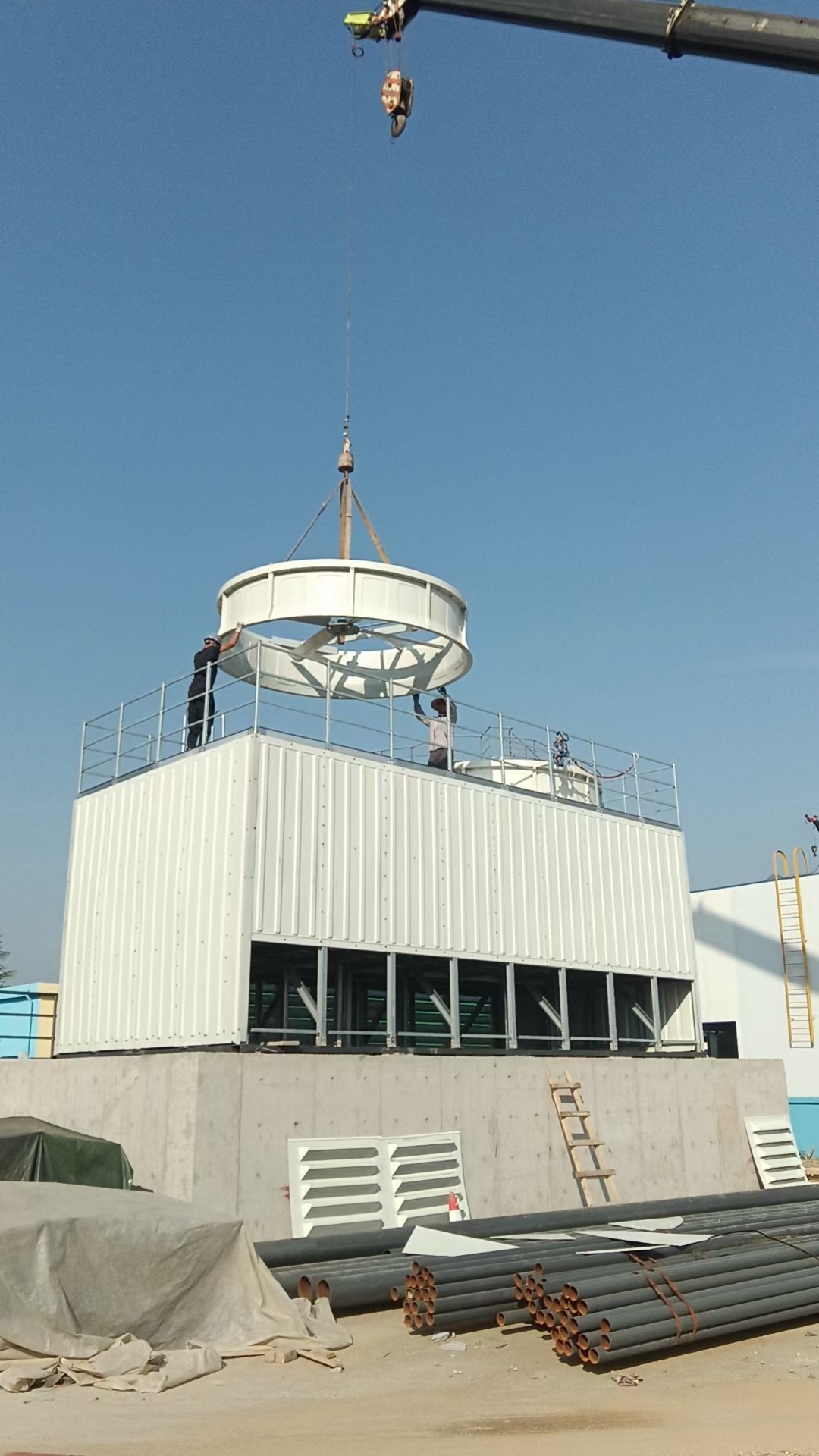
A Counter flow Cooling Tower is a type of mechanical draft, wet cooling tower where air flows vertically upward, directly opposite to the downward flow of hot water. This counter-current arrangement creates highly efficient heat and mass transfer.
Step-by-Step Working Principle
1. Hot Water Inlet & Pressurized Distribution
- Hot process water (typically 35–45°C / 95–113°F) enters at the tower’s mid-height.
- It’s pumped into a pressurized piping system with spray nozzles located above the fill.
- Key Difference from Cross flow: Distribution is pressurized, not gravity-fed. Nozzles atomize water into a fine spray to maximize surface area before it hits the fill.
2. Water Falls Through Fill Media
- The sprayed water falls vertically downward through the fill/packing material.
- Fill is designed to create maximum surface area with minimal airflow resistance—typically vertical PVC sheets with corrugated patterns to create thin water films.
- Water temperature drops as it falls through the fill.
3. Airflow (Upward)
- Air enters through lower louvers at the tower’s base.
- One or more fans (typically at the top for induced draft) pull air upward through the fill.
- Critical Feature: Air moves directly upward, opposite to the falling water → hence “Counter flow.”
4. Heat & Mass Transfer (Counter-Current)
- As air rises, it contacts the coldest water first (at the bottom of the fill).
- As air continues upward, it meets progressively hotter water.
- This counter-current arrangement allows:
- Maximum temperature difference throughout the fill height.
- More uniform heat transfer.
- The exiting air to reach near saturation with the hottest water at the top.
5. Cooled Water Collection
- Cooled water collects in the cold-water basin at the bottom.
- It’s then returned to the process or chiller.
6. Air Exhaust
- Warm, humid air exits through the fan(s) at the top.
- Drift eliminators are positioned above the fill to capture water droplets before they exit.