

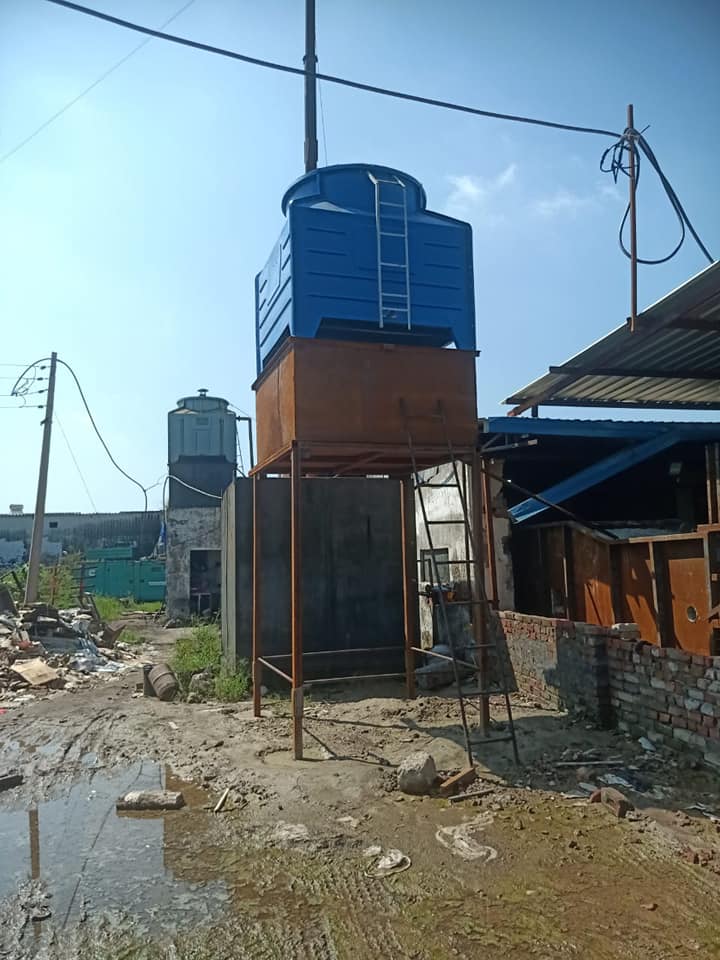
Factors Affecting Cooling Tower Performance
Cooling tower performance is influenced by a complex interplay of design parameters, operating conditions, and maintenance factors. They can be categorized as follows:
I. THERMODYNAMIC & ENVIRONMENTAL FACTORS
1. Ambient Wet-Bulb Temperature (WBT)
- Impact: The MOST CRITICAL external factor. WBT is the theoretical lower limit of cooling.
- Effect: Lower WBT = Better performance (smaller approach, easier to cool). Higher WBT = Reduced capacity, larger approach. Towers are rated at a specific design WBT (e.g., 78°F).
2. Ambient Dry-Bulb Temperature & Relative Humidity
- Impact: Together, they determine the WBT. High humidity reduces the air’s capacity to absorb moisture, lowering evaporative potential.
3. Heat Load (Range)
- Impact: Determined by the process, not the tower. A higher heat load (larger Range = T1 – T2) requires more from the tower. Exceeding design load reduces efficiency.
4. Approach Temperature
- Impact: A result of performance, but also a target. Maintaining a small, stable approach indicates optimal operation.
. OPERATIONAL & FLOW FACTORS
5. Water Flow Rate
- Impact: Must match design specification. Too high: Poor distribution, excessive pressure drop, reduced contact time. Too low: Incomplete wetting of fill, channeling, scaling.
6. Water Distribution
- Impact: Even distribution over the fill is paramount. Clogged nozzles, misaligned spray arms, or uneven pan levels cause dry spots and air channeling, drastically cutting efficiency.
7. Airflow Rate
- Impact: Governed by fan speed/pitch. Insufficient airflow reduces evaporation and heat transfer. Excessive airflow can cause carryover (droplet loss), increases fan power, and may not improve cooling linearly.
8. Air/Water Flow Ratio (L/G Ratio)
- Impact: The mass flow ratio of Liquid to Gas. Each tower has an optimal L/G ratio for its fill design. Deviations reduce thermal performance.
III. WATER QUALITY & TREATMENT FACTORS
9. Cycles of Concentration (COC)
- Impact: Running at optimal high COC saves water/chemicals, but excessive COC leads to scaling, corrosion, and fouling, which degrade fill and heat transfer.
10. Scaling
- Impact: Mineral deposits (calcium carbonate, silica) on fill surfaces act as an insulating layer, reducing heat transfer and clogging water passages.
11. Fouling
- Impact: Dirt, silt, algae, and biological slime coat the fill. This inhibits water spreading into thin films/droplets and increases pressure drop.
12. Corrosion
- Impact: Damages fill material, distribution system, and structure. Corrosion products (rust) can become foulants. Changes in surface wettability affect heat transfer.
13. pH & Chemical Balance
- Impact: Improper pH accelerates scaling (high pH) or corrosion (low pH). Ineffective biocide treatment allows bio fouling.
IV. MECHANICAL & MAINTENANCE FACTORS
14. Fill Media Condition
- Impact: Clogged, collapsed, or damaged fill is the single biggest internal cause of performance loss. It reduces surface area, increases air resistance, and disrupts flow patterns.
15. Fan Performance
- Impact: Worn blades, loose belts, improper pitch, or motor issues reduce designed airflow. Fan vibration also indicates problems.
16. Drift Eliminator Condition
- Impact: Clogged or damaged eliminators increase air pressure drop, reducing airflow. They also fail to contain water loss.
17. Cold Water Basin Condition
- Impact: Excessive sediment (mud, silt) reduces effective volume and can be pumped into the system, fouling nozzles and fill. Low water level causes pump cavitation.
V. DESIGN & INSTALLATION FACTORS
18. Tower Sizing & Selection
- Impact: An undersized tower will never meet approach under design conditions. An oversized tower may operate inefficiently at part load.
19. Air Inlet & Discharge Conditions
- Impact:
Recirculation: Hot, moist exhaust air is drawn back into the inlets, raising the entering
- WBT and killing performance.
- Interference: Nearby walls, roofs, or other towers disrupt airflow patterns.
- Obstruction: Debris on louvers or inlet screens reduces airflow.
20. Pump & Piping Configuration
- Impact: Undersized piping, excessive elbows, or faulty valves can restrict water flow. Pump wear reduces flow and pressure.