

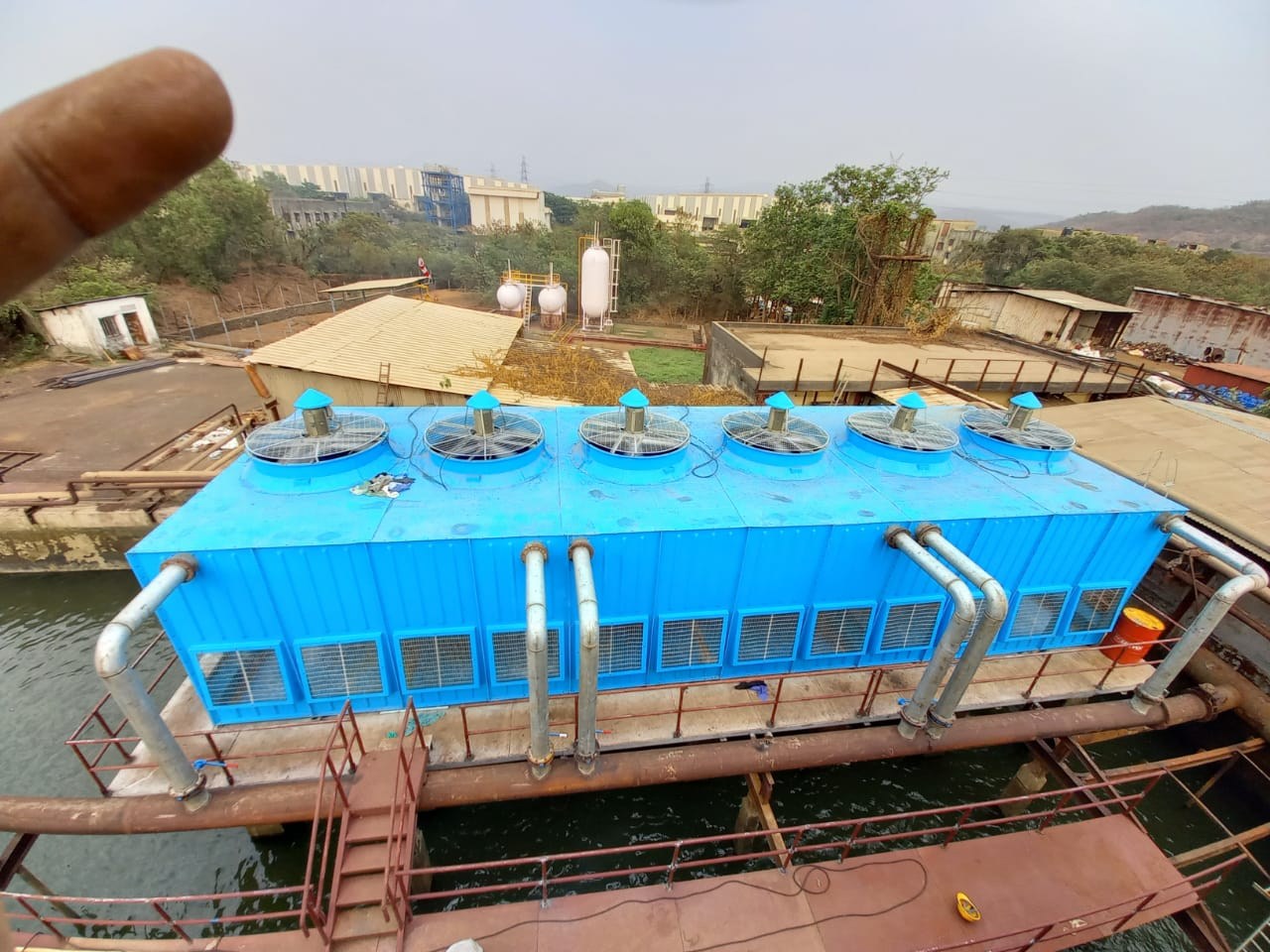
cooling tower for Steel Mills
In a steel mill, the cooling tower is not a peripheral component but a core utility system essential for safety, efficiency, and continuity of production. Its role is to manage the massive waste heat generated and enable water reuse on a gigantic scale.
Here’s a detailed breakdown of its role in a steel mill, moving from core function to specific applications.
Core Function: The Heart of the Cooling Water Circuit
A steel mill operates like a massive engine that produces intense heat. The cooling tower acts as the radiator for the entire plant. It cools the heated water from various processes so it can be pumped back and reused in a closed-loop system. This accomplishes two critical goals:
- Heat Rejection: Rejects waste heat to the atmosphere via evaporation.
- Water Conservation: Recirculates 95-98% of water, reducing freshwater intake from rivers or aquifers by millions of gallons per day.
Key Applications in the Steelmaking Process Flow
The cooling tower serves virtually every major department:
1. Ironmaking (Blast Furnace)
- Cooling Staves: Large water-cooled panels forming the furnace walls to protect the refractory lining from molten iron (1500°C+).
- Tuyeres: Water-cooled nozzles that inject hot blast air and pulverized coal into the furnace.
- Gas Cleaning Plant: Cools and cleans the hot blast furnace gas (top gas) for reuse as fuel.
2. Steelmaking (Basic Oxygen Furnace – BOF or Electric Arc Furnace – EAF)
- Furnace Shell & Vessel Cooling: Critical for protecting the structural integrity of the furnace.
- Fume Hood & Duct Cooling: The off-gas from the BOF or EAF is extremely hot and must be cooled before it can be cleaned by baghouses or electrostatic precipitators.
- Electrode Cooling (EAF): Cools the massive graphite electrodes.
3. Casting (Continuous Caster – This is a MAJOR user)
- Mold Cooling: The primary cooling zone where water circulates through the copper mold to form a solid shell around the molten steel. Temperature control is critical for quality and safety.
- Secondary Spray Cooling: A series of water sprays further solidify the steel strand. Precise cooling affects the internal metallurgical structure of the steel.
4. Rolling Mills (Hot Strip Mill, Plate Mill, etc.)
- Run-Out Table (ROT) Cooling: High-pressure water jets control the cooling rate of the steel plate or coil after rolling, which directly determines its mechanical properties (Thermo-Mechanical Controlled Processing – TMCP).
- Work Roll & Backup Roll Cooling: Cools the rolls to prevent thermal fatigue and maintain dimensional accuracy.
- Descaler Systems: High-pressure water used to remove scale (iron oxide) from the surface.
5. Captive Power Plant & Auxiliaries
- Steam Turbine Condenser Cooling: Most integrated mills have their own power plant. The cooling tower provides cold water to condense steam back into water in the turbine cycle, which is essential for power generation efficiency.
- HVAC & Compressor Cooling: Provides cooling for plant air compressors, hydraulic systems, and ventilation.