

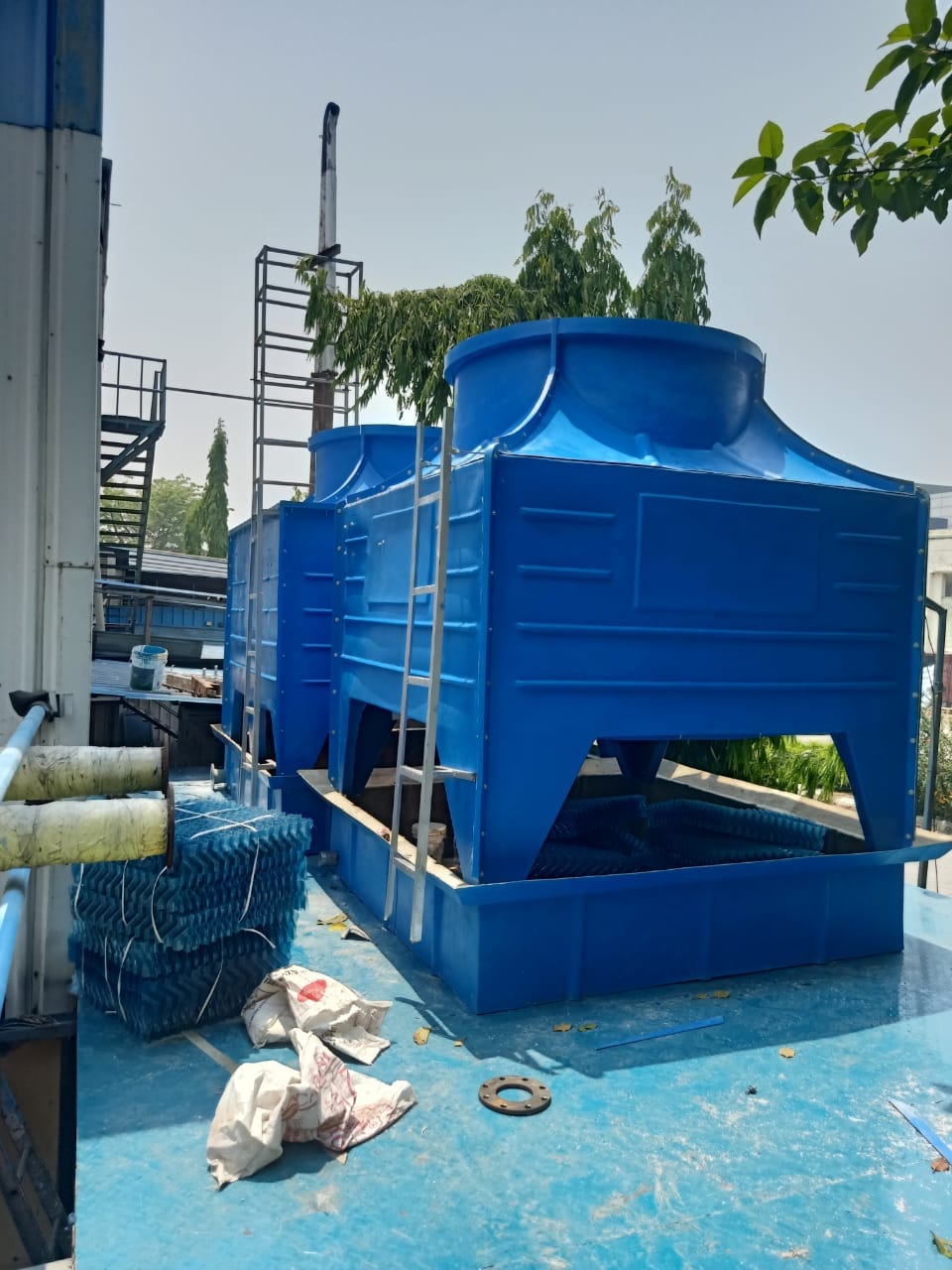
To calculate the Blow-down Loss, we need one more critical piece of information: the Evaporation Loss (E). The Blow down is directly derived from the evaporation rate and the Cycles of Concentration.
The fundamental formula relating Blow down (B), evaporation (E), and COC is:
B=ECOC−1B=COC−1E
Where:
- B = Blow down Loss (in the same flow units as E, typically GPM or m³/hr)
- E = Evaporation Loss
- COC = Cycles of Concentration
Step-by-Step Calculation with Example
Since you haven’t provided the evaporation rate, I’ll show you the calculation assuming two common scenarios.
Given: COC = 3.0
Formula Applied:
B=E3.0−1=E2B=3.0−1E=2E
This means the Blow down loss is exactly HALF of the evaporation loss at 3 cycles.
Example 1: For a Typical HVAC Tower
- Assume: Evaporation Loss (E) = 100 GPM
- Calculation:
B=1002=50 GPMB=2100=50GPM - Result: Blow down Loss = 50 GPM
Example 2: Using the “Rule of Thumb” Evaporation Estimate
Evaporation is often estimated as ~1% of circulating flow for each 10°F ΔT (Range).
- Assume: Circulating Flow Rate = 5,000 GPM, Range = 10°F
- Evaporation (E) ≈ 5,000 GPM × 0.01 = 50 GPM
- Blow down (B) = 50 / 2 = 25 GPM
The Complete Water Balance Picture
With COC = 3.0, the total water losses are distributed as:
- Evaporation Loss (E): ~66.7% of (E + B)
- Blow down Loss (B): ~33.3% of (E + B)
- Drift Loss (D): Very small (typically 0.001-0.2% of circulation), often ignored in this simplified calculation.
Makeup Water Required = E + B + D ≈ E + B
For our Example 1 (E=100 GPM):
- Makeup Water ≈ 100 + 50 = 150 GPM
- Evaporation is 67% of makeup, Blow down is 33%.
How to Find Your Specific Blow down Loss:
To get your actual Blow down loss, you need to determine or measure:
- Evaporation Rate (E):
- Method A: Use heat load and the formula:
E (GPM)=Heat Load (BTU/hr)×0.00085÷Range (°F)E(GPM)=Heat Load (BTU/hr)×0.00085÷Range (°F)
- Method B: Use the approximation:
E≈Circulation Rate (GPM)×Range (°F)÷1,000E≈Circulation Rate (GPM)×Range (°F)÷1,000
- Method C: Measure it indirectly via makeup and conductivity if COC is controlled automatically.
- Method A: Use heat load and the formula:
- Then apply the formula:
B=E2(for COC = 3.0)B=2E(for COC = 3.0)
Practical Implication:
Operating at COC = 3.0 is relatively low by modern standards. Increasing the COC (e.g., to 5 or 6 through better water treatment) would significantly reduce Blow down:
- At COC = 6, B=E/5B=E/5 – only 20% of the evaporation rate instead of 50%.
- This reduces makeup water and sewer costs substantially.
In summary: With COC = 3.0, Blow down loss is exactly half of your evaporation loss. Provide your evaporation rate or circulation/range data for a specific numerical answer.