

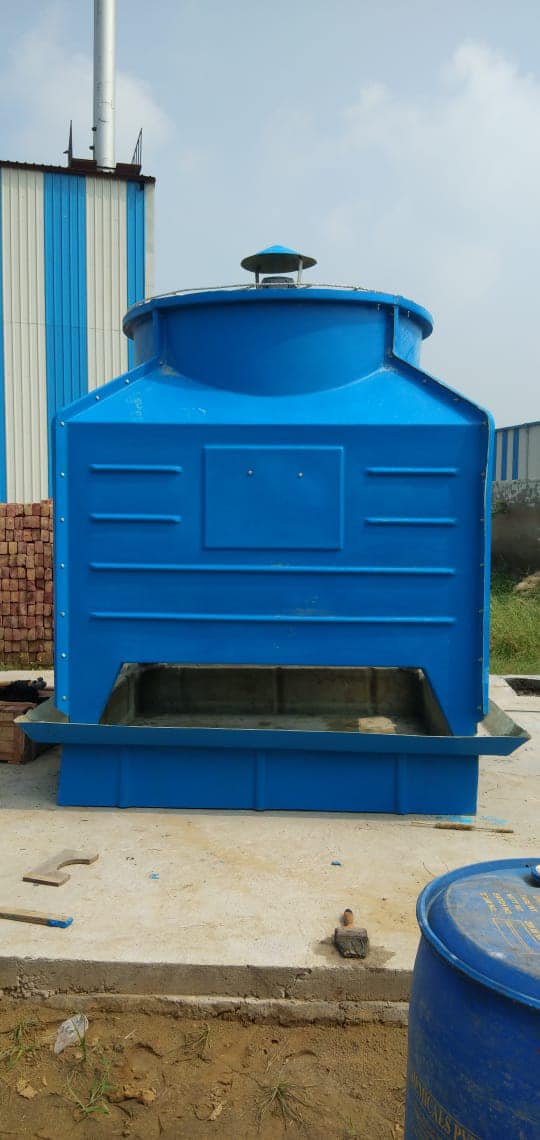
Induced Draft vs. Forced Draft Cross Flow Cooling Towers: Comprehensive Comparison
Here’s a detailed side-by-side analysis of both designs, highlighting their operational differences, advantages, disadvantages, and best applications.
Quick Comparison Table
| Feature | Induced Draft Cross Flow | Forced Draft Cross Flow |
| Fan Position | Top (air discharge) | Bottom/sides (air inlet) |
| Air Flow Mechanism | Fan pulls air through tower | Fan pushes air into tower |
| Internal Pressure | Negative pressure (suction) | Positive pressure |
| Fan Environment | Hot, humid, corrosive air | Cool, dry ambient air |
| Energy Efficiency | Higher (handles less dense warm air) | Lower (pushes dense cold air) |
| Air Distribution | More uniform naturally | Less uniform, requires plenum design |
| Maintenance Access | Difficult (elevated, corrosive environment) | Easier (ground level, less corrosive) |
| Weather Protection | Excellent (fan at top acts as cover) | Poor (open top vulnerable) |
| Recirculation Risk | Low (high-velocity vertical discharge) | Moderate (low-velocity horizontal discharge) |
| First Cost | Higher (corrosion-resistant materials) | Lower (standard materials often sufficient) |
| Noise Discharge | Upward (less impact at ground level) | At ground level (easier to contain with barriers) |
| Freeze Protection | Better (controlled air flow) | Poorer (cold air directly on fills) |
| Footprint | Similar for same capacity | Similar for same capacity |
Detailed Comparative Analysis
1. Air Flow & Performance Characteristics
Induced Draft:
- Air travels through fill → drift eliminators → fan → discharge
- Gradual acceleration through tower
- Better air-water contact time due to natural distribution
- Approach temperatures: Typically 4-6°C
- Stable performance across varying ambient conditions
Forced Draft:
- Air enters at high velocity → plenum → fill → natural exit
- Potential for channeling (air takes path of least resistance)
- Shorter contact time if distribution poor
- More sensitive to wind effects (open top)
2. Mechanical & Structural Considerations
Induced Draft:
- Structural: Fan/motor weight at top requires robust support
- Vibration: Isolated at top, less transfer to structure
- Materials: FRP, stainless steel, corrosion-resistant alloys
- Drive Systems: Typically belt-driven or direct-drive at top
Forced Draft:
- Structural: Simpler, no top heavy loads
- Vibration: At ground level, easier to isolate
- Materials: Mild steel, standard coatings often acceptable
- Drive Systems: Easier access for maintenance
. Maintenance & Reliability
Induced Draft:
- Fan Maintenance: Difficult access, corrosive environment
- Component Life: Shorter due to harsh conditions (typically 10-15 years)
- Routine Tasks: Water system accessible, mechanical parts less so
- Winter Operation: Better control, less icing risk
Forced Draft:
- Fan Maintenance: Easy ground-level access, standard environments
- Component Life: Longer (typically 15-20+ years)
- Routine Tasks: All mechanical components easily accessible
- Winter Operation: Higher freeze risk at inlets
4. Energy Consumption Comparison
text
Typical Power Consumption (kW/TR of cooling):
• Induced Draft: 0.03 - 0.08 kW/TR
• Forced Draft: 0.04 - 0.10 kW/TR (25-30% higher typically)
Factors affecting energy use:
- Air density differences (forced draft moves colder, denser air)
- System pressure drops (forced draft often has higher resistance)
- Fan efficiency (induced draft fans often more optimized)
- Motor efficiency (similar, but environment affects forced draft less)
5. Application-Specific Considerations
Choose INDUCED DRAFT when:
- Energy efficiency is critical (high operating hours)
- Reliable performance in varied weather is needed
- Limited site space requires vertical discharge
- Corrosion-resistant materials budget is available
- Minimal plume visibility is important
- Cold climate operation is required
Choose FORCED DRAFT when:
- Maintenance accessibility is primary concern
- First cost limitations exist
- Indoor installation prevents vertical discharge
- Corrosive fan environment must be avoided
- Noise containment at ground level is easier
- Short-term or intermittent operation is planned