

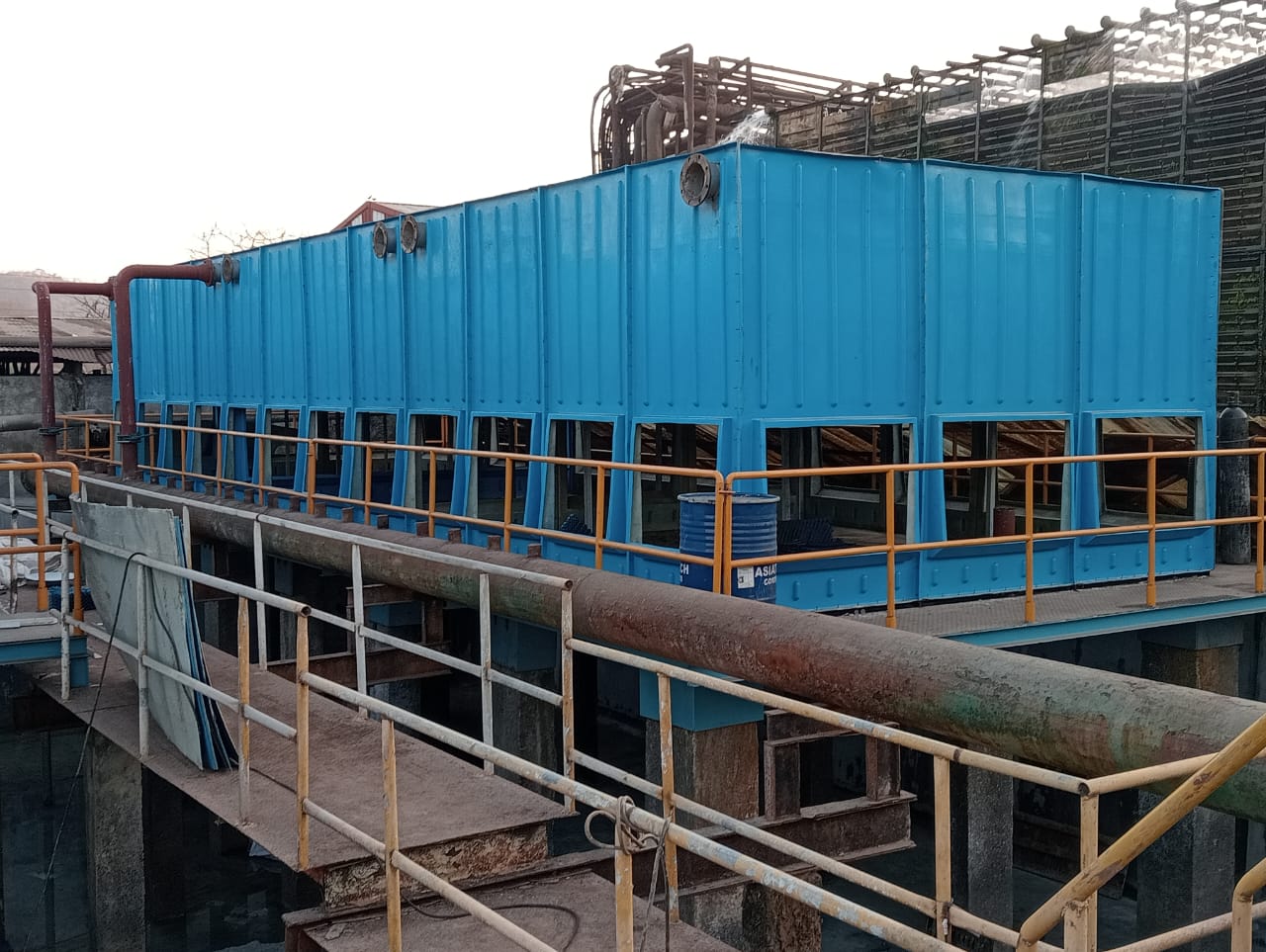
Two Main Types of Mechanical Draft Towers
1. Forced Draft
- Airflow: The fan is located at the base (air intake) and pushes air into the tower.
- Pressure: The tower operates under positive pressure.
- Structure: Fan and motor are at the entering air stream, making them susceptible to corrosion from warm, moist air. They are typically easier to access for maintenance.
- Air Distribution: Can be less uniform, potentially leading to recirculation.
- Common Use: Often found in smaller industrial systems or as part of a packaged cooling tower unit.
2. Induced Draft
- Airflow: The fan is located at the top (exhaust) and pulls air through the tower.
- Pressure: The tower operates under negative pressure.
- Structure: Fan and motor are in the cooler, exiting air stream, reducing corrosion potential. This is the most common design for large-scale applications.
- Advantages:
- More uniform air distribution across the fill.
- Reduced risk of moist air recirculation around the tower.
- Better water distribution due to lower air velocity at the water inlet.
- Sub-types:
- Counterflow: Air flows vertically upward, opposite to the falling water. Typically has a vertical fan stack.
- Crossflow: Air flows horizontally across the falling water. Typically has a large, box-like structure with an open rain zone and a horizontal fan on top.