

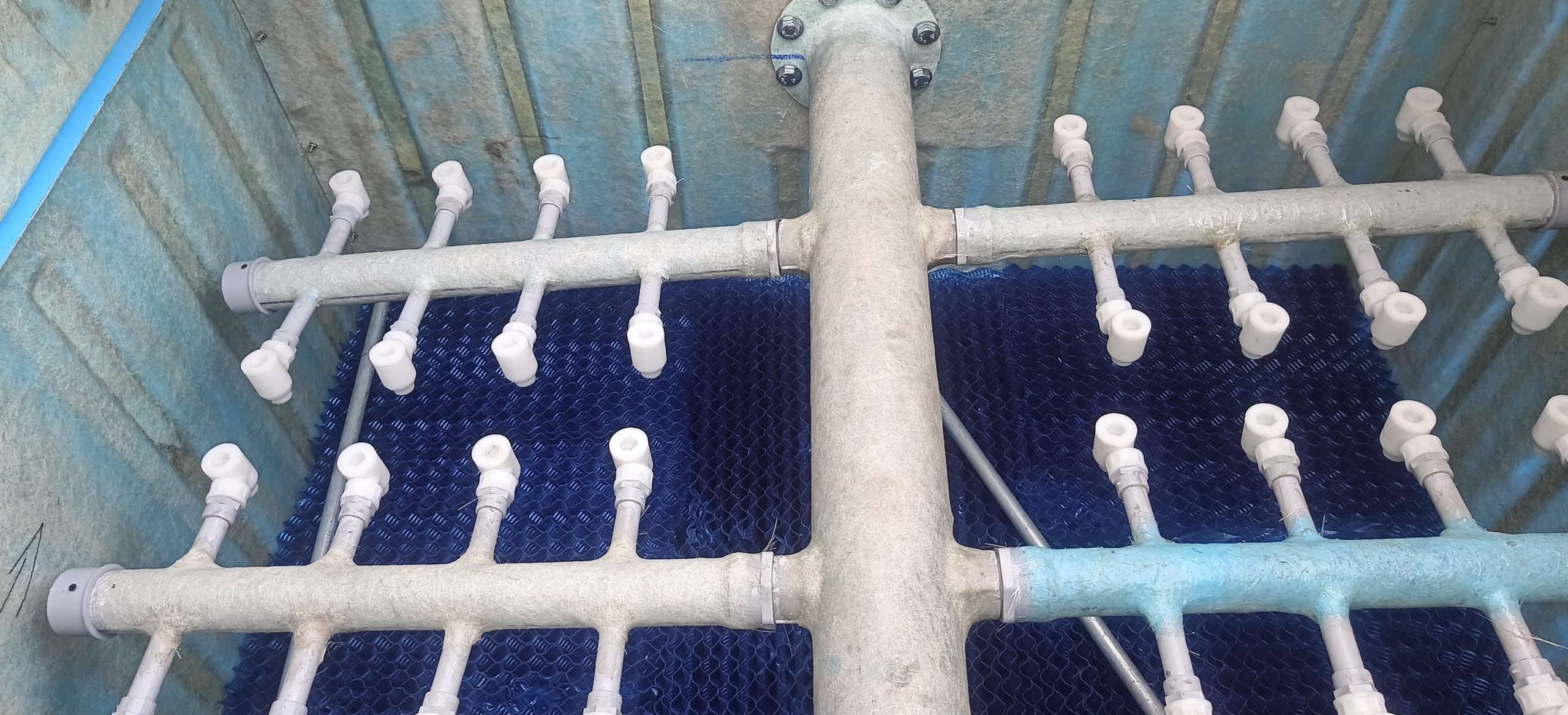
COOLING TOWER MATERIALS
Overview
Material selection is critical for cooling tower longevity, performance, and cost. The choice depends on corrosiveness of water/air, temperature, structural requirements, budget, and maintenance philosophy. Here’s a breakdown by component:
1. STRUCTURAL CASING & SUPPORTS
Fiber Reinforced Plastic (FRP)
- Composition: Glass fibers + polyester/vinyl ester resin.
- Advantages:
- Excellent corrosion resistance (ideal for coastal, chemical plants).
- Lightweight, easy installation.
- Low maintenance (no painting).
- Smooth surface resists scaling.
- Disadvantages:
- UV degradation requires UV-stabilized resin.
- Temperature limited (~65°C continuous).
- Lower structural strength than steel/concrete for very large towers.
- Typical Use: Packaged towers, industrial casings, basins, fan stacks.
Galvanized Steel (Galv Steel)
- Composition: Carbon steel coated with zinc layer (hot-dip galvanized).
- Advantages:
- Strong, durable, cost-effective.
- Good corrosion resistance in mild environments.
- Disadvantages:
- Zinc coating can degrade in aggressive water (low pH, high chlorides) or coastal salt air.
- Requires maintenance painting after coating failure.
- Typical Use: Structural framework, casing for HVAC towers.
Stainless Steel (SS)
- Grades: 304 (general), 316 (high chloride environments), 2205 duplex.
- Advantages:
- Superior corrosion resistance.
- High strength, temperature tolerance.
- Long life with minimal maintenance.
- Disadvantages:
- High initial cost.
- Can still suffer from pitting/crevice corrosion in specific conditions.
- Typical Use: Critical components in harsh environments, food/pharma, marine applications.
Concrete
- Types: Reinforced concrete, pre-cast panels.
- Advantages:
- Extremely durable and strong.
- Fireproof, UV resistant.
- Low lifetime cost for large towers.
- Disadvantages:
- High capital cost and long construction time.
- Can crack; susceptible to acidic water corrosion over decades.
- Typical Use: Large natural draft hyperbolic towers, field-erected industrial towers.
Wood (Traditionally Treated)
- Types: Redwood, Douglas Fir, treated pine.
- Advantages:
- Natural corrosion resistance (redwood).
- Good thermal insulation.
- Repairable.
- Disadvantages:
- Decays over time (fungi, rot).
- Requires chemical treatment.
- Environmental sourcing concerns.
- Less common in new builds.
- Typical Use: Older industrial towers, some Cross Flow fills.
2. FILL / PACKING MATERIALS
PVC (Polyvinyl Chloride)
- Form: Thin sheets formed into corrugated film fill or splash bars.
- Advantages:
- Lightweight, excellent corrosion resistance.
- High thermal efficiency (film fill).
- Low cost.
- Disadvantages:
- Temperature limited (~50-60°C).
- Can deform under load or at high temperature.
- Susceptible to fouling (biofilm adhesion).
- Typical Use: Most common fill material for film and splash fill in industrial/HVAC towers.
Polypropylene (PP)
- Advantages:
- Higher temperature tolerance than PVC (~70-80°C).
- Good chemical resistance.
- Often used in more aggressive thermal/chemical environments.
- Disadvantages:
- More expensive than PVC.
- Softer material, can be less rigid.
- Typical Use: Hot water applications, certain chemical processes.
Wood (Splash Fill)
- Advantages:
- Handles dirty water well (less prone to clogging).
- Good structural strength.
- Disadvantages:
- Degrades over time (rot, biological attack).
- Heavier, less efficient than film fill.
- Typical Use: Older towers, or in applications with high suspended solids.
Ceramic / Clay
- Advantages:
- Excellent high-temperature resistance.
- Inert, excellent fire resistance.
- Disadvantages:
- Very heavy, fragile.
- High cost.
- Typical Use: Special high-temperature industrial applications (e.g., metallurgy).
3. COLD WATER BASIN MATERIALS
Monolithic FRP
- Advantages:
- Seamless, leak-proof.
- Excellent corrosion resistance.
- Lightweight.
- Typical Use: Standard in modern packaged FRP towers.
Concrete (Poured-in-Place or Precast)
- Advantages:
- Permanent, durable.
- Can be coated with epoxy for chemical resistance.
- Disadvantages:
- Can crack and leak.
- Typical Use: Large field-erected towers.
Coated Steel
- Coatings: Epoxy, coal-tar epoxy, polyurethane.
- Advantages:
- Strong, cost-effective.
- Disadvantages:
- Coating failure leads to rapid corrosion.
- Requires diligent maintenance.
Polyethylene (PE) Liners
- Advantages:
- Low cost, corrosion-resistant barrier.
- Used as a liner in concrete or steel basins.
- Disadvantages:
- Can tear/puncture.
- Typical Use: Retrofit or repair of existing basins.
4. DRIFT ELIMINATORS
PVC
- Most common. Corrugated sheet assemblies. Efficient, low cost.
FRP
- Used in corrosive environments or for structural strength.
Wood
- In older towers.
5. NOZZLES & DISTRIBUTION SYSTEM
ABS (Acrylonitrile Butadiene Styrene)
- Common for nozzles. Tough, chemical resistant.
PVC / PP Piping
- For distribution piping.
Brass / Stainless Steel Nozzles
- Used for high temperature/pressure or where abrasion is a concern.
6. FANS & MECHANICAL COMPONENTS
- Fan Blades:
- Aluminum: Lightweight, general use.
- FRP: Corrosion resistant, balanced.
- Stainless Steel: For harsh environments.
- Shafts: Stainless steel or carbon steel with protective coating.
- Bearings: Sealed, lubricated for wet environment.
- Drive Assemblies: Steel with galvanized or painted protection.
MATERIAL SELECTION MATRIX BY ENVIRONMENT
| Environment / Condition | Recommended Materials | Avoid / Use With Caution |
| Coastal / High Salt Air | FRP, 316 Stainless Steel, Special Coatings | Galvanized Steel, Mild Steel |
| Chemical Plant / Aggressive Water | FRP, PVC/PP Fill, 316SS/duplex SS | Galvanized Steel, Carbon Steel |
| High Temperature Water (>60°C) | PP Fill, Stainless Steel, Concrete | PVC, Standard FRP resins |
| Dirty Water / High Solids | Splash Fill (PVC or Wood), Easy-clean design | Fine-cell film fill (clogs easily) |
| Fire Risk Area | Concrete, Ceramic, Special Fire-retardant FRP | Standard Plastics, Wood |
| Cost-Sensitive, Mild Environment | Galvanized Steel, PVC fill | Stainless Steel, FRP |
TRENDS & BEST PRACTICES
- FRP Dominance: FRP has become the standard for casings and basins in packaged towers due to its all-around durability and low lifecycle cost.
- PVC for Fill: PVC film fill dominates for efficiency, but PP is growing for hotter applications.
- Hybrid Construction: Common to use galvanized steel structure with FRP casing panels or PVC fill for cost optimization.
- Coatings & Linings: Epoxy and polyurethane coatings extend life of concrete and steel basins significantly.
- Material Degradation Awareness:
- UV on FRP → Use UV-inhibited resin.
- Chlorides on stainless → Use 316 or duplex.
- Low pH water on galvanized steel → Accelerated coating loss.