

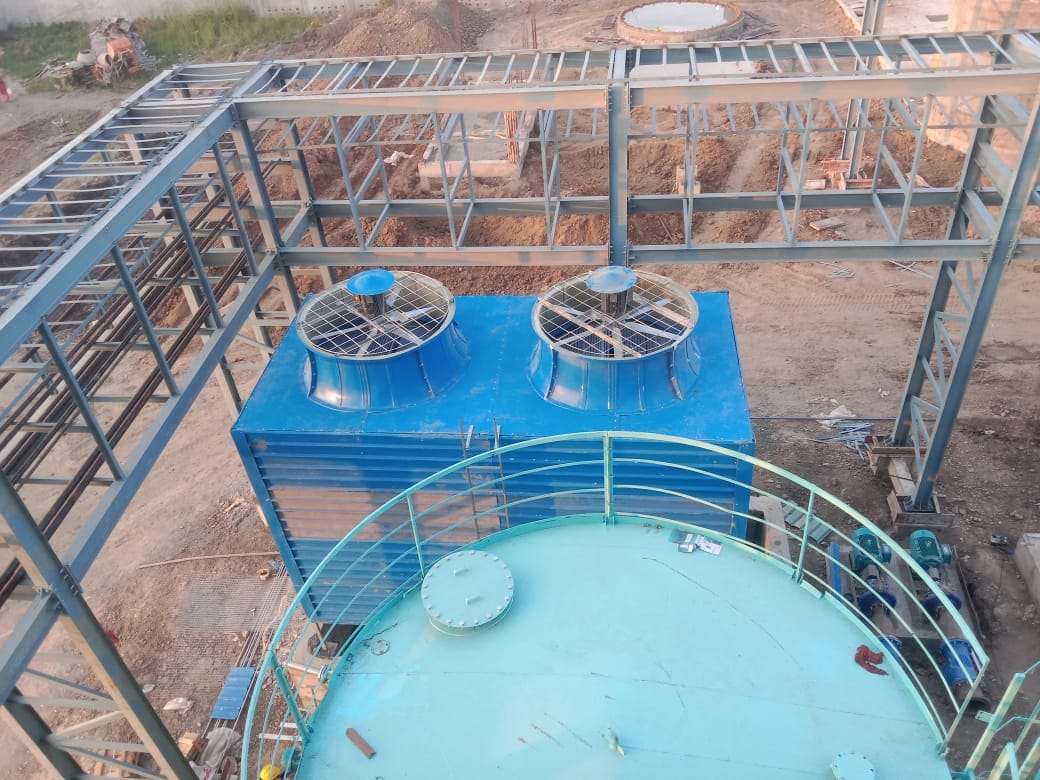
DOUBLE CROSSFLOW vs. SINGLE CROSSFLOW COOLING TOWER
Comparison Overview
Both are induced draft, crossflow towers using gravity distribution and horizontal airflow. The core difference is air entry from one side vs. two sides, leading to significant practical implications.
Core Definition Recap
| Feature | Single Crossflow | Double Crossflow |
| Air Inlets | One side only | Two opposite sides |
| Fill Sections | One fill bank (on the air inlet side) | Two fill banks (mirrored on either side) |
| Hot Water Basin | Single-sided distribution | Central basin distributing to both sides |
| Air Path | Air enters → crosses fill → turns upward → exits fan | Air enters both sides → crosses two fills → merges in central plenum → exits fan |
| Visual Shape | Like a “D” or half-box | Symmetrical, rectangular box |
Comparison Matrix: Key Differences
| Parameter | Single Crossflow Tower | Double Crossflow Tower | Implication / Winner |
| 1. Capacity vs. Footprint | Lower capacity for same length/width. | Higher capacity for same length/width (effectively 2 towers in 1). | Double: More compact per ton. |
| 2. Plan Area (Footprint) | Smaller absolute footprint for low capacity. | Wider but much higher capacity per unit length. | Single: For tight spaces where width is limited. Double: For high capacity where width is available. |
| 3. Height Profile | Can be taller for same capacity (to increase fill depth). | Can be lower height for same capacity (fill depth spread over two sides). | Double: Preferred where height restrictions exist. |
| 4. Airflow Distribution | Can be uneven; potential for air “short-circuiting”. | More balanced and symmetrical airflow from two sides. | Double: Better thermal performance, less recirculation. |
| 5. Water Distribution | Simpler, single-sided basin. | Central basin must distribute evenly to both sides; risk of imbalance if not level. | Single: More forgiving. |
| 6. Maintenance Access | Excellent from open (non-louvered) side. | Excellent internal access from central plenum to both fill banks. | Tie: Both good, but access type differs. |
| 7. Freeze Vulnerability | Exposed fill on one side to cold air. | Exposed fill on two sides—double the freezing risk. | Single: Easier to winterize. |
| 8. Pumping Head | Low (gravity basin). | Low (gravity basin). | Tie. |
| 9. Static Pressure & Fan Power | Lower static pressure (air makes one 90° turn). | Slightly higher static pressure (air converges, more restrictive path). | Single: Slightly lower fan power. |
| 10. Structural Wind Loading | Uneven; high load on air inlet side. | Symmetrical, balanced wind loads. | Double: Structurally more stable. |
| 11. Application Typical Size | Small to medium capacities (e.g., < 500 tons). | Medium to large capacities (e.g., 500 – 2,000+ tons). | Single: Smaller projects. Double: Larger industrial. |
| 12. Cost per Ton | Higher for large capacity (inefficient use of space). | Lower per-ton cost at large capacities due to modular efficiency. |