

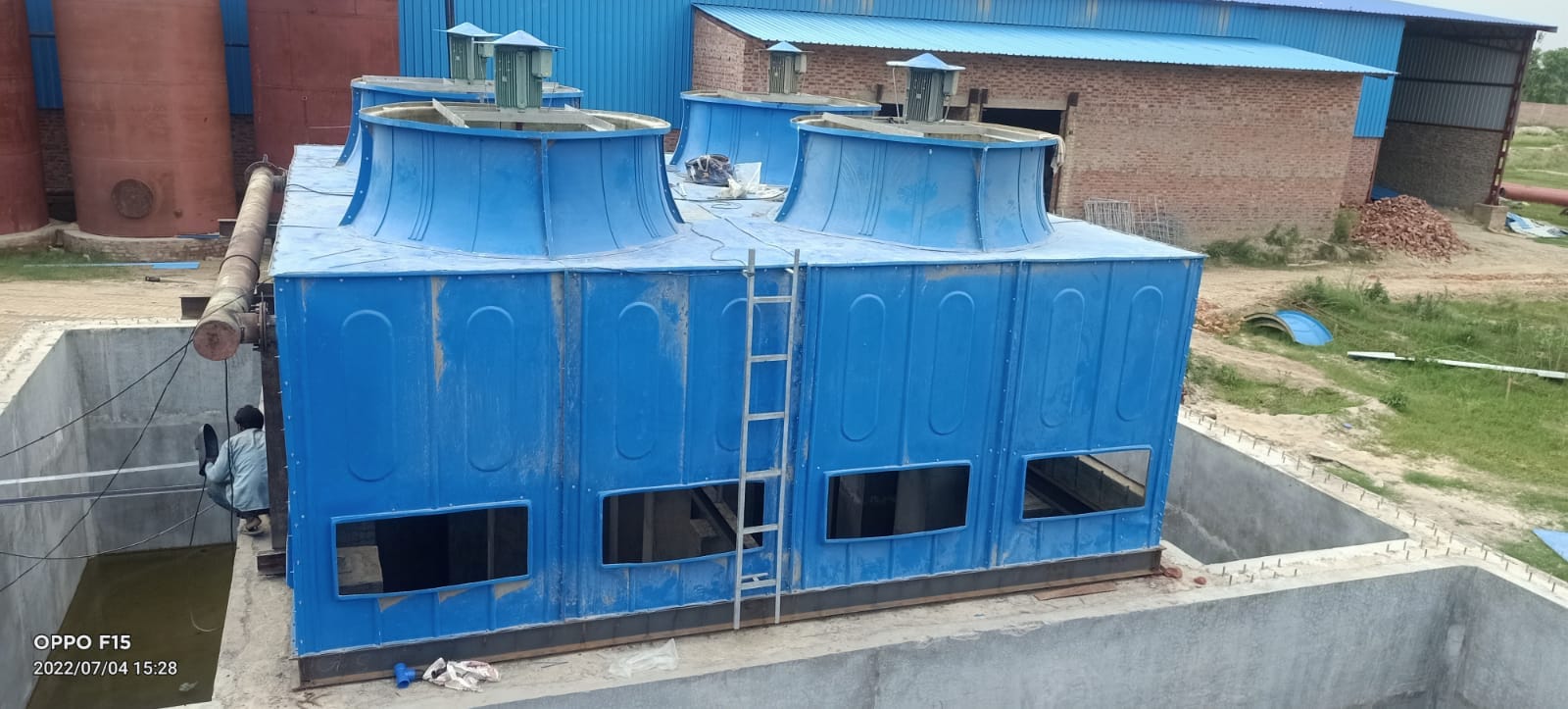
Combined Flow Coil/Fill Evaporative Cooling Tower
A Combined Flow Coil/Fill Evaporative Cooling Tower (also called a Hybrid Wet/Dry Tower or Two-Stage Tower) is an innovative design that integrates both a closed-circuit coil bundle AND open tower fill media into a single unit, typically in series. This combination leverages the advantages of both dry (sensible) and wet (evaporative) cooling in different operational modes or simultaneously.
Core Operating Principle
The tower operates with two distinct cooling stages that work on the same air stream:
Two-Stage Air Path:
- First Stage (Dry/Sensible Cooling):
Ambient air first passes through the closed-circuit coil bundle where it sensibly cools the process fluid inside the tubes without evaporation. - Second Stage (Wet/Evaporative Cooling):
The same air, now pre-warmed by the first stage, then passes through traditional open fill media where it participates in evaporative cooling of a separate water stream.
Two Independent Water Circuits:
- Primary Circuit (Coil Loop):
- Clean process fluid (e.g., from chiller condenser) circulates inside the sealed coils.
- Receives cooling from both stages: First from dry sensible cooling, then potentially from evaporative spray on the coil exterior if equipped.
- Secondary Circuit (Open Loop):
- Spray water (or “saturated air” stream water) recirculates over the traditional fill media in the lower section.
- Provides the evaporative cooling effect for the second stage.
Key Design Configurations
There are two primary arrangements:
1. Series Configuration (Most Common)
text
[Air In] → [COIL SECTION (Dry)] → [FILL SECTION (Wet)] → [Fan] → [Air Out]
↑ (Process Fluid) (Open Spray Water)
│ Inside │
└────── Sensible Cooling ←──── Evaporative Cooling
- Process fluid is cooled first sensibly (in coil), then further cooled if needed by optional evaporative spray on coils.
- Air gains heat sensibly in coil section, then provides evaporative cooling in fill section.
2. Parallel Configuration
Both coil and fill sections operate in parallel on the same air stream, with separate fluid circuits.
Operating Modes
The true power of combined flow towers is their operational flexibility:
| Mode | Coil Section | Fill Section | Best For |
| 1. Dry Mode | ACTIVE (air-cooled) | INACTIVE (no spray) | Freezing conditions, water conservation, low-load periods |
| 2. Wet Mode | ACTIVE (with spray)* | ACTIVE (evaporative) | Peak summer loads, high efficiency required |
| 3. Adiabatic Mode | ACTIVE (pre-cooled air) | ACTIVE (minimal water) | High ambient temps, water/energy balance |
| 4. Evaporative-Only | BYPASSED/INACTIVE | ACTIVE | When only open-loop cooling needed |
*Note: In wet mode, some designs spray water directly on the coil exterior, turning it into an evaporative heat exchanger.
Advantages
1. Water Conservation
- Can operate in dry mode during cool/humid periods, using zero evaporation water.
- Reduces annual water consumption by 30-70% compared to traditional open towers.
2. Plume Abatement
- When operating in hybrid mode, the warm moist air from the fill section mixes with warm dry air from the coil section.
- This mixing can eliminate or dramatically reduce visible plumes, crucial for urban areas with aesthetic/visibility concerns.
3. Freeze Protection
- The fill section can be turned off completely in freezing conditions.
- Process fluid remains in protected coils, eliminating basin freezing risks.
4. Seasonal Optimization
- Automatically switches between modes based on ambient conditions.
- Maximizes energy efficiency year-round:
- Winter: Dry operation saves water
- Summer: Wet operation maximizes efficiency
- Shoulder seasons: Adiabatic/hybrid mode optimizes water-energy trade-off
5. Process Fluid Protection
- Primary process loop remains in closed coils, protected from contamination.
- Open-loop section only handles clean water, reducing treatment complexity.