

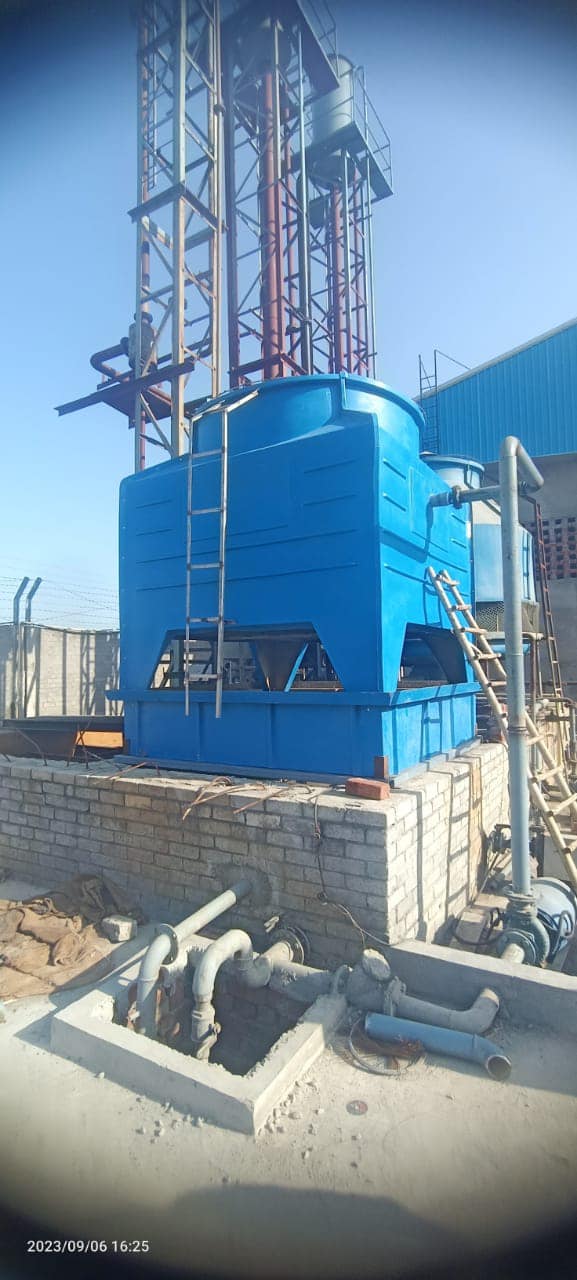
Crossflow vs. Counterflow Comparison
| Parameter | Cross Flow | Counter Flow |
| Air/Water Flow | Perpendicular (90°) | Opposite (parallel but opposite) |
| Footprint | Larger for same capacity | More compact |
| Pump Head | Lower (gravity distribution at lower height) | Higher (water pumped to top) |
| Air Pressure Drop | Lower | Higher |
| Maintenance | Easier (accessible basins/fills) | Harder (nozzles/fills enclosed) |
| Freeze Protection | Better (peripheral exposure) | Requires careful design |
| Water Quality | Tolerates dirtier water | Requires cleaner water |
| Typical Use | HVAC, medium industrial | High-efficiency industrial, space-constrained |
Applications
- Commercial & institutional HVAC systems
- Medium-capacity industrial cooling
- Power plant auxiliary cooling
- Geothermal plants
- Situations where water treatment is limited
Efficiency Factors
- Fill Media Type: Splash fills (common) vs. film fills (higher efficiency but prone to fouling).
- Air Inlet Design: Louver design affects uniform airflow distribution.
- Basin Design: Ensures even water loading across fill.
- Approach Temperature: Difference between cold water temperature and wet-bulb temperature (typically 4-6°C).
Key Design Considerations
- Uniform Air Distribution: Critical to prevent “hot spots” in fills.
- Wind Effects: External wind can disrupt airflow; wind walls may be needed.
- Water Load Variations: Distribution basins must handle flow variations.
- Material Selection: PVC fills, GRP basins, and corrosion-resistant metals.