

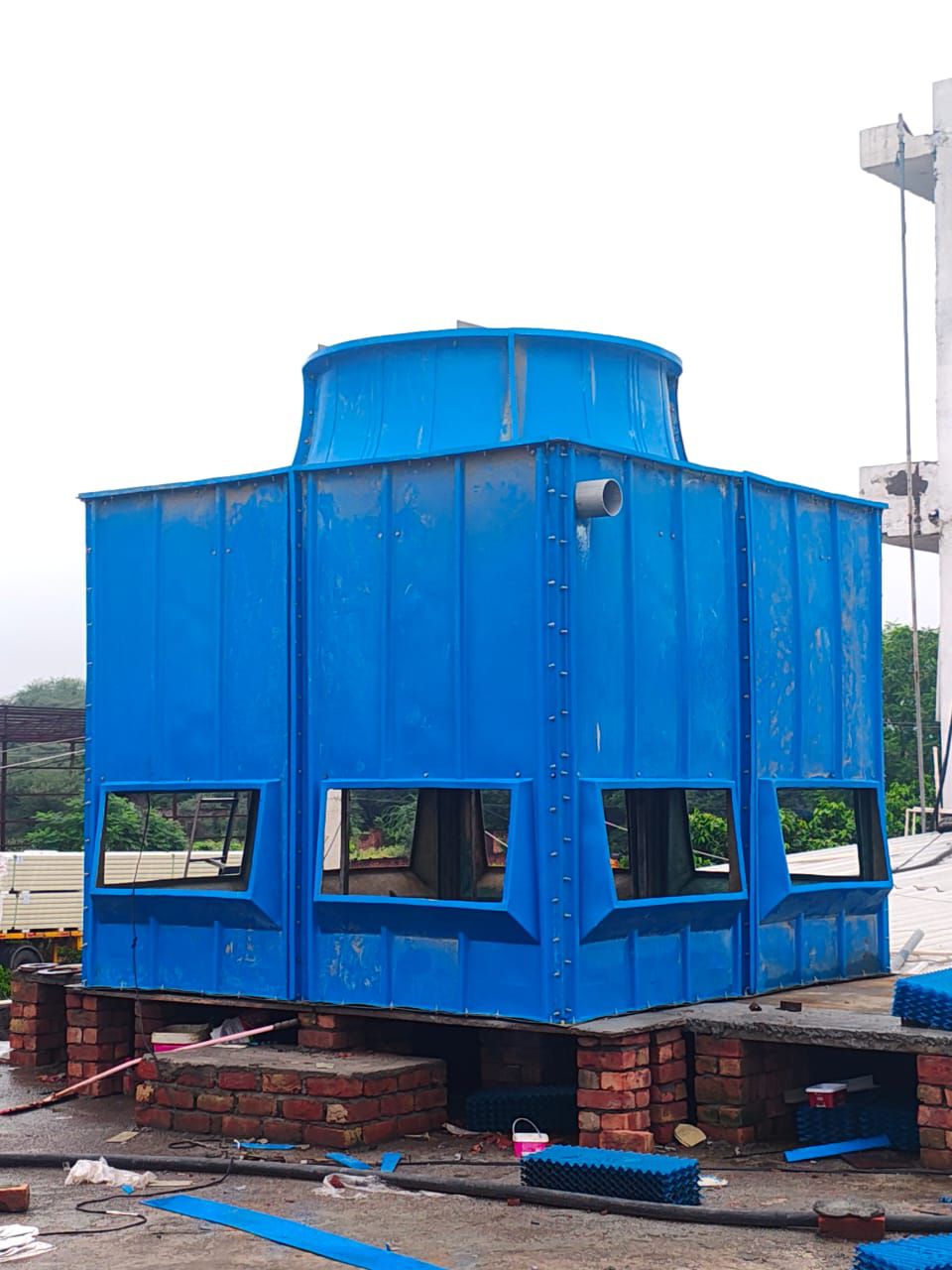
Main Components of Field-Erected Cooling Towers
- Structure & Casing: The robust framework and walls that enclose the tower.
- Cold Water Basin: The concrete or steel basin at the bottom that collects the cooled water.
- Fill (Heat Transfer Media): The core of the tower where air and water intimately contact. Can be splash fill (breaks up water droplets) or film fill (spreads water into thin sheets) for maximum efficiency.
- Distribution System: Spreads the hot return water evenly over the fill. Can be a gravity-fed piping and spray nozzle system or a redwood or FRP hot water basin with gravity or pressurized distribution.
- Drift Eliminators: Critical internal components that capture entrained water droplets in the exhaust air, minimizing water loss and environmental impact.
- Fans and Drives: Large, single or multiple axial fans (10+ ft in diameter) driven by heavy-duty motors via gearboxes or belt drives. Located at the top in induced draft designs.
- Louvers: Air inlet openings on the sides that help direct airflow and prevent water splash-out.
Common Types of Field-Erected Towers
- Cross Flow (Induced Draft):
- Airflow: Air is drawn horizontally across the falling water stream.
- Water Flow: Gravity distributes water from a hot water basin located above the fill.
- Advantages: Lower pumping head, easier maintenance of distribution system, good freezing resistance.
- Counter Flow (Induced Draft):
- Airflow: Air is drawn vertically upward, opposite the direction of the falling water.
- Water Flow: Pressurized piping and spray nozzles distribute water.
- Advantages: More thermally efficient per unit plan area, smaller footprint, less prone to fouling in dusty environments.
- Natural Draft:
- Mechanism: Uses a massive hyperbolic chimney to create airflow via the buoyancy effect (warm, moist air rises). No mechanical fans.
- Application: Extremely large capacity (e.g., power plants), where the immense scale and constant load justify the high construction cost for fan power savings.