

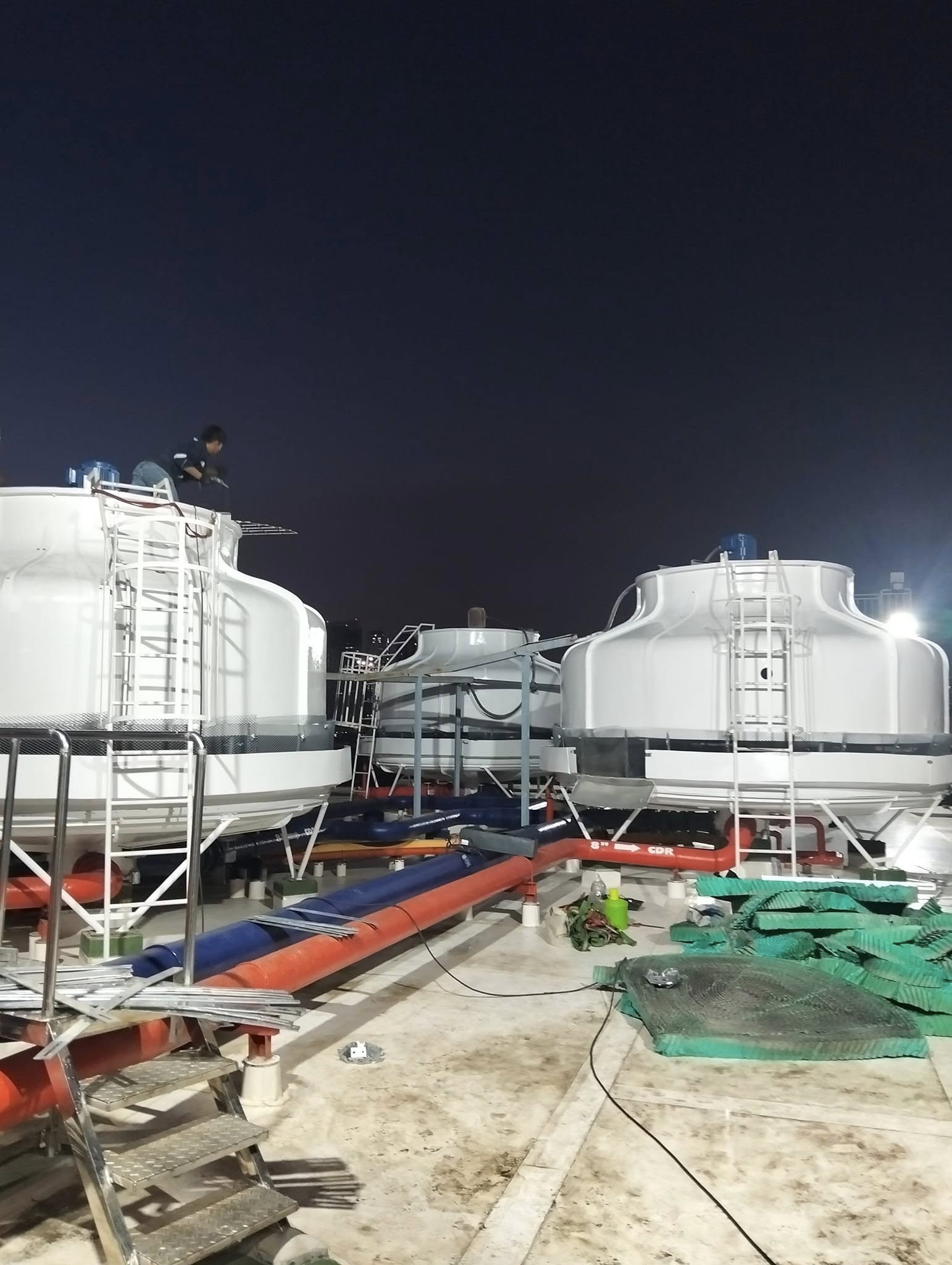
The Mechanics of Drift Eliminator for cooling tower
Drift eliminators don’t “filter” like a screen. They work by inertial impaction.
- Location: Positioned in the air stream after the fill and before the air exits the tower (e.g., just below the fan in an induced draft tower).
- Structure: They consist of a series of closely spaced, zig-zag baffles or blades (made of PVC, wood, or fiberglass) that create a sinuous, changing-path airway.
- Process:
- As the air (carrying fine droplets) passes through these winding channels, it is forced to change direction rapidly.
- The heavy water droplets, due to their inertia, cannot follow the sharp air turns.
- The droplets impact the surface of the eliminator blades, coalesce into larger drops, and then drain by gravity back into the tower’s cold water basin.
- The cleaned air continues out of the tower.
Key Performance Metrics
- Drift Rate or Drift Loss: Expressed as a percentage of the circulating water flow rate. Modern eliminators are highly efficient.
- Old Towers: Could have drift rates of 0.1% to 0.2%.
- Modern Towers with High-Efficiency Eliminators: Achieve rates as low as 0.0005% to 0.001% of circulation flow. This is often called “ultra-low drift.”
- Pressure Drop: Eliminators create resistance to airflow. A key design goal is to achieve high drift capture with minimal additional fan power (low pressure drop).