

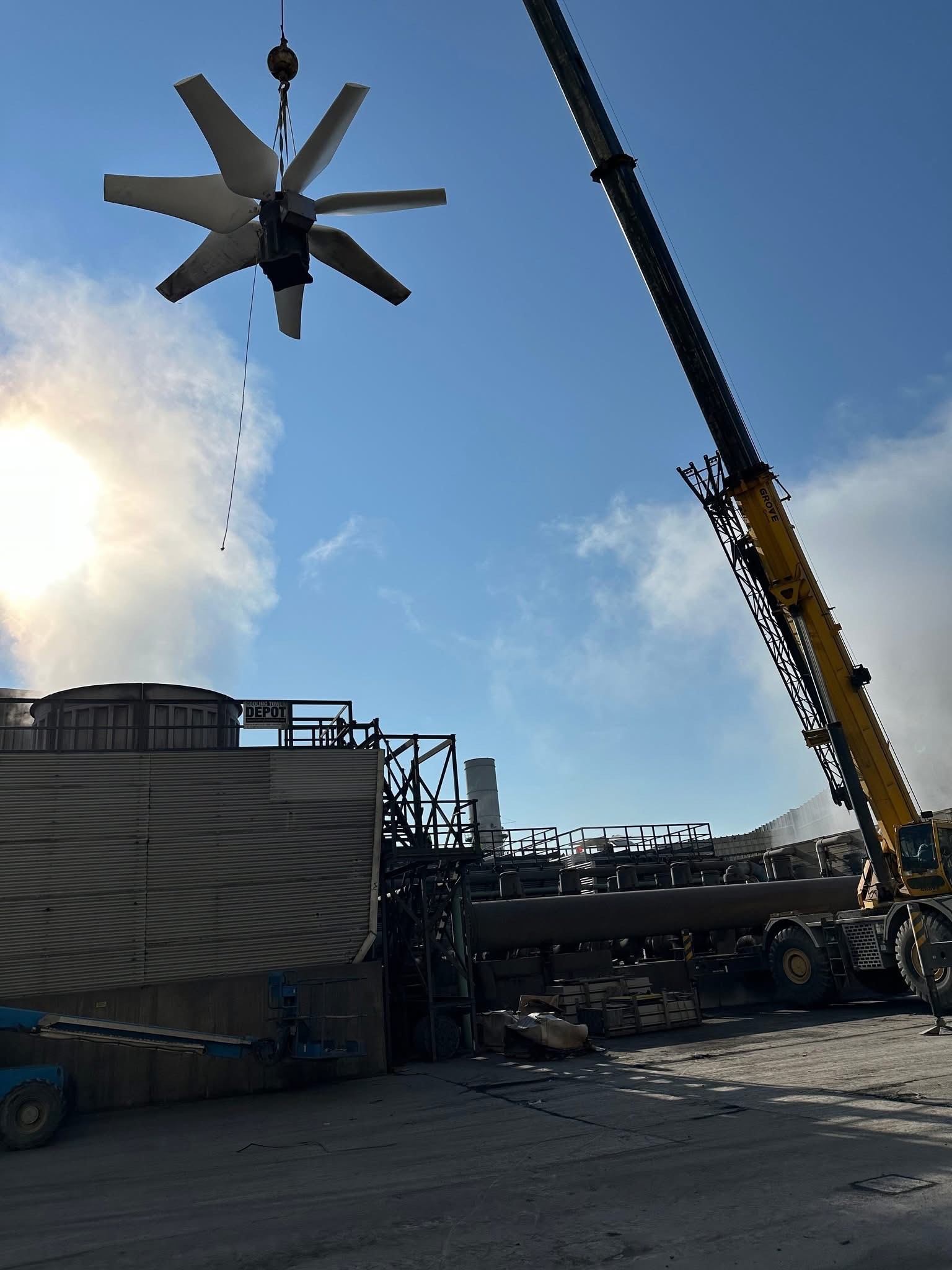
Use of Cooling Tower
The primary function of a cooling tower is to remove waste heat from a water-based system and reject it to the atmosphere. This is achieved primarily through the principle of evaporative cooling.
Here is a detailed breakdown of the key functions of a cooling tower:
Primary Function: Heat Rejection
This is the core reason cooling towers exist. They are designed to efficiently extract waste heat from processes or building cooling systems and dissipate it into the air. This prevents machinery from overheating and allows processes to run continuously.
2. Water Cooling for Reuse
Cooling towers don’t just get rid of heat; they cool down the water that absorbed the heat so it can be used again. This creates a closed-loop or recirculating system. The function is to:
- Collect hot water from heat exchangers, condensers, or industrial processes.
- Cool it significantly through evaporation and air contact.
- Return the cooled water back to the system to absorb more heat.
This cycle repeats continuously, making the system highly efficient and sustainable.
3. Conservation of Water and Energy
While cooling towers use evaporation (which consumes water), their recirculating design is a major function for conservation:
- Water Conservation: They save massive amounts of water compared to a “once-through” system, where water is used once and then discharged. A recirculating system might make up only 1-2% of the water volume lost to evaporation, drastically reducing the need for fresh water.
- Energy Conservation: Providing a continuous supply of cooled water allows systems like chillers and condensers to operate much more efficiently, saving significant energy compared to using warm, fresh water.
4. Maintaining System Efficiency
The efficiency of many industrial processes and HVAC systems is directly tied to the temperature of the cooling water. The function of the cooling tower is to provide a reliable supply of water at the optimal temperature to ensure these systems run at peak performance. Warmer cooling water makes air conditioners work harder and power plants less efficient.
. Environmental Protection
By recirculating water, cooling towers minimize thermal pollution. Discharging large volumes of hot water directly into rivers or lakes can harm aquatic ecosystems. Cooling towers release the heat into the atmosphere instead, which is a much more benign form of heat rejection.
How These Functions Are Achieved: The Process
To fulfill these functions, a cooling tower performs a specific process:
- Heat Transfer: Hot water from the industrial process or condenser is pumped to the top of the tower.
- Distribution: This water is distributed across the “fill” (a large internal surface area). This maximizes water-to-air contact.
- Evaporation: Air is drawn through the falling water by large fans. A small portion of the water evaporates.
- This is the key: The process of evaporation requires energy (the “latent heat of vaporization”). This energy is taken from the remaining water, thereby cooling it significantly.
- Collection & Recirculation: The now-cooled water collects in a basin at the bottom and is pumped back to the plant to absorb more heat.
- Heat Dissipation: The warm, moist air created by evaporation is exhausted to the atmosphere, carrying the waste heat with it.