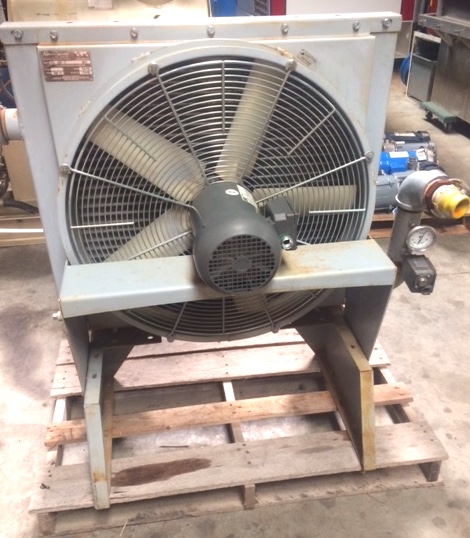
Induced Draft Oil Cooler vs. Forced Draft Oil Cooler
Air-cooled oil coolers rely on airflow to dissipate heat, and the method of air movement defines their efficiency. The two main types are Induced Draft and Forced Draft coolers. Below is a detailed comparison:
1. Airflow Mechanism
Feature
Induced Draft Oil Cooler
Forced Draft Oil Cooler
Fan Position
Pulls air (fan located on the outlet side of the cooler).
Pushes air (fan located on the inlet side of the cooler).
Airflow Path
Air is drawn through the cooler.
Air is forced into the cooler.
Pressure Zone
Creates a negative pressure (suction) inside the cooler.
Creates a positive pressure (pushing) inside the cooler.
2. Performance Comparison
Factor
Induced Draft
Forced Draft
Cooling Efficiency
More uniform cooling (air spreads evenly across fins).
Air may bypass some fins due to turbulence.
Heat Distribution
Better for high-temperature oils (hot air exits smoothly).
Risk of hot spots if airflow is uneven.
Fan Power Consumption
Slightly higher energy use (fan works against pressure drop).
More energy-efficient (fan pushes air directly).
Dust & Debris Accumulation
Less dust build-up (negative pressure reduces ingress).
More prone to clogging (dust pushed into fins).
Noise Levels
Louder (fan handles hot air).
Quieter (fan handles cooler air).
3. Maintenance & Durability
Aspect
Induced Draft
Forced Draft
Fan Exposure
Fan handles cooler air → longer lifespan.
Fan exposed to hot air → higher wear.
Induced Draft Oil Cooler vs. Forced Draft Oil Cooler
Air-cooled oil coolers rely on airflow to dissipate heat, and the method of air movement defines their efficiency. The two main types are Induced Draft and Forced Draft coolers. Below is a detailed comparison:
1. Airflow Mechanism
Feature
Induced Draft Oil Cooler
Forced Draft Oil Cooler
Fan Position
Pulls air (fan located on the outlet side of the cooler).
Pushes air (fan located on the inlet side of the cooler).
Airflow Path
Air is drawn through the cooler.
Air is forced into the cooler.
Pressure Zone
Creates a negative pressure (suction) inside the cooler.
Creates a positive pressure (pushing) inside the cooler.
2. Performance Comparison
Factor
Induced Draft
Forced Draft
Cooling Efficiency
More uniform cooling (air spreads evenly across fins).
Air may bypass some fins due to turbulence.
Heat Distribution
Better for high-temperature oils (hot air exits smoothly).
Risk of hot spots if airflow is uneven.
Fan Power Consumption
Slightly higher energy use (fan works against pressure drop).
More energy-efficient (fan pushes air directly).
Dust & Debris Accumulation
Less dust build-up (negative pressure reduces ingress).