

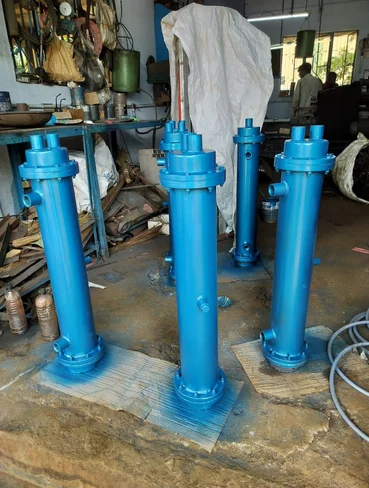
When to Choose a Shell and Tube Oil Cooler? A shell and tube oil cooler is ideal for specific applications where durability, high pressure
and harsh conditions are key factors. Here’s when you should consider one:
1. High-Pressure Applications (300+ psi)
◉ Why?
- Robust construction handles extreme pressures (e.g., hydraulic systems, power plants).
- Tubes resist deformation better than plate-type coolers.
◉ Examples: - Industrial hydraulics (presses, injection molding).
- Turbine lube oil systems.
2. High-Temperature Environments
◉ Why?
- Metal tubes (SS/titanium) withstand >200°C without degradation.
- No gaskets to fail (unlike plate coolers).
◉ Examples: - Heavy-duty diesel engines.
- Steel mill lubrication systems.
3. Corrosive or Dirty Fluids
◉ Why?
- Handles contaminated oils (sludge, particulates) without clogging.
Titanium/SS tubes resist seawater, acids, and chemicals.
- Examples:
- Marine engine lube oil cooling.
- Mining/oilfield equipment.
4. Large Oil Flow Rates (>100 GPM)
◉ Why?
- Larger diameter tubes reduce pressure drop vs. plate coolers.
- Scalable for heavy industrial use.
◉ Examples: - Power plant turbine oil systems.
- Large compressors.
5. Long Service Life & Low Maintenance
◉ Why?
- No gaskets to replace (unlike plate coolers).
- Tubes can be mechanically cleaned (rodding, brushing).
◉ Examples: - Offshore rigs (minimal downtime).
- Cement plant gearboxes.
When NOT to Use a Shell and Tube Cooler? ◉ Space is limited (plate coolers are more compact).
Cooling efficiency is critical (plate coolers transfer heat faster).
◉ Low-viscosity oils (plate coolers work better for thin oils).
Comparison: Shell and Tube vs. Alternatives
| Scenario | Shell and Tube | Plate Cooler | Air-Cooled |
| High Pressure (500+ psi) | ◉ Best | ◉ Limited | ◉ No |
| Dirty/Corrosive Oil | ◉ Best | ◉ Clogs | ◉ Good |
| Compact Space Needed | ◉ Poor | ◉ Best | ◉ Good |
| Low Maintenance | ◉ Best | ◉ Gasket issues | ◉ Best |
Final Decision Checklist
Choose a shell and tube oil cooler if your application requires:
◉ Extreme pressure/temperature resistance.
◉ Durability in harsh environments.
◉ Cleaning/maintenance ease.
◉ Large oil flow rates.
For smaller, efficient systems with clean oils, a plate-type cooler may suffice.
Need a recommendation? Share your:
- Oil type (ISO grade/contaminants).
- Flow rate & operating pressure.
- Temperature range.
Space constraints.