

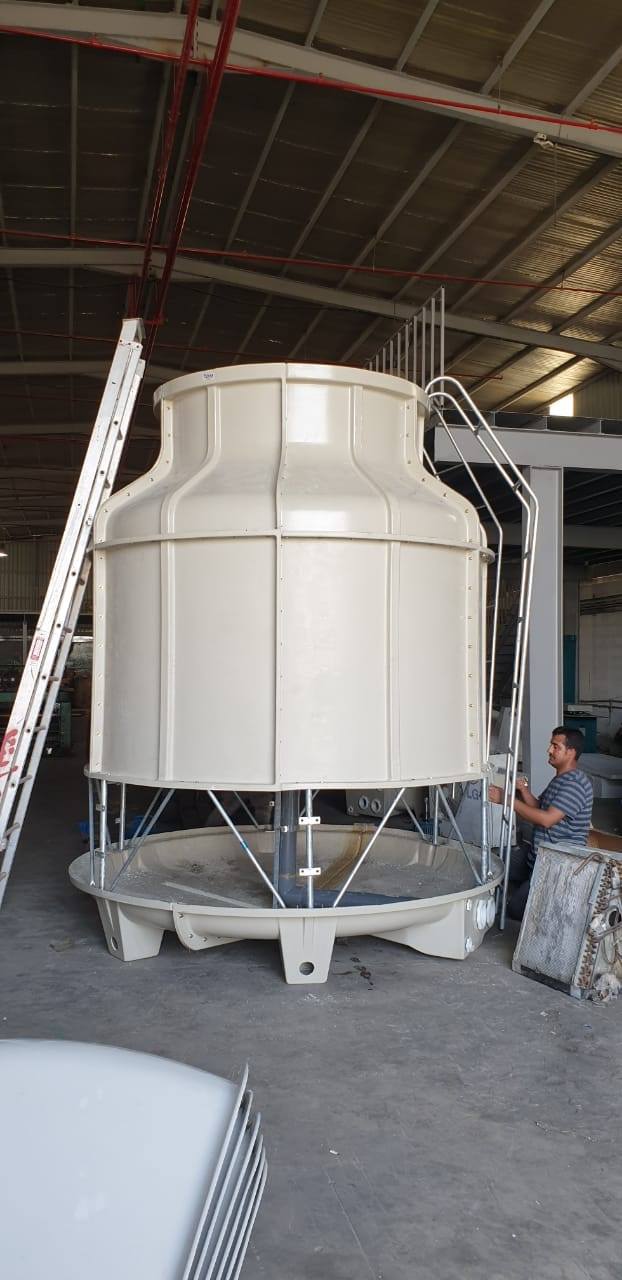
Cooling towers are absolutely critical, ubiquitous, and often massive components in petroleum refineries and petrochemical plants. Their role is fundamental to safety, efficiency, and profitability.
Here’s a detailed breakdown of their use:
Core Function: Heat Rejection
The primary purpose is to remove excess heat from process streams and equipment, rejecting it to the atmosphere via evaporative cooling. Refining and petrochemical processes are highly exothermic (heat-generating).
Key Applications and Processes
1. Distillation and Fractionation
- Crude Distillation (Atmospheric & Vacuum): The hot crude oil is cooled after pre-heat exchangers and needs condensation of various fractions (naphtha, kerosene, gas oil) in overhead condensers. Cooling towers supply the circulating water for these condensers.
- Fractionation Columns: Throughout the plant (FCC, hydrocracker, coker, reformers), towers separate products. Their overhead vapors must be condensed, requiring significant cooling.
2. Catalytic Processes
- Fluid Catalytic Cracking (FCC): One of the largest cooling water users. The reactor effluent must be rapidly quenched and cooled. The regenerator, which burns coke off the catalyst, also requires cooling to control temperature.
- Hydrocracking & Hydrotreating: These high-pressure processes use hydrogen and generate immense heat from exothermic reactions. Interstage coolers and product coolers are essential to control reaction rates and protect catalysts.
3. Condensation of Products and By products
- All vapor-phase products (like light ends, LPG) are condensed to liquids for storage and transport using shell-and-tube or air-fin coolers (which often use cooling tower water as a backup or for trim cooling).
4. Equipment Cooling
- Compressor Intercoolers & Aftercoolers: Large reciprocating or centrifugal compressors (for hydrogen, air, or refrigeration) generate heat. Cooling between stages (intercooling) improves efficiency and protects the machinery.
- Lube Oil and Seal Oil Systems: Critical for rotating equipment like pumps, turbines, and compressors.
- Transformer and HVAC Cooling: Supporting utilities.
5. Specific Petrochemical Processes
- Steam Cracking (Ethylene Plant): The quench tower is paramount. The cracked gas from furnaces (at ~850°C) is instantly quenched with oil and then water to stop reactions. This generates vast amounts of low-pressure steam, which must be condensed using cooling water from the tower.
- Polymerization (Polyethylene, Polypropylene): Reactor cooling is vital to control the highly exothermic polymerization reaction and product properties.
- Aromatics Complexes (BTX – Benzene, Toluene, Xylene): Multiple distillation and extraction units all require condensers and coolers.
Types of Cooling Towers Used
- Mechanical Draft Towers (Most Common): Use large fans to force or induce air flow.
- Induced Draft: Fan at the top, pulling air up. Most common in large industrial settings due to good efficiency and ice control.
- Forced Draft: Fan at the bottom, pushing air in. Less common.
- Natural Draft Towers: Huge hyperbolic concrete structures (iconic at large power plants and some mega-refineries). Rely on the density difference between warm, moist air inside and cooler, dry outside air. Used for very large heat loads (e.g., >500,000 gpm).
Critical Considerations in Refinery/Petrochemical Context
1. Water Chemistry & Treatment
This is a massive operational focus. Poor water quality leads to:
- Scaling: Mineral deposits (calcium carbonate, silica) reduce heat transfer efficiency.
- Corrosion: Attacks carbon steel pipes, exchangers, and the tower structure.
- Fouling: Suspended solids or biological growth (biofilm, algae, legionella) clog systems.
- Microbiological Induced Corrosion (MIC): A major threat.
- Treatment Regimes: Include biocides, scale inhibitors, corrosion inhibitors, and dispersants. Blowdown (controlled purge) is used to limit dissolved solid concentration.
2. Materials of Construction
- Tower Structure: Often concrete or fiberglass-reinforced plastic (FRP) for corrosion resistance.
- Fill (Internals): PVC, wood, or advanced plastics.
- Cold Water Basin: Concrete with protective coatings.
- Piping & Exchangers: Carbon steel, but critical/severely corroded areas may use stainless steel, cupronickel, or titanium for tubes (especially in final coolers).
3. Environmental & Safety Aspects
- Drift Emission: Tiny water droplets escaping the tower can carry chemicals. Regulations may limit this.
- Blowdown Discharge: Contains concentrated salts and treatment chemicals, requiring monitoring and sometimes pretreatment before release.
- Legionella Risk: Warm, aerated water is an ideal breeding ground for Legionella bacteria. Strict monitoring and biocidal treatment are mandatory to prevent outbreaks.
- Vapor Plume: The visible plume (condensed water vapor) can be a visual concern and, in cold weather, cause icing on nearby roads and structures.
4. Integration with Other Systems
- Heat Integration: Modern plants use extensive heat exchanger networks (pinch technology) to recover heat from hot streams to pre-heat colder feeds. The cooling tower system handles the remaining, unavoidable “residual” heat that cannot be economically recovered.
- Once-Through vs. Recirculating: Almost all modern plants use recirculating systems with cooling towers due to enormous water conservation needs. “Once-through” systems (taking water from a river/sea and discharging it warm) are now heavily restricted.