

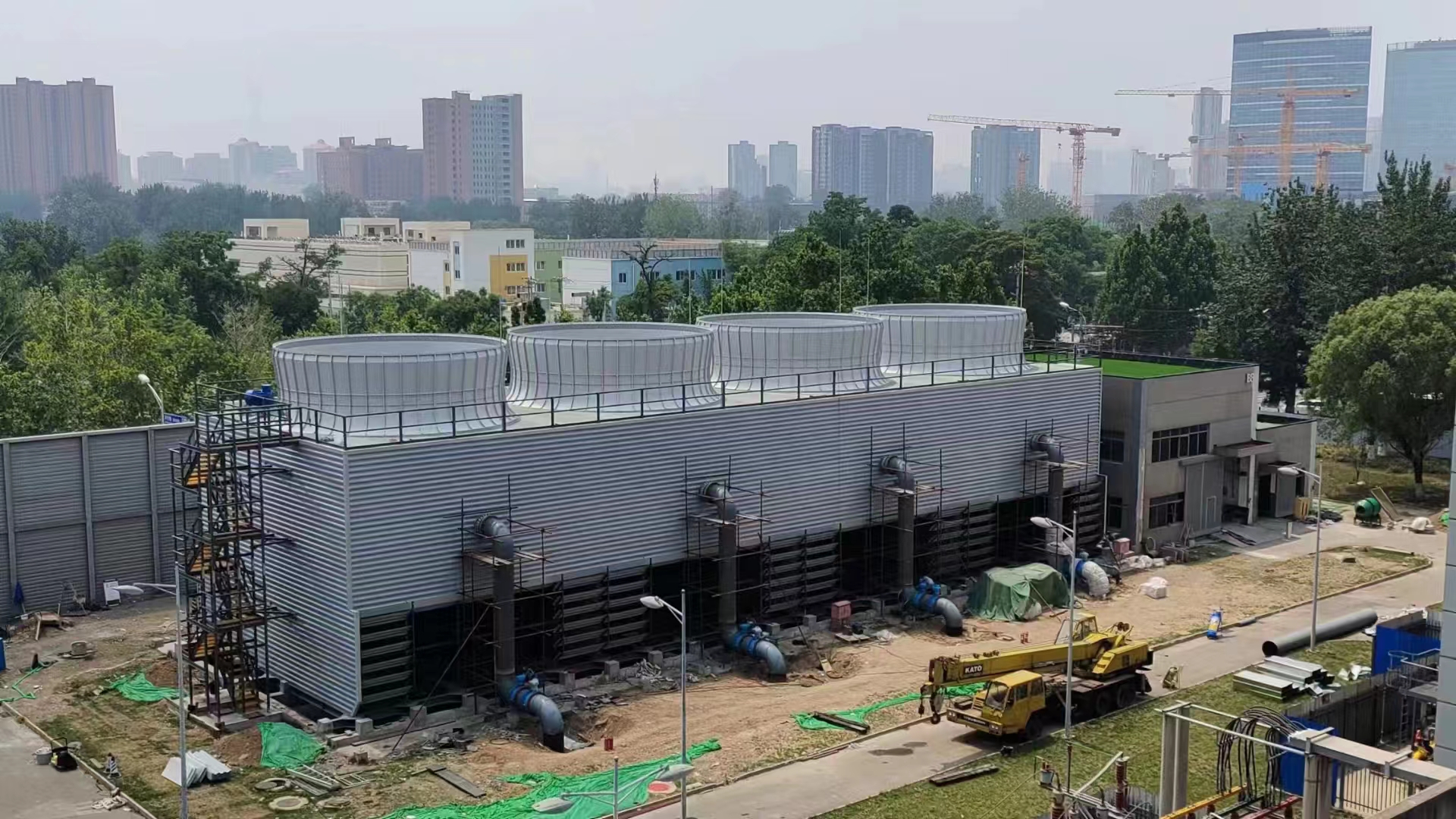
Power Plant Cooling Towers
| Aspect | Power Generation Cooling Tower | Industrial Processing Cooling Tower |
| Primary Goal | Reject waste heat to complete the thermodynamic (Rankine) cycle. | Control temperature to ensure product quality, process stability, and equipment safety. |
| Heat Load Profile | Relatively steady, tied to electrical load. | Often variable and batch-oriented (e.g., a reactor heats up, then needs cooling). |
| System Criticality | Plant shuts down if the cooling tower fails. | A failure can ruin a multi-million dollar batch, damage equipment, or cause safety incidents. |
| Water Quality | Focus on scaling/corrosion control. | Often must handle process contamination (oils, organics, particulates) from leaks in heat exchangers. Requires robust filtration & treatment. |
| Tower Type & Size | Often massive natural draft or large induced draft cells. | Predominantly modular, factory-assembled Mechanical Draft towers (Crossflow, Counterflow). Smaller, more distributed. |
| Redundancy | Multiple cells, but often one large system. | Frequently N+1 redundancy with multiple independent units to ensure no process interruption. |
System Design: The Industrial Cooling Loop
A typical industrial setup involves:
- Process Heat Exchanger: The hot process fluid (chemical, oil, gas) transfers heat to the cooling water via a shell-and-tube or plate heat exchanger.
- Hot Return Line: Warm water (typically 95-115°F / 35-46°C) returns to the cooling tower.
- Cooling Tower: Cools the water primarily through evaporation.
- Cold Basin & Pump: Cooled water (typically 85°F / 29°C, depending on wet-bulb) is pumped back to the process.
- Filtration & Water Treatment System: Crucial in industry. Removes contaminants (silt, algae, oils, organics) and adds biocides, scale, and corrosion inhibitors to protect the tower and process equipment.
Critical Industrial Considerations
- Make-up Water & Blowdown: Water is lost through evaporation, drift, and deliberate blowdown. Water cost and availability are major operational factors.
- Legionella Risk: Industrial towers must have rigorous biocide treatment and maintenance plans to prevent bacterial growth, a major public health concern.
- Fouling: Process leaks (oil, glycol, organics) can foul tower fill and heat exchangers, drastically reducing efficiency. Monitoring is key.
- Freeze Protection: In cold climates, towers require basin heaters, bypass valves, and fan controls to prevent ice formation.