

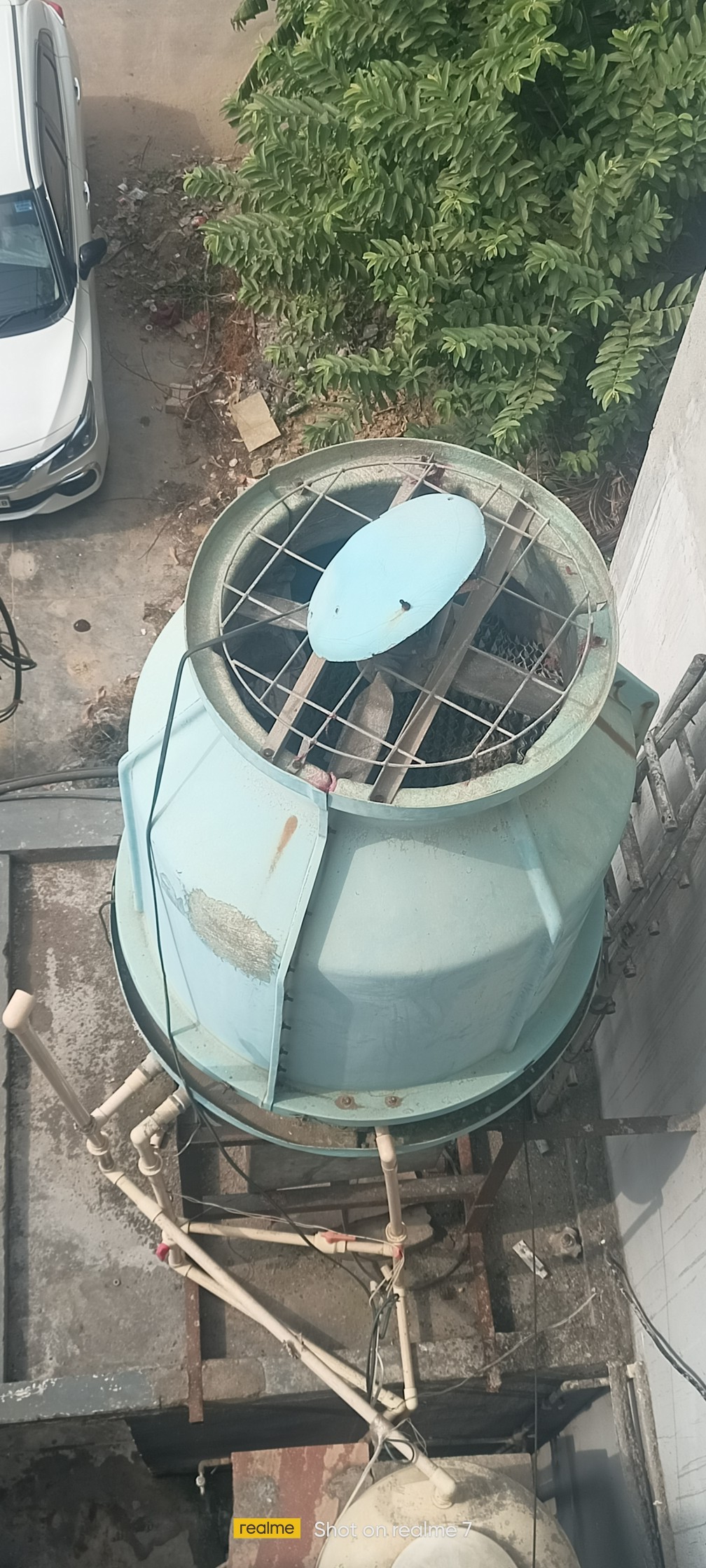
The role of a cooling tower in Concentrated Solar Power (CSP) is fundamentally similar to its role in conventional thermal power plants, but with unique challenges and opportunities due to the nature of solar energy.
In CSP plants that use a steam Rankine cycle (the most common type, like parabolic troughs and power towers), the cooling tower is just as critical as in a coal or nuclear plant.
Core Function: Identical Thermodynamic Need CSP plants use mirrors to concentrate sunlight, heating a heat transfer fluid (HTF). This HTF then generates steam to drive a turbine. The condensation of that steam after the turbine requires rejecting waste heat
- Bottom Line: A CSP plant with a steam turbine must have a condenser, and that condenser needs a cooling system. The cooling tower is the most efficient and common choice for this.
Why Cooling Towers Are Especially Important for CSP
- Location-Driven Necessity:
- CSP plants are built in high-insolation, arid, and semi-arid regions (e.g., deserts in the U.S., Chile, UAE, South Africa).
- These locations have scarce water resources. While wet cooling towers use water, they use far less than once-through cooling and are often the only viable option for efficient power generation where no large water body exists.
- Efficiency is Paramount:
- Solar thermal energy is already a diluted resource. Maximizing the conversion efficiency of collected heat to electricity is crucial for project economics.
- Cooling towers (especially wet ones) provide the coldest possible cooling water, which maximizes the temperature differential across the turbine, leading to higher cycle efficiency and more power from the same solar field.
- Thermal Storage Integration:
- Many modern CSP plants have molten salt thermal storage. This allows them to generate power after sunset, acting like a traditional base-load plant for several hours.
- During these extended generation periods, a reliable and consistent cooling system is essential. The cooling tower provides this stability independently of the time of day.
The Critical Water-Energy Conflict in CSP
This is the central challenge. CSP plants are ideally located in sunny deserts, but these areas have the least water.
- Wet Cooling Tower: Offers the highest efficiency (~40% more power output than dry cooling for the same solar input on a hot day) but has high water consumption (approx. 750-1,000 gallons per MWh for parabolic troughs).
- Dry Cooling (Air-Cooled Condensers): Uses over 90% less water, but comes with severe penalties:
- Lower Efficiency: On a hot day (e.g., 40°C / 104°F), plant output can drop by 10-15% compared to wet cooling.
- High Capital & Operating Cost: Massive finned-tube arrays and large fans are expensive.
- Parasitic Load: The fans consume significant electricity themselves.
- Hybrid Cooling: An increasing popular compromise. Uses a dry section most of the time and engages a smaller wet section during peak heat or to boost output when electricity prices are high. This optimizes the water-efficiency trade-off.
Example: The trade-off is stark. A 100 MW CSP plant with wet cooling might use 600-800 million gallons of water per year. The same plant with dry cooling might use only ~60 million gallons but produce significantly less annual energy, especially during summer peaks.
Innovations and Trends for CSP Cooling
- Advanced Dry Cooling: Research into improved fin designs, better fan controls, and advanced materials to reduce the performance penalty.
- Alternative Water Sources: Using brackish or saline groundwater that is unsuitable for agriculture, or treated wastewater (reclaimed water) for makeup water in wet towers. This is a major focus in places like the Middle East.
- Plant Design Optimization: New CSP designs (like supercritical CO₂ cycles) aim for higher temperatures and efficiencies, which can reduce the relative size and impact of the cooling system.
- Regulatory Driver: In many arid regions, permitting is tied to water use. A project using dry or hybrid cooling with reclaimed water is much more likely to be approved.
Visual Comparison: CSP vs. Traditional Thermal Plant Cooling
| Aspect | Traditional Thermal (Coal/Gas/Nuclear) | Concentrated Solar Power (CSP) |
| Primary Need | Reject constant, high-density waste heat from fuel combustion/fission. | Reject intermittent/variable heat from the sun, often with a storage buffer. |
| Location Flexibility | Can be near fuel sources or water bodies. | Must be in high-DNI (sunshine) areas, which are typically arid. |
| Water Conflict | Significant, but plant can sometimes be sited near abundant water. | Extreme. The ideal solar site is the worst place for water availability. |
| Load Profile | Often base-load, steady cooling demand. | Highly variable (diurnal, cloudy periods), but smoothed by thermal storage. |
| Economic Pressure | Fuel cost is dominant. Cooling system choice affects efficiency and water costs. | Capital cost is dominant. Cooling choice directly impacts revenue (via efficiency) and often permitting. |
| Typical Choice | Large natural draft wet towers (for big base-load plants). | Increasingly dry or hybrid systems due to water constraints, even at an efficiency cost. |