

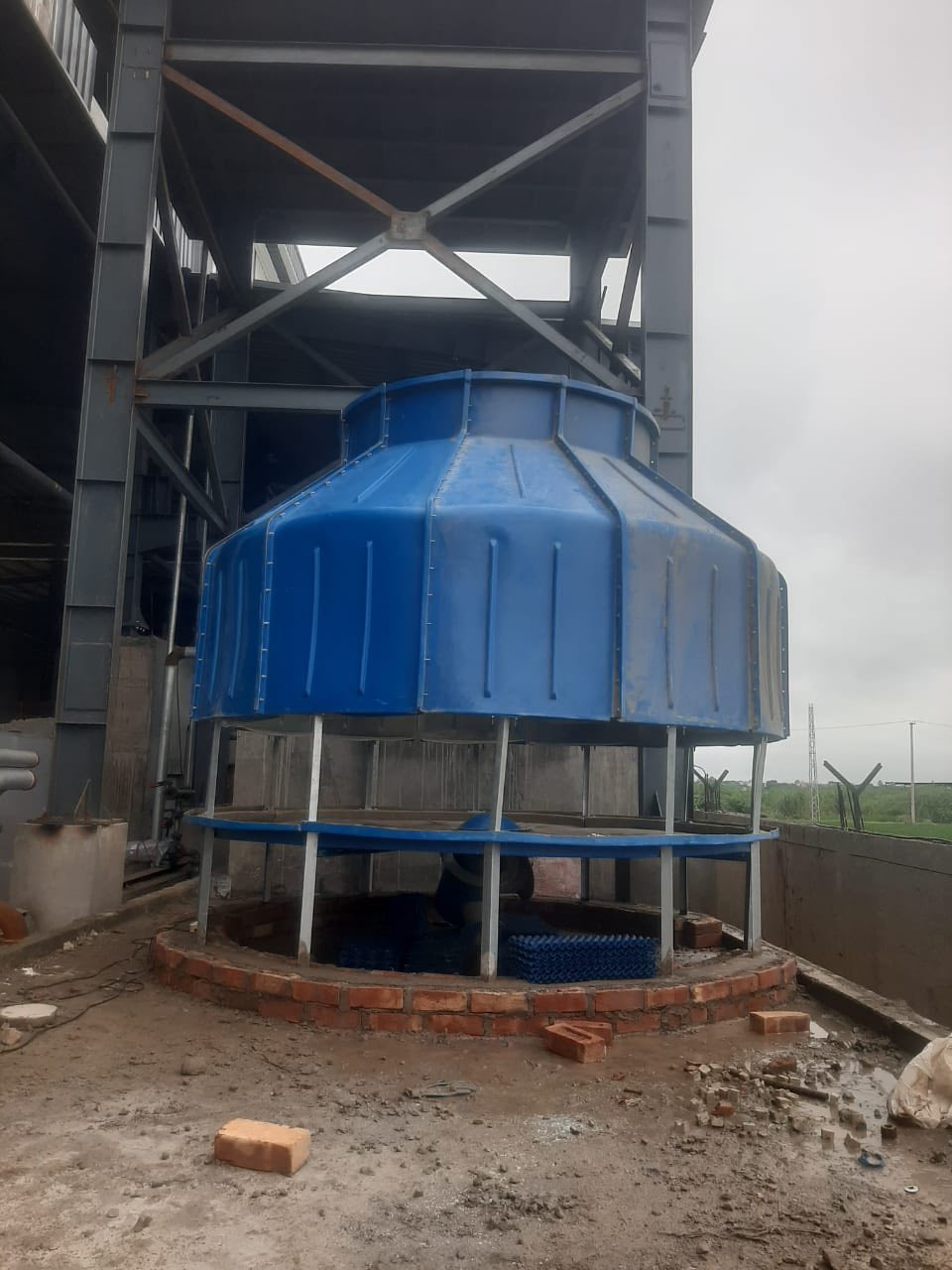
Role of Cooling tower in Power Generation ?
Cooling towers play a critical and non-negotiable role in most thermal power plants (coal, natural gas, nuclear, and even some geothermal and concentrated solar). Their primary function is to reject waste heat into the atmosphere so that the power cycle can operate efficiently.
Here’s a detailed breakdown of their role:
1. The Core Thermodynamic Principle: The Rankine Cycle
Most power plants generate electricity by spinning a turbine with high-pressure steam. After passing through the turbine, the steam must be condensed back into water (condensate) to be pumped back to the boiler and reused. This condensation process releases a massive amount of latent heat.
- Problem: This heat must be removed for condensation to happen.
- Solution: Cooling towers provide the means to remove this waste heat continuously.
2. How Cooling Towers Integrate with the Power Plant Cycle
The cooling tower is part of the condenser cooling system:
- Hot Water In: Superheated steam from the turbine exhaust is condensed inside the condenser. This is done by circulating cool water through thousands of tubes in the condenser. This water absorbs the steam’s heat and becomes hot (typically 10-20°F warmer).
- Heat Rejection: The now-hot cooling water is pumped to the cooling tower.
- Cooling Process: Inside the tower, the hot water is sprayed downward over a fill material (“packing”) to maximize surface area. Air is drawn upward through the tower (by fans or natural draft).
- Evaporation: A small portion (1-2%) of this water evaporates, which is a highly effective heat transfer process. The latent heat required for this evaporation is taken from the remaining bulk of the water, thereby cooling it significantly.
- Cool Water Out: The cooled water collects in the tower’s cold basin and is pumped back to the condenser to repeat the cycle. This is a closed loop for the cooling water.
3. Key Roles and Importance
- Maintains Cycle Efficiency: The efficiency of a thermal power plant (Rankine cycle) depends heavily on the temperature difference between the steam source and the heat sink (the cooling tower’s output). Colder cooling water allows for lower steam condensation pressure, creating a greater pressure drop across the turbine, which maximizes electricity generation.
- Water Conservation: While cooling towers use water (through evaporation, drift, and blowdown), they are far more water-efficient than once-through cooling systems (which draw vast amounts from a river/lake and discharge it back warmer). They allow plants to be built where large water bodies are not available.
- Environmental Protection: By recycling cooling water, they prevent thermal pollution (discharging large volumes of hot water into rivers/lakes, which can harm aquatic ecosystems).
- Enables Continuous Operation: They provide a reliable and controllable method of heat rejection regardless of the local water body’s capacity to absorb heat.
4. Types of Cooling Towers in Power Generation
- Natural Draft Cooling Towers: Iconic hyperbolic-shaped towers. They use the natural buoyancy of warm, moist air—the tall chimney creates a draft. Very high capacity, used for large nuclear and coal plants. Low operating cost (no large fans), but high construction cost.
- Mechanical Draft Cooling Towers: Use large electric fans to force or induce air flow.
- Forced Draft: Fans at the air inlet.
- Induced Draft: Fans at the top outlet (more common and efficient). More flexible and compact than natural draft.