

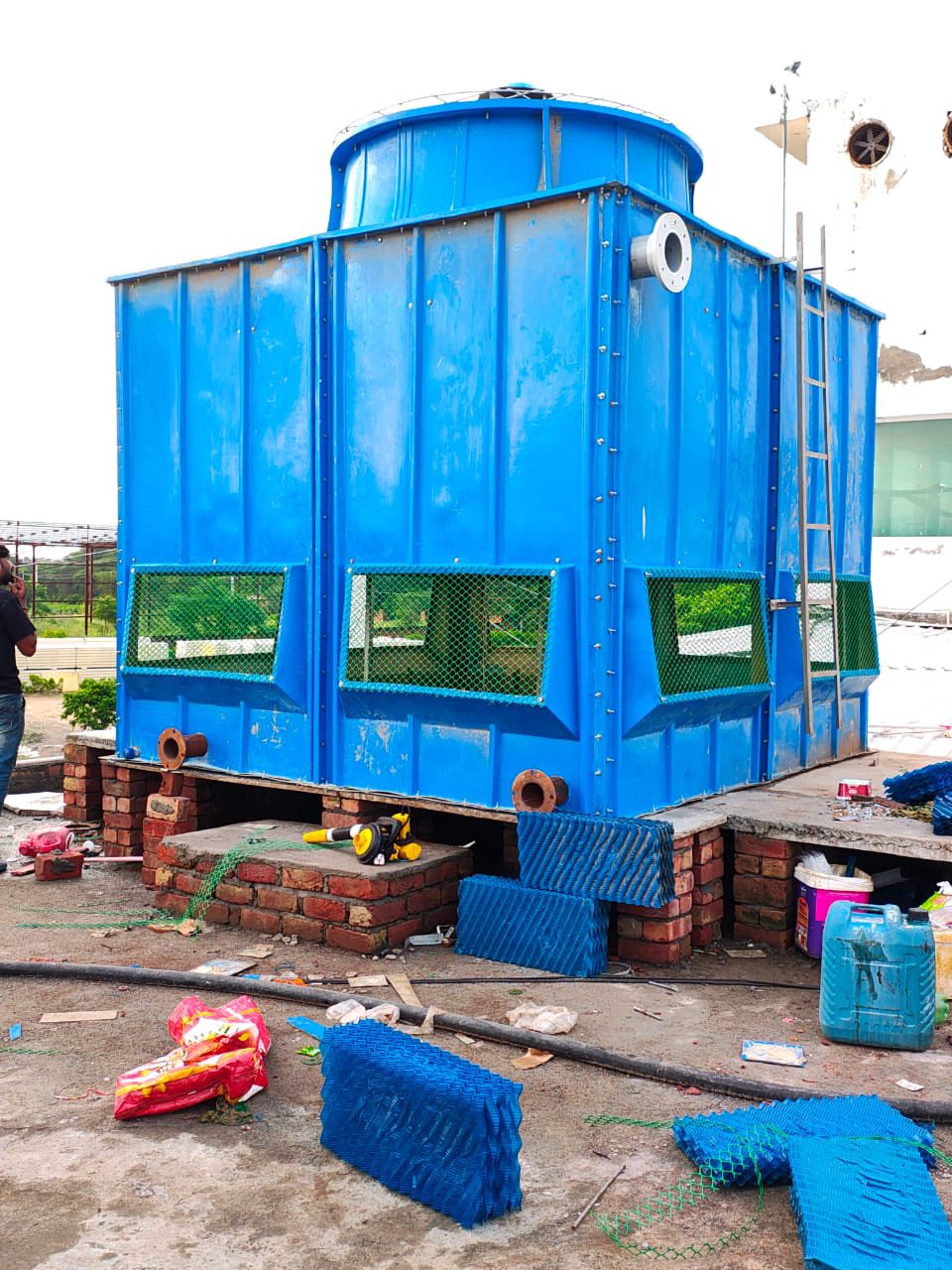
Types of Hybrid Fill Used in Cooling Towers
Hybrid fill represents an engineering optimization where two distinct types of fill media (or materials) are strategically combined within a single cooling tower to balance thermal performance, fouling resistance, water distribution, and maintenance requirements. It aims to leverage the strengths of each fill type while mitigating their weaknesses.
Core Concept: The Two Fundamental Fill Types
To understand hybrids, you must first know the two primary fill categories:
- Film Fill
- How it works: Creates thin sheets of water over closely spaced, corrugated PVC sheets to maximize surface area for evaporation.
- Pros: Superior thermal efficiency in a compact space.
- Cons: Highly susceptible to fouling/clogging from suspended solids, scale, or biological growth. Higher pressure drop.
- Splash Fill
- How it works: Uses staggered bars, grids, or droplets to break water into small droplets, increasing air-water contact through splashing.
- Pros: Excellent fouling resistance. Handles dirty water, high suspended solids, and scaling water better. Lower pressure drop.
- Cons: Lower thermal efficiency per unit volume. Requires more space for equivalent cooling duty.
Hybrid fill combines these two principles in one assembly.
Primary Types of Hybrid Fill (By Configuration & Material)
Type 1: Vertical Stacked Hybrid (Film-over-Splash or Splash-over-Film)
This is the most common configuration, arranged in vertical stages.
- Film Fill Section (Typically Upper): Placed where the cleanest, coldest water enters. This is the high-efficiency zone, extracting the maximum heat transfer while the water is still relatively clean and less likely to scale.
- Splash Fill Section (Typically Lower): Placed below the film fill. It receives water that has already passed through the film section and may have higher concentration of solids. The splash fill provides reliable, non-clogging performance for the final cooling stage and acts as a safeguard.
Variations:
- Splash-over-Film: Less common. Used when initial water distribution is poor; splash fill helps evenly distribute water before it hits the high-efficiency film fill below.
Best For: Systems with moderate fouling potential or where water quality varies. Common in HVAC, power plant auxiliary cooling, and many industrial applications.
Type 2: Material-Based Hybrids
Combining fill made from different materials to address specific chemical or physical challenges.
- PVC Film Fill + Wooden Splash Fill:
- PVC: Provides the efficient film fill section.
- Wood: Provides a robust, traditional splash grid below. Wood offers good thermal performance as splash fill and can withstand certain water chemistries that might degrade plastics over time.
- Consideration: Wood requires maintenance (fungal control, preservative treatment).
- PVC/PP Film Fill + Metal (Stainless Steel, Galvanized) Splash Fill:
- Used in applications with high temperatures (>65°C / 150°F) that would warp PVC, or in harsh chemical environments (e.g., certain geothermal or petrochemical applications).
- The metal splash fill handles the hot or corrosive inlet section, while plastic film fill handles the lower-temperature section.
Type 3: Composite Design Hybrids (Integrated Geometry)
Modern engineered fills that incorporate both film and splash principles into a single, monolithic fill sheet or block.
- Design: A fill sheet may have a film-type, closely spaced corrugated pattern at the top of its profile, which transitions into a more open, splash-type grid pattern at the bottom.
- Advantage: Simplifies installation and creates a more gradual transition between regimes. Optimizes air-water interaction through a single element.
Selection Drivers & Application-Specific Use
The choice of hybrid fill is dictated by water quality and operational priorities.
| Application / Water Condition | Recommended Hybrid Fill Strategy | Reasoning |
| Dirty Water / High Suspended Solids (e.g., River water intake, wastewater reuse, some industrial processes) | Robust Splash Fill (Lower 50-70%) with a Durable Film Fill (Upper). Very open splash fill is critical. | Splash section acts as a filter and pre-conditioner, catching debris and preventing the film section from clogging. |
| High Scaling Potential Water (e.g., High hardness, silica, geothermal brine) | All-PVC Hybrid with easy-clean or ultra-open film fill design on top of a splash grid. | Scaling will occur first on the film fill. The design must allow for easy cleaning (access, removable blocks). The splash section provides backup capacity as scale builds. |
| Variable Load / Legionella Risk | Hybrid with a significant splash fill component. | Splash fill’s open structure is less conducive to biofilm attachment and is easier to inspect and clean. Improves biocide penetration and reduces stagnant zones. |
| Space-Constrained Retrofit | High-Efficiency Film Fill on top of existing or new splash fill. | Maximizes tower capability (approach and range) in a limited footprint without the full risk of converting 100% to film fill. |
| Corrosive Atmosphere (e.g., Coastal, chemical plants) | PVC Film + PVC or CPVC Splash. Avoid metals. | All-plastic construction resists salt and chemical corrosion. CPVC can be used for higher temperature sections. |