

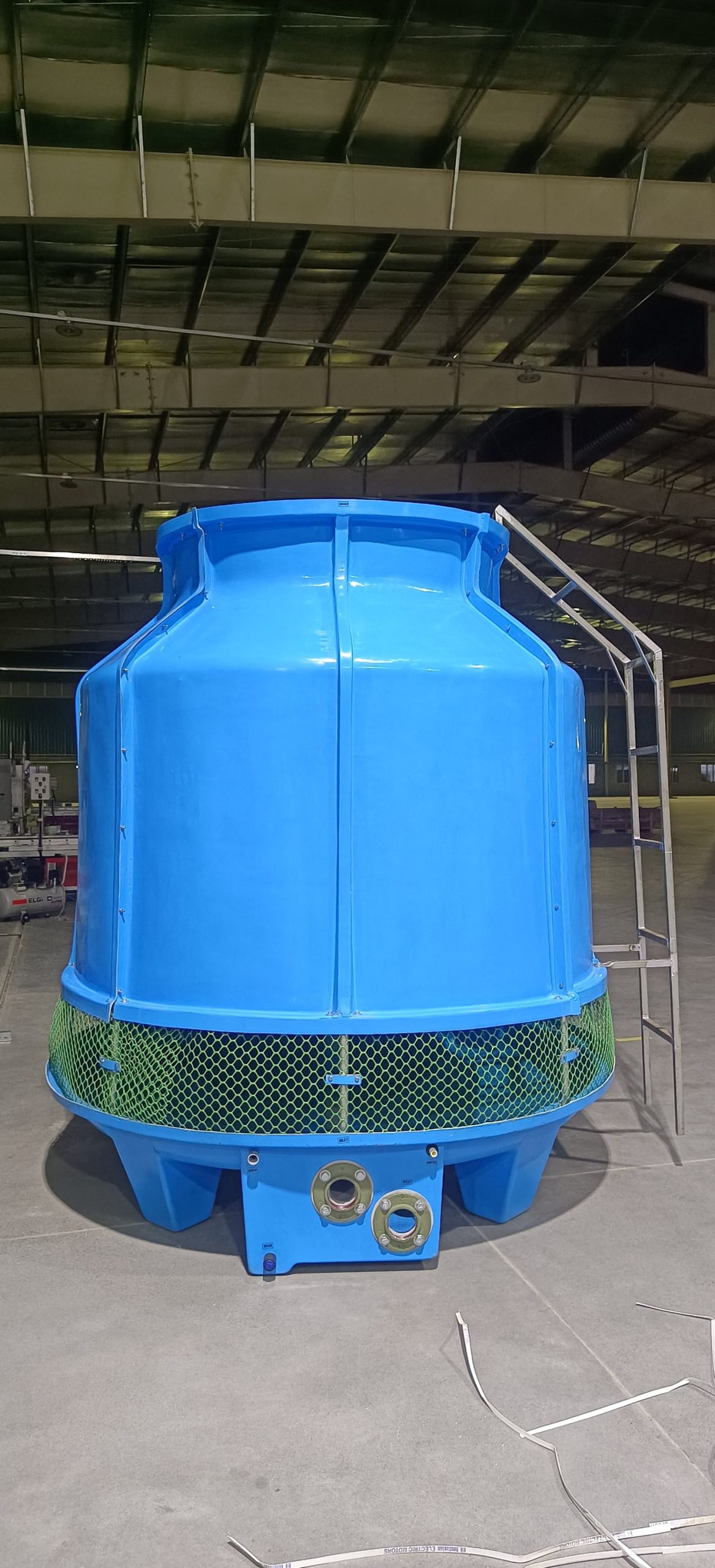
Water Treatment in Cooling Towers: A Comprehensive Guide
Water treatment is absolutely critical for the safe, efficient, and reliable operation of any cooling tower system, regardless of industry. Without proper treatment, cooling towers become sources of bacterial hazards, equipment failure, and operational inefficiency
Why Water Treatment is Non-Negotiable: The “Big Three” Problems
Cooling towers create an ideal environment for three destructive processes due to evaporation, aerosolization, and warm temperatures.
**1. Corrosion
- What it is: Electrochemical degradation of metal components (pipes, heat exchangers, fill, structure).
- Cause: Water (especially with dissolved oxygen and salts) attacks metal surfaces.
- Consequences: System leaks, equipment failure, reduced heat transfer efficiency, costly repairs and downtime.
- Key Targets: Carbon steel pipes, copper tubes in heat exchangers, galvanized steel structures.
**2. Scale (Fouling)
- What it is: Hard, mineral deposits (primarily Calcium Carbonate, Calcium Sulfate, Silica) that form on heat transfer surfaces.
- Cause: As pure water evaporates, dissolved minerals concentrate until they precipitate out of solution.
- Consequences: Insulating layer on heat exchangers → drastic reduction in heat transfer efficiency, increased energy consumption, flow restriction, under-deposit corrosion.
- Analogy: Like cholesterol building up in arteries.
**3. Microbiological Growth (Biofouling)
- What it is: Proliferation of bacteria, algae, and fungi in the warm, oxygen-rich, nutrient-laden water.
- Most Critical Risk: Legionella pneumophila, the bacteria causing Legionnaires’ Disease, a potentially fatal form of pneumonia. Cooling towers are a major amplifier and transmission source if not controlled.
- Other Impacts: Slime (bacterial biofilm) that reduces efficiency and promotes under-deposit corrosion; algae that clog filters and fill; fungi that degrade wood (in older towers).
The Four Pillars of a Water Treatment Program
An effective program is a balanced, continuous process, not just occasional chemical addition.
Pillar 1: Make-up Water Analysis & Understanding Cycles of Concentration (COC)
- Baseline: You must know your make-up water’s chemistry (hardness, alkalinity, silica, chloride, etc.).
- Cycles of Concentration (COC): The ratio of dissolved solids in the circulating water vs. the make-up water.
- Higher COC = Less water bled off (blowdown) = Greater water conservation.
- BUT: Higher COC = Higher scaling potential.
- The treatment program aims to maximize COC while preventing scale, a key economic and sustainability metric.
- COC is controlled by bleeding off a portion of concentrated water (blowdown) and adding fresh make-up water.
Pillar 2: Chemical Treatment (The Core Control Mechanism)
A. Scale & Corrosion Inhibitors
- Phosphonates & Polymers: Sequester/disperse scale-forming ions, preventing them from crystallizing on surfaces. They keep minerals in solution.
- Azoles (e.g., Tolyltriazole): Specifically protect copper and brass alloys from corrosion.
- Ortho- & Poly-Phosphates: Form protective films on steel surfaces.
- Silicate-Based Inhibitors: Used in systems with aluminum components.
- pH Control: Maintaining water in a slightly alkaline range (typically pH 7.5-9.0) is crucial for inhibitor effectiveness and corrosion control. Acid feed may be used to lower pH if natural alkalinity is too high.
. Biocides
- Oxidizing Biocides: Kill microbes by direct oxidation of cell structures.
- Chlorine/Bromine-based: Most common (sodium hypochlorite, gaseous chlorine, stabilized bromine). Effective but can be corrosive at high doses. Demand is increased by organic matter.
- Chlorine Dioxide, Ozone, Peracetic Acid: Stronger, often used for Legionella control or where chlorine is problematic.
- Non-Oxidizing Biocides: Work via interference with metabolism or cell walls.
- Examples: Isothiazolins, Quaternary Ammonium Compounds (“Quats”), Glutaraldehyde.
- Use: Dosed periodically (e.g., weekly) to penetrate and disrupt biofilms that oxidizing biocides cannot reach. Essential for a complete program.
Pillar 3: Mechanical & Operational Controls
- Filtration: Side-stream or full-flow filters remove suspended solids (dust, sand, biofilm debris) that provide food and hiding places for bacteria.
- Automatic Blowdown Controls: Conductivity controllers automatically bleed water when dissolved solids get too high, maintaining optimal COC.
- Maintenance: Regular physical cleaning, debris removal, and inspection. No chemical program can overcome poor maintenance.
Pillar 4: Monitoring, Control, & Documentation
- Continuous/Regular Testing: Parameters checked daily or weekly:
- pH (critical for inhibitor performance)
- Conductivity (to control COC)
- Oxidant (chlorine/bromine) Residual (key for instant microbial kill)
- Inhibitor Concentration
- Hardness & Alkalinity
- Legionella Testing: Periodic testing (quarterly or as per risk assessment and local regulations) is a best practice for risk management. It validates biocide program effectiveness.
- Corrosion Coupons & Scale Monitors: Metal strips and heated probes inserted into the water to physically measure corrosion rate and scaling tendency over time.
- Logs & Records: Documentation is critical for liability, compliance (ASHRAE 188), and troubleshooting.
Industry-Specific Nuances
| Industry | Key Water Treatment Focus |
| Commercial HVAC | Legionella risk management is paramount due to public exposure. Compliance with ASHRAE Standard 188 (Legionella Risk Management) is essential. Often uses milder chemistries. |
| Power Plant (Auxiliary) | Protecting expensive, sensitive heat exchangers (lube oil, seal oil). Uses high-purity, closed loops with dedicated corrosion inhibitors. Zero tolerance for scaling. |
| Geothermal | Extreme scaling (silica, calcium) from mineral-rich brine. Corrosion from H₂S and CO₂. Requires specialized scale inhibitors and highly corrosion-resistant materials. |
| Industrial Process | Product contamination prevention is key. Often uses closed-circuit towers or plate-and-frame heat exchangers to isolate process fluid. Must consider compatibility with process if a leak occurs. |
| Data Centers | Reliability is absolute. Treatment focuses on preventing any fouling that could reduce chiller efficiency and cause overheating. Often uses high-quality make-up water (RO-treated). |
The Consequences of Failure (Cost of Not Treating)
- Energy Costs: A thin layer of scale (0.025 inches / 0.6 mm) can increase chiller energy consumption by 10-20%.
- Water & Sewer Costs: Poor control of COC leads to excessive blowdown, wasting water and increasing sewer charges.
- Capital Costs: Premiere replacement of corroded pipes, plugged heat exchangers, and structural components.
- Health & Liability Costs: A Legionnaires’ Disease outbreak traced to a cooling tower can result in millions in lawsuits, fines, reputational damage, and criminal charges.
- Production Downtime: An unexpected tower shutdown for cleaning or repair can halt an entire plant or facility.
Best Practice Summary:
- Start with a water analysis.
- Implement a balanced chemical program (scale/corrosion inhibitor + oxidizing biocide + non-oxidizing biocide).
- Automate control with conductivity/pH controllers.
- Maintain meticulously (clean, inspect, filter).
- Monitor religiously (test, log, validate with Legionella testing).
- Document everything for compliance and risk management.
In essence, water treatment is the low-cost insurance policy that protects a high-value asset, ensures operational efficiency, and safeguards public health.