

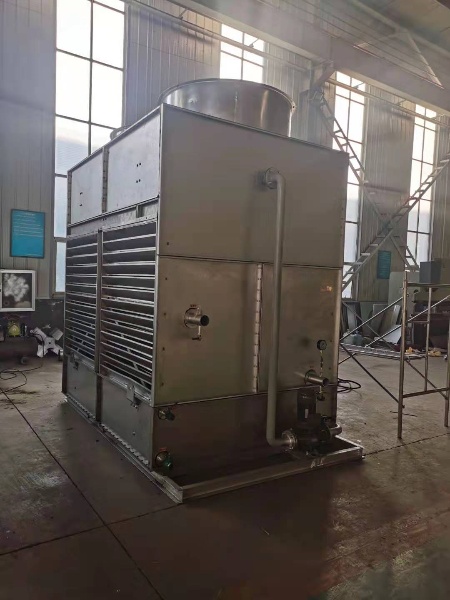
Closed Circuit cooling tower vs open circuit cooling tower
The choice between a Closed Circuit Cooling Tower (CCT) and an Open Circuit Cooling Tower (OCT) is one of the most fundamental decisions in cooling system design. It boils down to a trade-off between initial cost and system protection/lifecycle cost.
Here’s a detailed, side-by-side comparison.
Core Functional Difference
- Closed Circuit (CCT): The process fluid to be cooled is sealed inside coils. It is cooled indirectly by water sprayed on the coils and air flowing over them. Two separate circuits: one closed (process), one open (spray).
- Open Circuit (OCT): The process fluid to be cooled is exposed directly to the atmosphere and air flow. It is pumped to the top of the tower, distributed, and cooled by direct evaporative contact with air. One open circuit.
Comparative Table: Closed Circuit vs. Open Circuit Cooling Tower
| Feature | Closed Circuit Cooling Tower (CCT / Fluid Cooler) | Open Circuit Cooling Tower (OCT / Wet Cooling Tower) |
| Process Fluid Path | Sealed inside tubes/coils. Never contacts air or spray water. | Open to atmosphere. Directly contacts air and water. |
| Heat Transfer Method | Indirect, conductive through coil wall + evaporative cooling on the outside. | Direct evaporative cooling. |
| Fluid Contamination Risk | Very Low. Process fluid stays clean, free of airborne dirt, microbes, and scale from evaporation. | Very High. Fluid is exposed to air, dust, microbes (Legionella), and evaporative concentration leads to scaling. |
| Water Treatment Focus | Only the small spray water loop needs treatment (scale, algae). Simple and low-cost. | The entire large volume of process water needs constant chemical treatment. Complex and expensive. |
| Freeze Protection | Excellent. Glycol can be easily added to the sealed process loop. Spray loop can be drained. | Difficult. Adding glycol to the entire open volume is prohibitively expensive. Requires basin heaters or continuous flow. |
| System Pumping Energy | Lower. Pump only overcomes pipe friction (closed loop, no static head to tower top). | Higher. Pump must also lift water to the top of the tower (significant static head). |
| Space & Footprint | More compact for equivalent capacity, but often heavier due to coils. | Larger basin and footprint typically required. |
| Initial Capital Cost | Significantly Higher. Due to the cost of the coil bundle and more complex construction. | Significantly Lower. Simpler design with no internal coils. |
| Maintenance Location | Coil exterior (from spray water) may scale; cleaning is localized. Process side stays clean. | Entire system—basin, fill, distribution—scales and fouls. Process equipment (chiller, etc.) also fouls. |
| Risk of Legionella | Process loop is protected. Risk is confined to spray water, which is separate. | Process loop itself can become contaminated, posing a risk to equipment and potential aerosol drift. |
| Environmental Impact | Lower chemical discharge (smaller treated volume). Less water drift. | Higher chemical discharge. Greater risk of drift carrying treatment chemicals or microbes. |
| Installation Flexibility | Can be installed indoors with ducting for air intake/exhaust. Can be in dirty environments. | Almost always installed outdoors with ample ventilation. Poor choice for dusty/dirty sites. |
| Applications | Sensitive equipment, dirty environments, cold climates, water-scarce areas (less blowdown). | Non-sensitive applications, mild climates, where lowest first cost is the prima |