

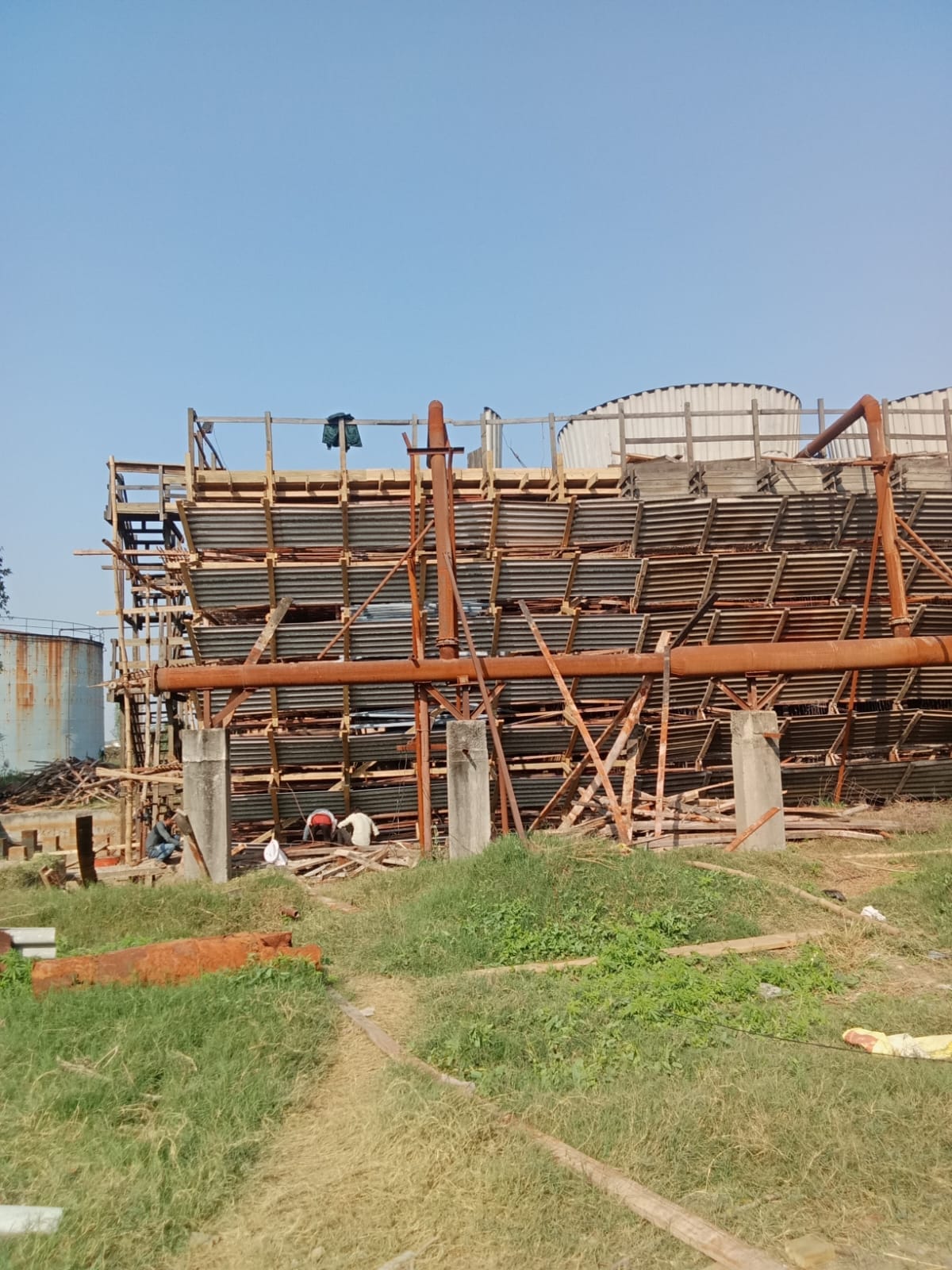
COOLING TOWER WATER QUALITY PARAMETERS & CONTROL
| Parameter | Target Range | Reason / Effect |
| pH | 7.5 – 9.0 | Low pH: Corrosion. High pH: Scaling, reduced biocide efficacy. |
| Conductivity (TDS) | Controlled via COC | Direct measure of dissolved solids. Used to control blowdown. |
| Alkalinity (M-Alk) | 50-300 ppm as CaCO₃ | Buffer for pH, relates to scaling potential (Langelier Index). |
| Calcium Hardness | < 500 ppm as CaCO₃ | Key scaling ion. |
| Silica (SiO₂) | < 150 ppm | Forms very hard scale. Limits maximum COC. |
| Chlorides | < 500 ppm (mild steel) < 250 ppm (SS 304) | Corrosive, pitting. |
| Residual Oxidant | 0.5 – 1.0 ppm | Microbial control. |
Scaling Indices
- Langelier Saturation Index (LSI): Predicts CaCO₃ scaling tendency.
LSI = pH – pHₛ (where pHₛ is saturation pH).
LSI > 0: Scaling tendency. LSI < 0: Corrosive. - Ryznar Stability Index (RSI): Alternative. RSI ~ 6.5 is ideal.
- Puckorius Scaling Index (PSI): Accounts for buffering capacity.
LEGIONELLA RISK MANAGEMENT
- Critical Health Hazard.
- Key Controls:
- Maintain effective biocide residuals.
- Regular system cleaning & disinfection (shock chlorination at 10+ ppm).
- Avoid stagnant water (keep system running, design dead legs < 1 pipe diameter).
- Temperature control: > 60°C (140°F) kills Legionella, but tower operates at 25-35°C (ideal growth range: 20-45°C).
- Regular testing for Legionella (culture or PCR).
- Drift control to prevent aerosolization.
TREATMENT PROGRAM IMPLEMENTATION
Step 1 – Water Analysis
- Full analysis of make-up water and system water (pH, hardness, alkalinity, TDS, chlorides, silica, metals).
- Baseline to determine scaling/corrosion tendencies.
Step 2 – System Audit
- Review tower design, materials of construction, operating conditions (temperatures, cycles).
- Identify problem areas.
Step 3 – Chemical Selection & Dosage
- Choose appropriate scale/corrosion inhibitors and biocides.
- Calculate feed rates based on make-up water rate and desired holding concentration.
Step 4 – Feeding Equipment
- Chemical Feed Pumps: For continuous inhibitor feed.
- Automatic Controllers: For oxidant feed (ORP controllers) and blowdown (conductivity controllers).
- Day Tanks for chemical storage/dilution.
Step 5 – Monitoring & Control
- Daily/Weekly Tests: pH, conductivity, residual biocide.
- Monthly Tests: Full water analysis, corrosion coupons or probes.
- Quarterly/Annually: Inspect fill, basin, heat exchanger tubes.
Step 6 – Documentation & Review
- Maintain logs of chemical usage, test results, maintenance.
- Review program effectiveness annually.
NON-CHEMICAL & ADVANCED TREATMENT TECHNOLOGIES
A. Physical Water Conditioning
- Magnetic / Electronic Descalers: Claim to alter crystal structure; effectiveness debated.
- Pulsed Power / Electrolysis: Induces precipitation for easy removal.
B. Filtration
- Side-Stream Filtration: Continuously filters 1-10% of flow to remove suspended solids.
- Sand Filters, Cartridge Filters, Automatic Strainers.
C. Softening & Demineralization
- Ion Exchange Softeners: Remove calcium/magnesium (hardness) from make-up water, allow very high COC.
- Reverse Osmosis (RO): Produces high-quality make-up water, but expensive and produces waste stream.
D. Ultraviolet (UV) Disinfection
- Use: Supplementary for microbial control, especially Legionella. Effective for planktonic (free-floating) bacteria, not for biofilms.
E. Ozone Treatment
- Powerful oxidizing biocide and microflocculant. Reduces chemical usage but requires capital investment and safety measures.
BEST PRACTICES SUMMARY
- Know Your Water: Test make-up and system water regularly.
- Control COC: Operate at the highest sustainable cycles.
- Maintain Proper pH: Usually 7.5-8.5.
- Use a Dual Biocide Program: Oxidizing + Non-oxidizing, with periodic shock treatment.
- Monitor Corrosion Rates: Use coupons or probes (< 2 mpy for mild steel, < 0.2 mpy for copper).
- Prevent Scale: Monitor scaling indices; use appropriate inhibitors.
- Clean Regularly: Mechanical cleaning of fill and basin to remove deposits and biofilm.
- Have a Written Water Management Plan (WMP): Especially critical for Legionella control (required by many health codes).