

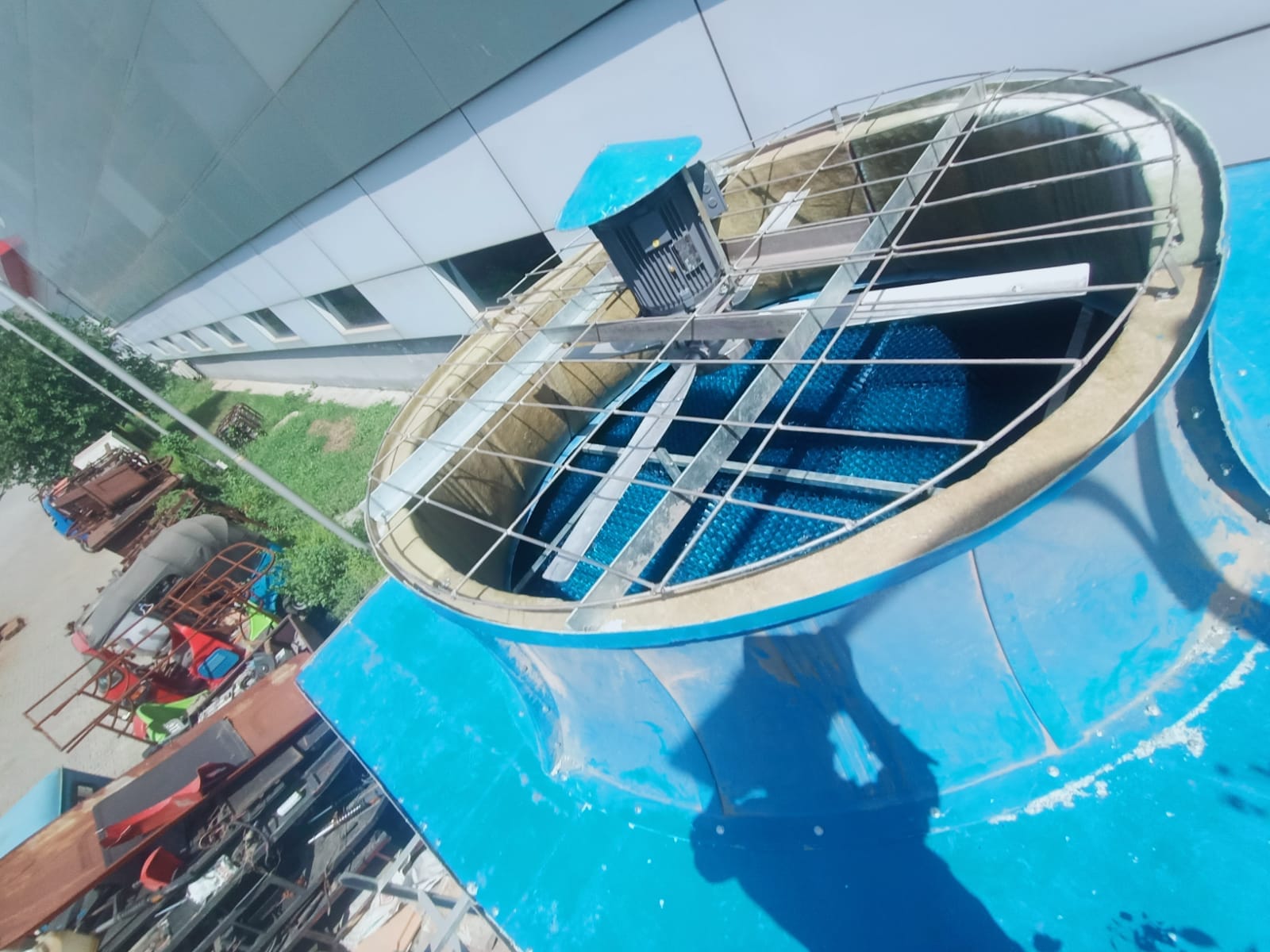
COOLING TOWER WATER BALANCE
Core Principle
A cooling tower operates on a closed-loop recirculation but experiences continuous water loss. The Water Balance accounts for all water entering and leaving the system to maintain a steady-state operation and control dissolved solids concentration.
1. COMPONENTS OF THE WATER BALANCE
INFLOWS (Make-up Water – M)
Water added to replace all losses.
OUTFLOWS (Losses)
- Evaporation (E): Water lost as vapor to the atmosphere. Largest loss.
- Drift (D): Liquid water droplets entrained in exhaust air.
- Blowdown / Bleed-off (B): Intentional purge of concentrated water to control scaling.
- Leakage & Other Losses (L): Usually small, sometimes grouped with blowdown.
2. THE FUNDAMENTAL BALANCE EQUATION
At Steady State:
Make-up (M) = Total Losses
M=E+D+B+LM=E+D+B+L
For practical purposes, leakage (L) is often negligible or included in blowdown:
M=E+D+BM=E+D+B
3. DETAILED CALCULATION OF EACH COMPONENT
. Evaporation Loss (E)
- Primary Driver of Cooling. Approximately 1,000 BTU of heat is rejected for every 1 lb of water evaporated.
- Formula 1 (Using Heat Load):
E(gpm)=Q(BTU/hr)1,000×8.34×60E(gpm)=1,000×8.34×60Q(BTU/hr)
Where QQ = Total heat rejected in BTU/hr.
- Formula 2 (Using Flow & Range – Most Common):
E(gpm)=R(gpm)×ΔT(°F)×0.001E(gpm)=R(gpm)×ΔT(°F)×0.001
Simplified Rule of Thumb:
E≈R×ΔT1,000E≈1,000R×ΔT
Where:R = Recirculation Rate (gpm)ΔT = Temperature Range (°F) [HWT – CWT]
In Metric:
E(m3/h)=0.00153×R(m3/h)×ΔT(°C)E(m3/h)=0.00153×R(m3/h)×ΔT(°C)
*(Factor 0.00153 ≈ specific heat / latent heat)*
B. Drift Loss (D)
- A very small fraction of recirculation rate.
- Modern towers: 0.0005% to 0.005% of
R. - Older towers: Up to 0.01-0.2%.
- Formula:
D(gpm)=R(gpm)×Drift Rate (as decimal)D(gpm)=R(gpm)×Drift Rate (as decimal)
Example: For R = 1,000 gpm and 0.001% drift:
D = 1,000 × 0.00001 = 0.01 gpm.
C. Blowdown / Bleed-off (B)
- The controlled variable used to manage water quality.
- Purpose: To limit the Cycle of Concentration (COC) by removing water high in dissolved solids.
- Cycle of Concentration (COC or N):
COC=TDSblowdownTDSmake-up=Concentration in systemConcentration in make-upCOC=TDSmake-up
TDSblowdown=Concentration in make-upConcentration in system
D. Relationship Between Blowdown & COC
From mass balance of dissolved solids:
- Solids entering via make-up = Solids leaving via blowdown & drift.
M×TDSM=B×TDSB+D×TDSDM×TDSM=B×TDSB+D×TDSD
Assuming TDSB≈TDSD≈TDSsystemTDSB≈TDSD≈TDSsystem and DD is very small:
M×TDSM≈B×TDSsystemM×TDSM≈B×TDSsystemCOC=TDSsystemTDSM≈MB(if drift is neglected)COC=TDSMTDSsystem≈BM(if drift is neglected)
More accurately (including drift):
COC=MB+D=E+B+DB+DCOC=B+DM=B+DE+B+D
Therefore, blowdown can be calculated as:
B=ECOC−1−DB=COC−1E−D
(This is the key operational formula)