

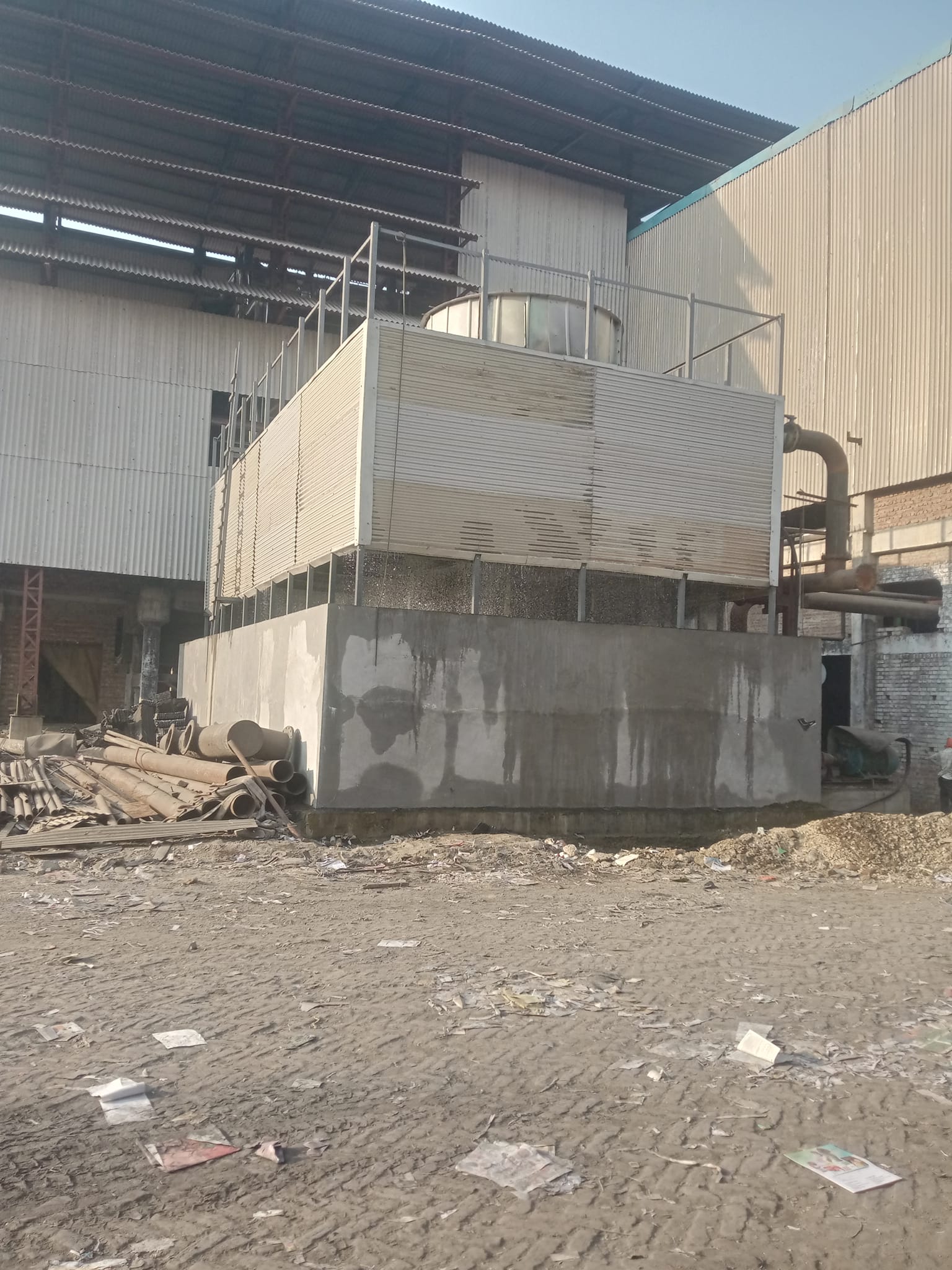
COMPONENTS OF A COOLING TOWER
Overview
A cooling tower is a system of integrated components designed to maximize heat transfer through evaporation. Each part has a specific function critical to performance, efficiency, and reliability. Components vary slightly by tower type (natural draft vs. mechanical draft, Cross Flow vs. counter flow), but the core elements are consistent.
1. STRUCTURAL & ENCLOSURE COMPONENTS
Casing/Shell
- Function: Forms the outer envelope, contains the internal components, directs airflow, and provides structural support.
- Materials: FRP (most common for packaged), galvanized steel, concrete (large towers), stainless steel, or wood (older towers).
Structural Frame
- Function: The skeleton that supports all internal and external loads (weight of water, fill, fan, wind, seismic).
- Materials: Hot-dip galvanized steel (most common), sometimes stainless steel or reinforced concrete.
Inlet Louvers
- Function: Located at air inlets (sides or base).
- Direct airflow into the fill.
- Prevent water splash-out from the tower.
- Help distribute air evenly across the fill area.
- Materials: PVC, FRP, or galvanized steel.
Access Doors & Ladders
Function: Provide safe entry for inspection and maintenance of internal components like fill and
- distribution systems.
2. HEAT TRANSFER & WATER DISTRIBUTION SYSTEM
Fill (or Packing)
- The “Heart” of the Tower. Provides maximum surface area for air-water contact.
- Types:
- Splash Fill: Uses layers of bars or grids to break falling water into small droplets. Advantage: Less prone to clogging with dirty water.
- Film Fill: Uses closely spaced, corrugated PVC or PP sheets. Water spreads into a thin film over the surface. Advantage: Higher thermal efficiency in a smaller volume.
- Material: Primarily PVC or Polypropylene (PP).
Hot Water Distribution System
- Function: Evenly distributes the incoming hot water over the top of the fill.
- Designs:
- Cross Flow Towers: Uses an open gravity distribution basin (FRP or coated steel) with metering orifices.
- Counter flow Towers: Uses a pressurized pipe and nozzle system (PVC or ABS pipes with spray nozzles).
- Rotary Sprinkler Arms: Used in some smaller towers.
Cold Water Basin
- Function: Collects the cooled water at the bottom of the tower for recirculation back to the process.
- Key Features:
- Includes a suction pit/sump for the pump.
- Has make-up water inlet (float valve or level control).
- Has overflow and drain connections.
- Materials: Monolithic FRP (packaged towers), coated steel, or concrete (large towers). Often lined for corrosion protection.
3. AIR MOVEMENT & MOISTURE SEPARATION SYSTEM
Fan(s)
- Function: Creates the air flow required for evaporation (in mechanical draft towers).
- Types:
- Axial Fans: Most common for induced draft towers. Mounted on top, move large volumes of air at low pressure.
- Centrifugal Fans: Used for forced draft towers or where higher static pressure is needed (e.g., ducted installations).
- Materials: Aluminum, FRP, or stainless steel blades.
Fan Deck & Fan Stack
- Fan Deck: The platform that supports the fan motor and drive assembly.
- Fan Stack (Cylinder): The cylindrical structure around the fan. It accelerates exhaust air, improves fan efficiency, and reduces recirculation.
- Materials: Typically FRP or galvanized steel.
Drift Eliminators
- Function: Critical for water conservation. Capture entrained water droplets from the exhaust air stream before they leave the tower.
- Design: A labyrinth of corrugated passages (usually PVC or FRP) that forces air to change direction, causing droplets to impact and fall back into the tower.
- Performance: Modern towers achieve drift loss rates as low as 0.0005% of circulation.
Gearbox & Drive Assembly
- Function: Transmits power from the motor to the fan at the correct speed.
- Types: Right-angle gear drives (common) or belt drives (simpler, for smaller fans).
- Includes: Shafts, couplings, bearings, and V-belts/pulleys if used.
4. MECHANICAL & AUXILIARY SYSTEMS
Fan Motor
- Function: Powers the fan.
- Mounting: Usually on the fan deck (induced draft).
- Modern Feature: Increasingly equipped with Variable Frequency Drives (VFDs) for energy savings and precise control.
Water Pump (External but Integral)
- Function: Circulates water from the cold water basin to the process heat exchanger and back to the tower distribution system.
- Note: Although not physically part of the tower structure, it is an essential component of the cooling loop.
5. PROTECTION & CONTROL COMPONENTS
Make-up Water System
- Components: Float valve or electronic level sensor/controller, make-up water line.
- Function: Automatically replaces water lost through evaporation, drift, and blowdown to maintain basin level.
Overflow Pipe
- Function: Prevents the basin from overflowing during rainstorms or control system failure.
Drain Valve
- Function: Allows for complete draining of the basin for maintenance or winter shutdown.
Strainers & Filters
- Location: Often in the pump suction line or distribution system.
- Function: Remove debris that could clog nozzles or fill.
Ice Prevention & Cold Weather Kits
May Include:Basin heaters (electric or steam), fan cycling controls, VFDs for fan reversal, and louvers
- with adjustable shutters.
Instrumentation & Controls
- Typical Sensors: Water temperature in/out, basin level, vibration (on fan/motor), motor amperage.
- Control Panel: Manages fan speed (VFD), pump operation, and safety alarms.
6. SPECIALIZED COMPONENTS (By Tower Type)
| Tower Type | Unique / Emphasized Components |
| Natural Draft (Hyperbolic) | Hyperbolic Concrete Shell, Massive Fill Support Grids, Large Inlet Air Opening at base. |
| Cross Flow | Open Gravity Hot Water Basin (key feature), Inlet Louvers on sides. |
| Counter flow | Pressurized Spray Nozzle System, Fan Stack is critical for air distribution. |
| Forced Draft | Fan at Air Inlet (bottom/side), Plenum Chamber for air distribution. |
| Dry/Wet Hybrid | Dry (Air Cooled) Section (finned coil bundle) in series/parallel with wet section. |
Summary: Component Flow & Interaction
Water Path:
Hot Water Inlet → Distribution System → Fill → Cold Water Basin → Pump → Process Heat Exchanger → (Back to Inlet)
Air Path:
Air Inlet Louvers → Through Fill → Through Drift Eliminators → Fan (in mechanical draft) → Out Fan Stack
Performance Dependability relies on the condition of three key components:
- Fill (clean for heat transfer)
- Distribution System (even spray/no clogging)
- Fan & Drive (correct airflow)
Understanding each component’s role is essential for proper operation, troubleshooting, and maintenance, ensuring the tower achieves its design Range and Approach efficiently and reliably.