

COOLING TOWER PERFORMANCE
Core Performance Indicators
Cooling tower performance is measured by its ability to reject a specified heat load while achieving the required cooling range with minimal approach to the wet-bulb temperature, all within constraints of energy use, water consumption, and cost.
1. KEY THERMODYNAMIC PARAMETERS
Range
- Definition: Temperature drop of the water as it passes through the tower.
Range (°F or °C) = Hot Water Temperature (HWT) – Cold Water Temperature (CWT) - Significance:
Directly proportional to the heat load rejected.
Q=mw×Cp×RangeQ=mw×Cp×Range
- where mwmw = mass flow rate of water, CpCp = specific heat of water).
- Higher range = Greater heat rejection.
Approach
- Definition: How close the cold water temperature gets to the ambient wet-bulb temperature (WBT).
Approach = Cold Water Temperature (CWT) – Wet Bulb Temperature (WBT) - Significance:
- Primary measure of cooling tower thermal efficiency.
- Lower approach = Higher tower capability and efficiency (but requires larger tower/fan/more energy).
- Theoretical limit: Approach can never be zero; practical limits are typically 2.5–4°C (5–7°F).
Wet-Bulb Temperature (WBT)
- Definition: The lowest temperature to which air can be cooled by evaporating water into it at constant pressure (measured by a psychrometer).
- Significance:
- The absolute thermodynamic limit for water cooling in an evaporative tower.
- Performance varies daily/seasonally with WBT.
Cooling Tower Capability
- Definition: The percentage of design heat load a tower can reject under actual conditions.
Capability (%) = (Actual Range / Design Range) × 100
(at same approach, or adjusted for actual WBT). - Significance: Indicates if the tower is underperforming or oversized.
2. PERFORMANCE CURVES & CHARACTERISTICS
Tower Characteristic Curve (KaV/L)
- A dimensionless parameter representing the tower’s “degree of difficulty” or required size.
- KaV/L = f(Range, Approach, WBT)
- KK = Mass transfer coefficient
- aa = Area of contact (fill)
- VV = Volume of fill
- LL = Water flow rate
- Used by engineers to select/size a tower for given conditions.
Typical Performance Graph
- Plots Approach vs. Water Flow Rate (or Range) for different Wet-Bulb Temperatures and Fan Speeds.
- Shows that:
- For a fixed WBT and flow, increasing fan speed lowers approach.
- For a fixed WBT and fan speed, increasing water flow increases approach.
- Lower WBT improves performance (lowers approach for same conditions).
“Approach Degradation”
- The increase in approach over time due to:
- Fouled fill (scaling, biological growth, debris).
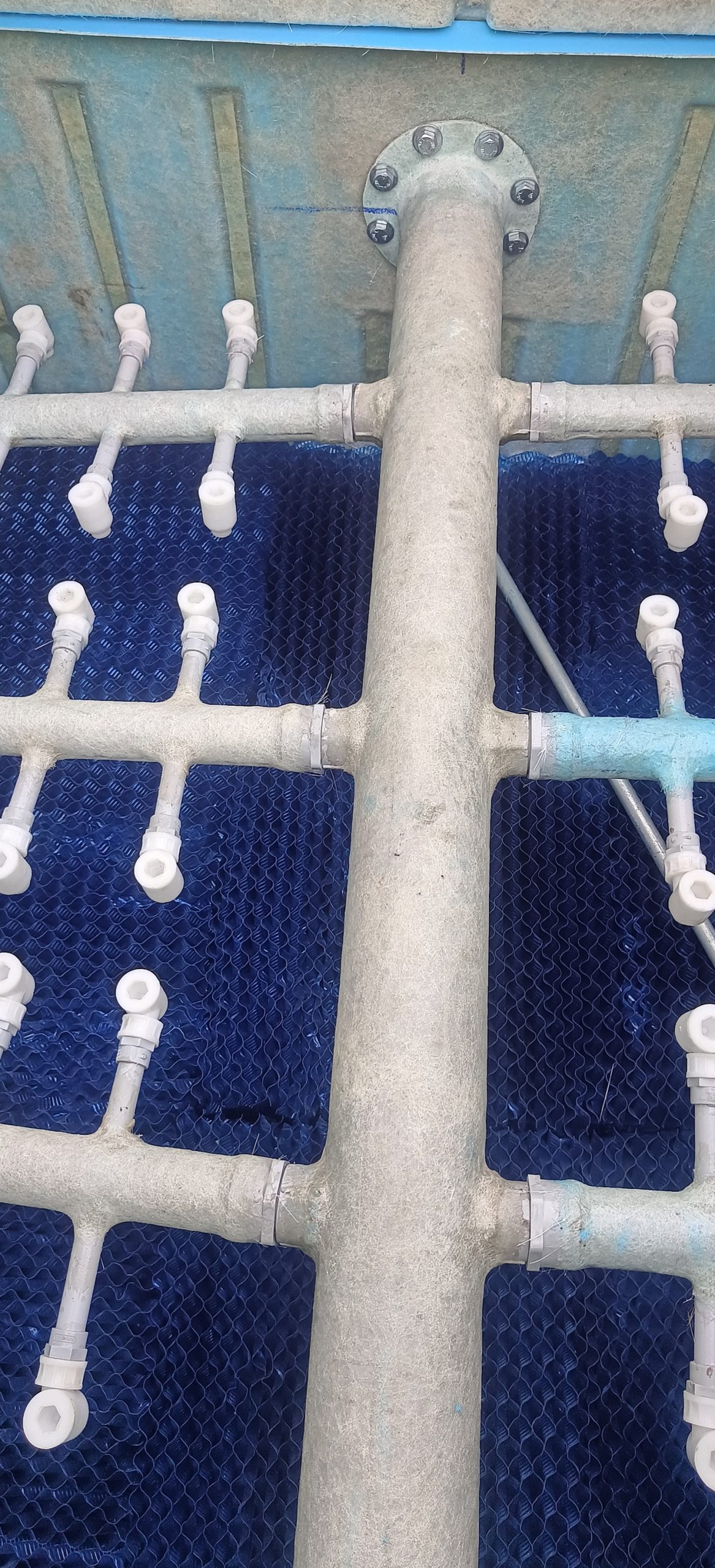
- Poor water distribution (clogged nozzles).
- Damaged drift eliminators (increasing air pressure drop).
- Fan/motor degradation.
. WATER-SIDE PERFORMANCE METRICS
Cycle of Concentration (COC)
- Definition: Ratio of dissolved solids in blowdown water to make-up water.
COC = TDS_blowdown / TDS_makeup - Typical Range: 3–7 cycles.
- Significance: Higher COC reduces water consumption but increases scaling potential. Optimizing COC is key to water and chemical cost savings.
Evaporation Loss
- Rule of Thumb: ~1% of circulation rate for every 7°C (12.5°F) of Range.
- Calculation:
E=Q×Range×0.00085E=Q×Range×0.00085 (in gpm, °F)
Or E=0.00153×Circulation Rate (m³/h)×Range (°C)E=0.00153×Circulation Rate (m³/h)×Range (°C)
Drift Loss
- Water droplets lost with exhaust air.
- Modern towers: 0.0005% – 0.005% of circulation rate.
- Older towers: Up to 0.2%.
- Significance: Wastes water and can spread treatment chemicals.
Blowdown (Purge)
- Intentional discharge to control dissolved solids.
- Calculation:
B=E/(COC−1)B=E/(COC−1)
Make-up Water Requirement
- M=E+D+BM=E+D+B
Where MM = Make-up, EE = Evaporation, DD = Drift, BB = Blowdown.
4. AIR-SIDE & ENERGY PERFORMANCE
Fan Performance
- Static Pressure: Resistance faced by the fan (fill + eliminators + louvers). Increases with fouling.
- Fan Power: Proportional to Air Flow³ and static pressure. Small reductions in airflow save significant power.
- Variable Frequency Drives (VFDs): Used to modulate fan speed based on load/WBT, saving 30–50% of fan energy.
Air Flow Rate
- Determined by fan size, speed, and tower static pressure.
- Higher air flow lowers approach but increases fan power and drift.
Effect of Ambient Conditions
- Wet-Bulb Temperature: Single biggest external factor. Performance declines as WBT rises.
- Dry-Bulb Temperature: Minor direct effect, but correlates with WBT.
- Relative Humidity: High humidity raises WBT, reducing cooling potential.
- Altitude: Affairs air density; towers at high altitude require more air volume for same mass flow.